Get a free AI visibility report

Brand visibility in AI search is no longer determined by where your pages rank. It is determined by how consistently AI models associate your brand with credible, relevant answers across multiple sources. Here is what practitioners need to know before diving in:
AI search platforms including ChatGPT, Claude and Gemini now function as discovery layers that sit above the traditional Google search, synthesizing answers from dozens of sources into a single response, and if your brand is not part of that synthesis, it does not exist in the user's decision process at that moment. The scale is real.
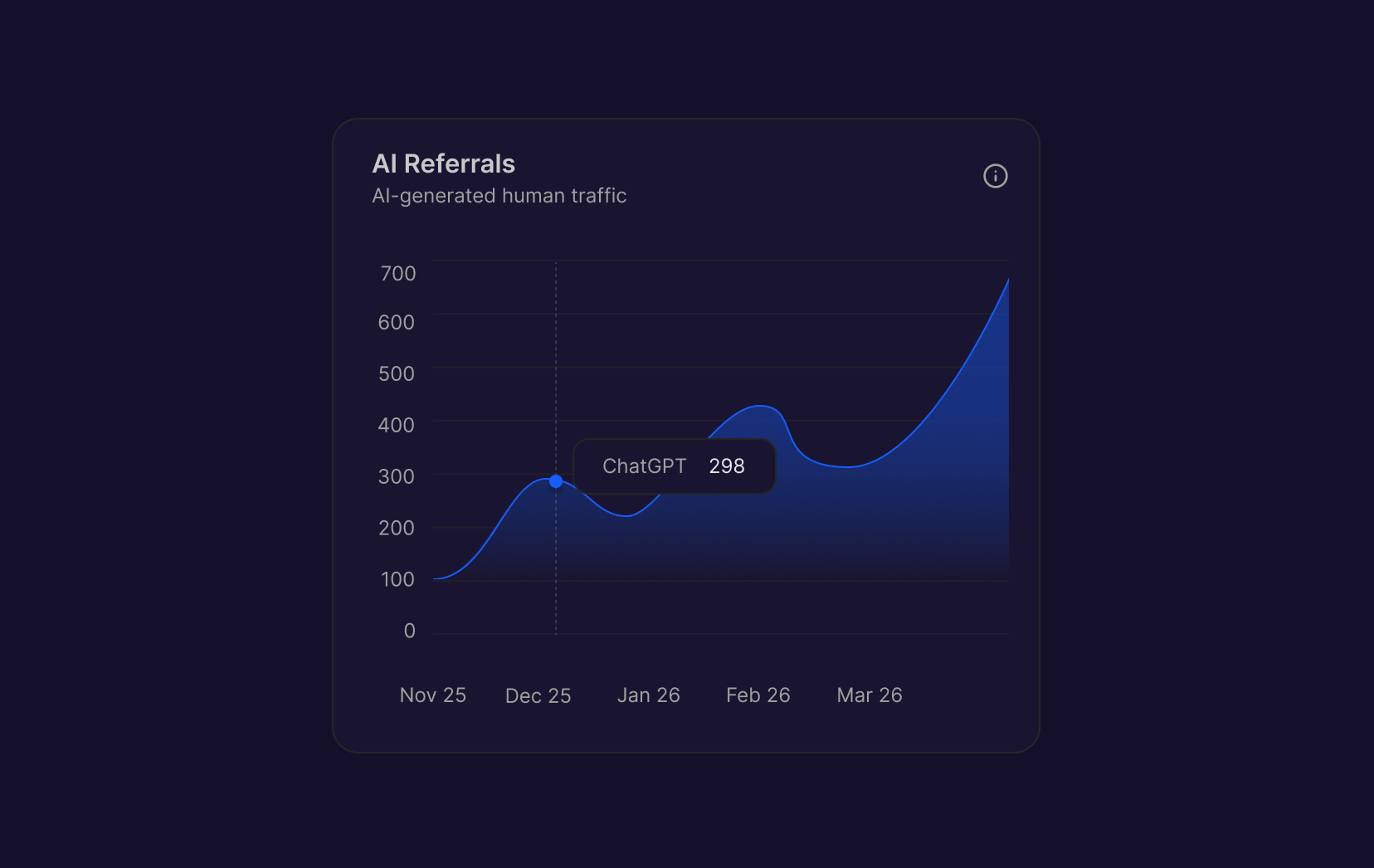
As per McFadyen’s research, AI-referred sessions grew 527% between January and May 2025, Perplexity hit 780 million queries in a single month, and a third of U.S. adults have now used ChatGPT. Yet traditional SEO strength in rankings and backlinks shows little correlation with brand mentions in AI-generated answers. Only optimizing your website for visibility is not enough anymore. You now need to optimize across external channels to have your brand in AI answers. This guide covers the mechanisms behind AEO visibility, how it differs from SEO, and the specific strategies that move the needle.
The 5 steps above are not independent. They are designed to work as a system. Here is how to sequence them operationally.
These are straight forward events, that require data to make sure you are doing them at the right place. Adopting an AI visibility optimization tool makes completing these steps easier and faster for practitioners.
While we can say it is technically possible to do this on your own manually, the reason so many companies are using full-stack AI visibility platforms like Cognizo is because they can do these steps both faster and with higher quality. The thing that makes a tool like this special and tough to replicate is how they use the data that accumulates as you compelte each step.
So while it is possible to do it manually, the value potential revenue unlock far outweighs the costs for almost all brands.
Now that we covered the practitioners guide on what steps you need to step to kick things off, it is also vital to understand the core principles behind these actions. Understanding these core ideas will make you feel confident as you take each step from the guide previously explained.
AI search platforms use Retrieval-Augmented Generation (RAG). Instead of answering from training data alone, the model retrieves relevant content from its index, synthesizes it, and generates a response. The sources it retrieves determine which brands get named.
Think of it like a journalist writing a sourced story. They do not cite press releases. They cite independent analysts, published research, and credible reviews. AI models work the same way. Studies confirm that AI search engines systematically favor earned media over brand-owned content, which is a notable contrast to how Google weights sources.
The implication is straightforward: optimizing your own website only influences one input in a multi-source retrieval system. Consistent AI visibility comes from shaping the broader ecosystem your brand appears in, including publications, forums, review platforms, and partner content. That requires a channel-wide view, not just attention to your own domain.
As you build out your content engine and start optimizing for AI, it will be crucial to know what metrics to look for, what they mean and how they are changing.
While you might be accustomed to traditional SEO measurements, effective measurement requires moving beyond that. They do not capture what is happening in AI-generated answers as studied previously in a previous blog post about what AI visibility is.
The metrics below form the core measurement framework for AI brand visibility.
Use these metrics as your new KPIs in the AI visibility initative. All are important on their own, and will help you strategize to take control of how often and how AI talks about you:
Brand visibility in AI search is not a separate discipline from SEO. It is SEO's next layer, built on the same foundation of credibility, clarity, and genuine utility but extending into a new surface where synthesized answers, not ranked links, determine what buyers discover first.
The brands that will own AI visibility over the next several years are not the ones with the highest budgets or the most content volume. They are the ones that understand the mechanism, build authority systematically across the full ecosystem of sources AI models draw from, and measure their presence with the right metrics rather than carrying over assumptions from a different era.
The opportunity is real and the window is open. The compounding nature of earned credibility signals means that early progress accelerates over time. Start with a visibility audit, build your informational authority layer, invest in earned coverage that carries genuine editorial weight, and measure monthly. The practitioners who get this right in 2026 will be the ones competitors are trying to catch in 2028.
How do I get my brand mentioned in ChatGPT?
Getting mentioned in ChatGPT requires building consistent credibility signals across the sources ChatGPT retrieves from, not just optimizing your website. Focus on earning coverage in authoritative third-party publications relevant to your category, participating in indexed community discussions, structuring your owned content with answer blocks and proper schema markup, and publishing original research that other credible sources will cite.
What strategies improve brand visibility in AI search engines?
The highest-impact strategies combine owned content authority with earned media coverage and technical readability. Start by structuring your informational content around specific questions with answer blocks at the top of each section. Apply FAQPage and HowTo schema markup to all relevant content. Build publication relationships that generate genuine third-party mentions from credible editorial sources. Maintain consistent organic social presence across platforms. Publish original research that positions your brand as a primary source on topics relevant to your buyers. Finally, avoid fully automated content workflows, which AI systems increasingly identify and deprioritize.
How do I improve visibility in Google AI Overviews specifically?
Google AI Overviews pull heavily from pages that are structured for answer extraction, meaning content with clear headings that map to real questions, concise answer paragraphs at the top of each section, and proper structured schema markups. Focus on content freshness (pages not updated in over three months are significantly more likely to lose citations), FAQPage schema, and earning mentions in sources Google's system already treats as authoritative in your category.
Does AI content optimization improve search visibility overall?
Yes, with an important caveat. Optimizing content for AI retrieval, through clear question-and-answer structure, and proper schema markup, also improves traditional SEO performance because both systems favor content that is clear, credible, and well-structured. The practices reinforce each other. However, AI optimization does not substitute for foundational SEO. Technical health, schema markup readiness, and domain authority remain mandatory. AI visibility is the extension layer, not the replacement layer.
Does keyword strategy affect visibility in AI search results?
Keyword strategy remains relevant in AI search but needs to be adapted. Traditional keyword targeting focused on exact-match phrases and search volume. In AI search, the relevant unit is a conversational prompt pattern: how a buyer would phrase a question in natural language, not how they would type a short search string. Generative queries consequently average significantly longer than traditional search queries since they usually become a chain of keywords forming a full sentence. Keyword research should be reframed as question research: identify the specific questions your buyers ask, structure content that answers them directly, and use those questions as headings that map to answer blocks. The underlying search intent logic is the same. The surface format and content structure are different.
Ready to see where your brand stands in AI search today? Start your AI visibility audit with a free report below.
.svg)

.svg)


