Get a free AI visibility report


30x
80%+
Opal is an enterprise marketing collaboration platform that connects strategy to execution for Fortune 500 marketing teams. Their customers include Starbucks, Target, SAP, General Motors, and Yeti. Despite this impressive roster, Opal operates as a challenger brand in a space dominated by heavily-funded competitors like Monday.com and Asana which are companies with substantially larger paid media budgets and brand recognition.
Lee Dussinger is Senior Content & Product Marketer at Opal, where he leads content and search workstreams. This is the story of how he and his lean marketing team used AI search optimization to outcompete companies spending hundreds of thousands on traditional digital marketing.
Lee Dussinger began to see signs that the future of search wasn't limited to Google. He knew buyers were increasingly turning to AI-powered answer engines like ChatGPT, Perplexity, and Google AI Overviews to understand industries, compare vendors, and make decisions.
But when Lee tested Opal's presence in those AI systems, the result was stark.
"We were at 0% visibility anywhere when this started. Anecdotally, when doing searches in anything, every competitor would come up—and we were nowhere to be found."
— Lee Dussinger, Senior Content & Product Marketer
The prevailing industry advice pointed him back to traditional SEO. Most tools and agencies treated LLM optimization as either a non-issue or an unsolvable one, and the guidance Lee kept hearing amounted to the same thing: do good SEO and the AI visibility will follow. But that wasn't matching his experience. Opal had put real effort into their SEO foundation, and it wasn't translating into presence in AI answers. The two channels were clearly operating by different rules, and the standard playbook had nothing useful to say about the one that was starting to matter.
Rather than writing off AI search as opaque or uncontrollable, Lee saw it as something worth understanding on its own terms. And what he found was that the dynamics were fundamentally different from paid or organic search. If the budget didn't determine who showed up, that meant the playing field was genuinely open.
"You can have a billion-dollar marketing and paid budget, and you will have the same ability to influence your AI search visibility. It's entirely based on what you can think and do versus what you can pay."
— Lee Dussinger, Senior Content & Product Marketer
That was an important realization. It meant AI search wasn't just another extension of traditional SEO strategy; AI search operated by different rules. Those rules rewarded clarity, relevance, and content that actually helped people make decisions. For Lee, that wasn't a pivot. It was a validation of the kind of marketing work he already believed in doing.
To turn that belief into a repeatable system, Opal partnered with Cognizo. Cognizo didn't replace strategy; it made good strategy measurable and repeatable. Three capabilities proved critical.
1. Decision-grade measurement: Cognizo provided clear visibility scores across ChatGPT, Perplexity, and Google AI Overviews, metrics Lee could directly tie to content decisions, not just to vanity dashboards.
"I can see something driving visibility against a prompt we've tracked in Cognizo in a fairly short order."
— Lee Dussinger, Senior Content & Product Marketer
2. Prompt-level direction: Instead of guessing at keywords, Cognizo surfaced specific, high-value prompts worth targeting, giving Lee confidence that every article had a clear purpose.
"There's something about the specificity of the blueprint Cognizo gives—the exact queries it recognizes—that helps me get closer to the goal than just throwing out random search terms."
— Lee Dussinger, Senior Content & Product Marketer
3. Expert partnership: Beyond the platform, Cognizo's team provided strategic guidance throughout the process, helping Opal avoid dead ends early and stay focused on what actually influenced AI results.
With structure in place, Opal committed to a sustainable cadence: roughly one targeted article per week. Each piece followed the same approach: direct answers to real buyer questions, grounded in Opal's expertise, targeting the content gaps Cognizo surfaced through prompt tracking and citation data.
"For a fairly small sunk cost, we're able to influence AI rankings by doing the kind of good, helpful, person-first content that helps people make easy decisions. That's the goal of content marketing, right?"
— Lee Dussinger, Senior Content & Product Marketer
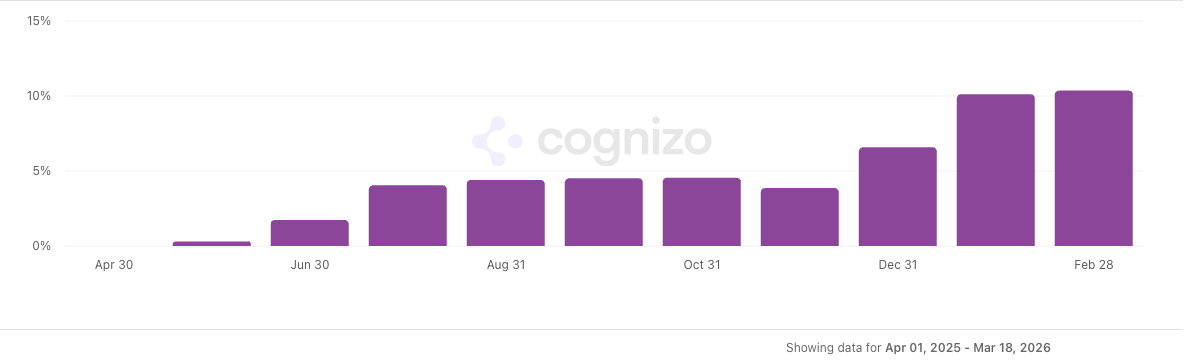
Opal grew overall AI search visibility from 0.3% to 10.3%. On high-value prompts across major AI search engines, like ChatGPT, visibility reached over 80%. Opal now appears consistently across all three engines, with positive sentiment wherever they show up.
Most importantly, the visibility translated into real pipeline. Opal began receiving qualified inbound leads sourced directly from LLMs.
"I was on a sales call and the prospect acknowledged that they found us through an LLM. The LLM served our link, our content, and they followed us there. This is actually driving qualified business conversations."
— Lee Dussinger, Senior Content & Product Marketer
Opal's success wasn't accidental. Posting helpful, person-first content consistently worked better in AI systems than traditional keyword thinking because each piece Opal published reinforced their credibility as a reliable voice, making it more likely the next piece would be cited too. The workflow looked like this:
Target high-value prompts → Develop focused, information-rich content → LLMs cite the source → Authority grows
With consistency across many key prompts, the formula compounds. Authority signals in the space strengthened over time, yielding more citations and more brand mentions in AI answers.
When Lee shared these results at Opal's company conference, the reaction surprised him. Many colleagues had assumed AI search was powerful but untouchable.
"People see AI as this black box. But actually, with very simple, direct, and helpful content, you can influence it. The idea that doing good work that helps people make decisions is what influenced AI—that really resonated."
— Lee Dussinger, Senior Content & Product Marketer
Compared to traditional paid search, where companies spend hundreds of thousands of dollars for uncertain returns, Opal achieved meaningful visibility through quality content and strategic targeting at a fraction of the cost.
For Opal, AI search optimization is a long-term bet on how buyers will discover solutions, and it's now a core pillar of their inbound strategy in 2026.
"AI is the best search engine ever. It gives you a scannable, true understanding of what a brand actually does—with so much more substance than a meta description. Better for brands, better for people. I want to be part of shaping that."
— Lee Dussinger, Senior Content & Product Marketer
.svg)

.svg)


