Get a free AI visibility report

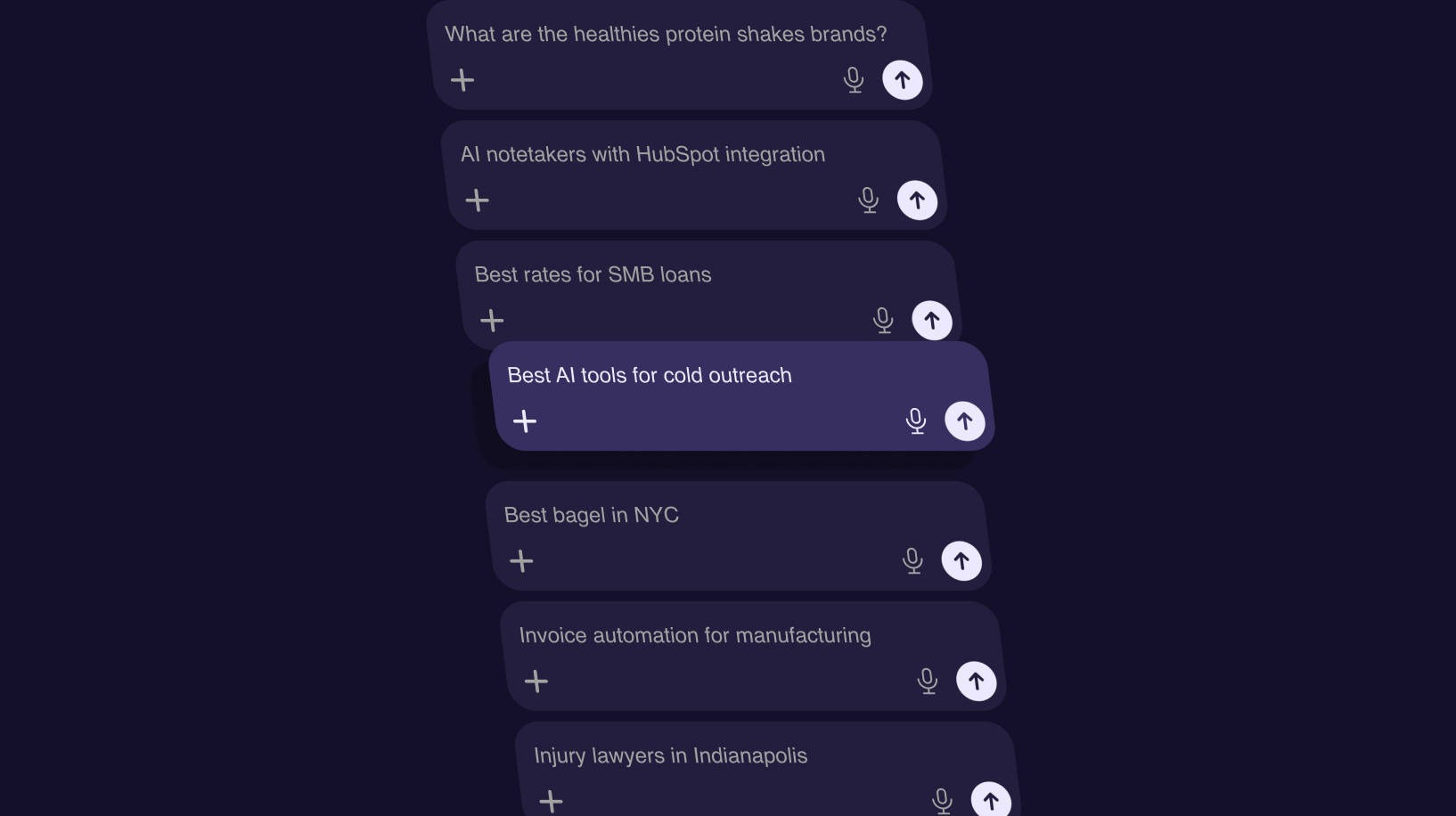
Answer Engine Optimization (AEO) is the practice of ensuring your brand appears accurately and competitively inside AI-generated answers, the new front door to digital discovery.
One of the largest fitness brands in the United States, with one of the bigger search investments in its industry, recently ran a test. The team conducted AI platform searches for their own category. The results were a wake-up call. A small, local company in Houston was outperforming them in AI-generated answers. Around the same time, a financial services executive observed something even more unsettling. A consumer searching for industry recommendations pulled up ChatGPT rather than Google. The executive's firm, the market share leader with the largest investment in traditional media, digital marketing, and SEO among its competitors, was not among the AI's recommendations. A much smaller player was. These cases were documented by MIT Sloan Management Review in their research on AI-driven search marketing.
These are not isolated cases. McKinsey research shows that approximately half of consumers now intentionally use AI-powered search engines, and a majority of those users say AI is their primary source for making buying decisions, ahead of traditional search, retailer websites, and review sites. By 2028, an estimated $750 billion in US consumer revenue will flow through AI-powered search.
Instead of visiting five websites, reading three blog posts, and downloading a whitepaper, a buyer can now ask a conversational AI platform for a synthesized comparison. That comparison shapes brand perception before anyone visits your website. And the answer is built from sources spanning the entire web: publishers, review platforms, forums, social discussions, not just the brand's own properties.
This guide defines what AEO is (sometimes called AI SEO or AI search optimization), how it relates to SEO, how answer engines actually work, what the discipline looks like in practice, and how to measure performance.
Answer Engine Optimization (AEO) is the practice of influencing the full ecosystem of sources that AI-powered platforms draw from, including owned content, earned media, third-party sites, and community discussions, so that platforms like ChatGPT, Perplexity, Google AI Overviews, Gemini, Claude, and Microsoft Copilot accurately include and competitively position your brand in the answers they generate.

An answer engine is any AI system that synthesizes a direct response to a user query rather than returning a list of links. This includes standalone AI platforms such as ChatGPT, Perplexity, and Claude, as well as AI layers embedded within traditional search, including Google AI Overviews and Microsoft Copilot.
The critical distinction: AI does not simply read your website and decide whether to feature you. It synthesizes information from across the entire web: publishers, review sites, industry analysts, community forums, affiliate platforms, social discussions, and your own properties. McKinsey's analysis of Google AI Overviews found that a brand's own site typically comprises only 5–10% of the sources referenced in AI-generated answers. The distribution varies by platform, industry, and query type, and it evolves as models update. Across other AI platforms like ChatGPT and Perplexity, the source mix differs, but the principle holds: AI draws heavily from sources beyond your own website
AEO covers the full range of strategies that get your brand into AI answers, from optimizing your own website and content to building presence across earned media, review sites, and community discussions.
As Microsoft Advertising has framed it, the goal is no longer traffic. It is influence.
SEO optimizes your website to rank in search engine results. AEO influences the full ecosystem of sources, including owned content, earned media, and community signals, that AI platforms synthesize into direct answers. Where SEO asks "how do we rank higher," AEO asks "will AI recommend us when buyers ask," and the answer depends on sources far beyond your own website.
The underlying question in SEO has always been: How do we rank higher?
AEO shifts the focus to: Will AI recommend us when buyers ask?
That requires a different mindset across several dimensions.
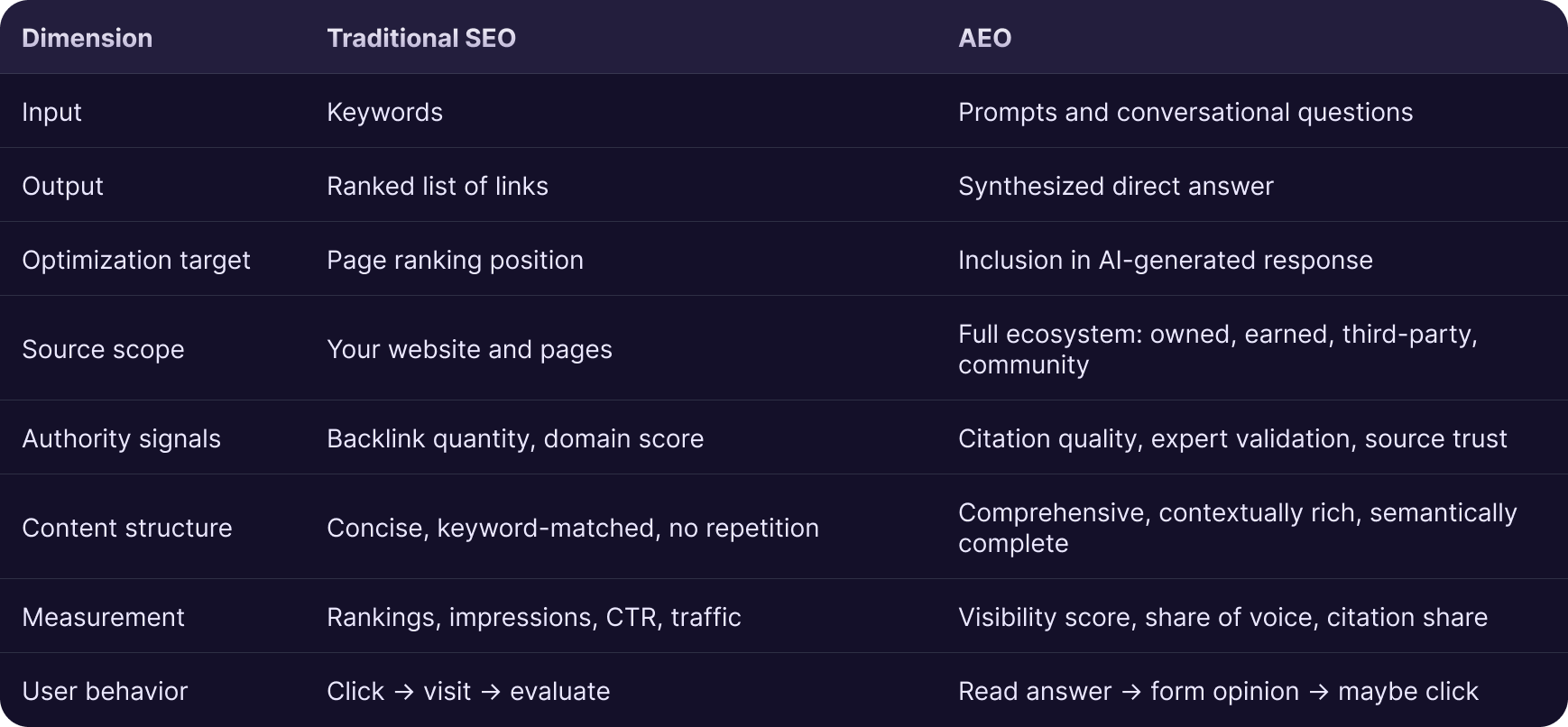
The authority dimension is particularly significant. Research from MIT Sloan Management Review found that traditional search rewards link volume: the more sites linking to your content, the stronger the ranking signal. AI-driven platforms, in contrast, prioritize citation quality and expert opinion. Each platform has its own determination of what constitutes quality, but the overall direction is clear. Fewer, more credible signals outweigh large quantities of lower-quality references.
The content structure dimension is equally important. In traditional search, repeating the same information across pages can be penalized as keyword stuffing. In AI-driven search, the opposite principle applies. AI retrieval favors completeness and contextual richness. Comprehensive coverage of a topic, even with some redundancy, is rewarded.
AEO does not replace SEO. It extends it. LLMs use traditional search indexes as their retrieval layer. A site that is not indexed by Google is unlikely to appear in ChatGPT responses. Foundations of SEO remain critical. What changes is that these foundations alone are no longer sufficient to ensure visibility in a world where AI generates the answer directly.
Yes. AEO and GEO describe the same discipline: optimizing for visibility inside AI-generated answers. The terminology varies because the market hasn't consolidated around a single name. Answer engine optimization, generative engine optimization, AI SEO, AI search engine optimization, AI search optimization, and LLMO all refer to the same strategic shift: ensuring your brand is represented accurately and competitively when AI platforms synthesize responses to user queries.
The fragmentation is real. MIT Sloan Management Review uses the umbrella term Information Search Marketing (ISM) and refers to the organic AI component as Generative Engine Optimization (GEO). McKinsey uses GEO throughout its research. Microsoft Advertising uses AEO and GEO together. Industry practitioners use various combinations.
AEO centers the terminology on what matters most to both buyers and brands: the answer. Regardless of which term an organization uses, the underlying practice is identical.
One adjacent term worth noting: Generative Engine Marketing (GEM) refers to paid placement within AI-generated responses, the AI equivalent of SEM (search engine marketing). AEO is to GEM as SEO is to SEM. As AI platforms evolve their monetization models, GEM will become an increasingly important complement to organic AEO efforts.
AI-generated answers increasingly shape buyer perception before website visits occur, and the scale is already massive. ChatGPT alone has over 900 million weekly active users, approximately half of consumers now use AI-powered search intentionally, and Google itself is embedding AI directly into search results through AI Overviews and AI Mode. This is why generative engine optimization, the same discipline as AEO, has become a strategic priority for marketing teams across industries.
McKinsey's research shows that approximately half of consumers now use AI-powered search intentionally, and 44% of those users consider it their primary information source, ahead of traditional search at 31%, retailer or brand websites at 9%, and review sites at 6%.
The behavioral shift is not limited to early adopters or younger demographics. McKinsey found that a majority of older generations, including baby boomers, have already adopted AI-powered search. Across top sectors (consumer electronics, grocery, travel, wellness, apparel, beauty, and financial services) 40 to 55% of consumers are using AI-based search to make purchasing decisions.
The scale of this shift is difficult to overstate:
For brands, the risk is both significant and difficult to detect through traditional analytics. If AI consistently positions competitors as category leaders while your brand is absent, the pipeline impact may occur before your analytics platform ever detects a drop in traffic. AI-driven discovery loss doesn't show up in Google Search Console. It doesn't appear in your SEO dashboard. But it quietly reshapes the shortlist before a prospect ever reaches your website.
AI scans a wide range of sources when generating answers, including publishers, review sites, forums, and community platforms alongside your own website. In industries like consumer packaged goods and financial services, McKinsey found that publishers, user-generated content, and affiliate sites account for more than 65% of sources in Google AI Overviews. Brands that optimize both their owned content and their broader source presence are the ones that consistently show up.
This means that even a brand with a perfectly optimized website can be misrepresented, or absent entirely, if the broader ecosystem of sources tells a different story.
Yet only 16% of brands today systematically track AI search performance, according to McKinsey's CMO survey. The gap between the scale of the shift and the level of organizational response is where the opportunity lies for early movers.
No. AI is evolving SEO, not replacing it. AI search platforms use traditional search indexes as their retrieval layer (content that isn't indexed by Google is unlikely to surface in ChatGPT's responses) so technical SEO, domain authority, and content quality remain foundational to digital visibility.
What is changing is the sufficiency of SEO on its own. A strong organic ranking no longer guarantees that your brand will be the one AI recommends. The value of traditional link building is shifting from volume to quality, a pattern that MIT Sloan's research confirms across AI-driven platforms. And the metrics that define success are expanding beyond rankings and click-through rates to include visibility inside AI-generated answers.
MIT Sloan proposes a useful framework: Information Search Marketing (ISM) encompasses all search marketing activity across four methods: SEO, SEM, GEO (organic AI optimization), and GEM (paid AI placement). Forward-looking organizations are beginning to allocate resources across all four, recognizing that each method serves a distinct function and that neglecting the AI-driven methods creates a growing blind spot.
The organizations that treat AEO as an extension of their existing SEO capability, rather than a replacement or a separate initiative, will be best positioned as the landscape matures.
Most major AI platforms now use a two-layer process: a large language model combined with real-time web search retrieval. When a user asks a question, the system first searches the web for relevant sources, then the model synthesizes those sources into a direct answer. The sources it draws from span the entire web, not just brand-owned pages, which is what makes the full source ecosystem so critical to AEO strategy.
Understanding these mechanics is essential for anyone optimizing against them.
AI platforms generate answers through two fundamentally different mechanisms.
Parametric knowledge is what the model learned during pre-training. It is baked into the model's weights from processing billions of web pages, and it reflects a static snapshot of information that can be months or years old. Influencing parametric knowledge requires long-term brand building and sustained visibility across high-authority sources over time. It cannot be optimized on a short timeline.
Retrieval-augmented generation (RAG) is the mechanism that has made AEO actionable. In a RAG-based system, the model queries the web in real time when a user asks a question, retrieves relevant pages from across the web, and then synthesizes those sources into a response. This means changes to your content, or to third-party content that mentions your brand, can influence AI-generated answers within days, not years.
Most major platforms now use some form of RAG for current queries. ChatGPT uses search indexes including Google's via real-time retrieval. Perplexity was built from the ground up as an AI search engine with retrieval at its core. Google AI Overviews synthesizes from Google's own index. This convergence of AI chat and search retrieval is what makes AEO a viable, measurable discipline rather than a theoretical concept.
One critical mechanic that distinguishes AI search from traditional search: when a user asks a complex question, AI platforms don't simply run that query against an index. They decompose it into multiple sub-queries (sometimes called fan-out queries) and run each one separately.
For example, a buyer asking "What's the best project management tool for a remote team of 50 with Jira integration?" might trigger sub-queries for "best project management tools 2026," "project management software Jira integration," and "remote team collaboration tools comparison." Each sub-query retrieves different sources, and the model synthesizes across all of them.
The strategic implication: your content doesn't just need to match the buyer's original conversational question. It needs to be retrievable for the shorter, more specific sub-queries that AI platforms generate from that question. This is where traditional SEO and AEO intersect most directly. Strong organic presence for specific, well-structured queries feeds directly into AI retrieval.
This is where the source ecosystem principle becomes concrete.
When an AI platform generates an answer about your category, it does not simply read your homepage and decide whether to include you. It retrieves and synthesizes across a broad array of source types:
Publisher and editorial content. Industry publications, news outlets, analyst reports, and expert commentary. These tend to carry high authority weight across AI platforms.
Review and comparison sites. Platforms like G2, Capterra, TrustRadius, and industry-specific review sites. AI systems frequently draw from structured review data when responding to product comparison queries.
Community and social discussions. Reddit, Quora, LinkedIn, YouTube, industry forums, and social platforms. AI platforms increasingly incorporate user-generated content and community consensus when synthesizing answers, particularly for queries about real-world experience and sentiment.
Affiliate and directory sites. Comparison aggregators, partner content, business directories. For many categories, these represent a significant share of the sources AI references.
Brand-owned properties. Your website, blog, documentation, knowledge base. Essential, but a minority of the total source mix.
The source mix varies by category and platform, but the opportunity is clear. Brands can influence AI answers both through their own content and by building presence across the external sources AI draws from.
Effective AEO strategy goes beyond your own website. It includes influencing how your brand appears across the external sources that AI cites, through PR, review site presence, community engagement, and third-party content accuracy.
AI platforms evaluate several signals when selecting which sources to include in a generated answer:
Source authority. AI-driven platforms prioritize citation quality over quantity. MIT Sloan's research identifies this as one of the foundational differences between traditional search and AI search. A single mention in a respected industry publication may carry more weight than dozens of lower-authority backlinks. Each platform defines quality differently, but the direction is consistent: expert validation and editorial credibility matter more than volume.
Content completeness. Comprehensive coverage of a topic outperforms thin or surface-level content. AI systems need enough material to synthesize a coherent answer. Long-form content that covers multiple dimensions of a topic (use cases, comparisons, limitations, implementation details) provides the depth models draw from.
Structural clarity. Clear headings, direct answers, structured data, and well-organized information make content easier for AI to parse and extract. Content that is easy for a human to scan is generally easy for an AI to synthesize.
Freshness. Updated content with current data, recent statistics, and timely information is favored, particularly for queries where recency matters.
Cross-source consensus. When multiple independent sources provide consistent information about a brand or topic, AI systems treat that information with higher confidence. Conversely, conflicting information across sources creates ambiguity that AI resolves by either excluding the brand or generating less definitive statements. This is why brand narrative consistency across the full source ecosystem is not just a branding exercise. In AEO, it is a technical requirement.
The AI search landscape is fragmented, and each platform behaves differently in how it retrieves, synthesizes, and cites information.

MIT Sloan's research emphasizes what it calls "agnostic alignment": marketers should avoid becoming attached to a single platform. The AI search landscape is dynamic. ChatGPT leads today, but competitors are evolving rapidly. The organizations that monitor across platforms, rather than optimizing for one, will be more resilient as the market shifts.
Understanding the failure modes is as important as understanding the optimization strategies.
Brands most commonly get excluded from AI answers, or inaccurately represented when:
The most insidious failure mode is inconsistency. When a brand's pricing, positioning, or product descriptions differ across its own website, review profiles, directory listings, and press coverage, AI systems encounter conflicting signals. They resolve that conflict conservatively: by hedging, by favoring competitors with clearer narratives, or by excluding the brand from the answer entirely.
Google AI Overviews generates summarized answers directly within search results, reducing click-through rates on informational queries, with zero-click rates averaging around 83% when AI summaries appear compared to roughly 60% for results without them. Visibility is shifting from ranking on page one to being included inside the AI-generated summary itself. Brands that appear in the overview capture attention before users scroll to traditional organic results.
This represents the most direct intersection of traditional SEO and AEO. AI Overviews sits within Google's own search results page, meaning SEO practitioners encounter its effects immediately. It is not a separate platform that can be ignored.
The impact varies by query type. Informational queries are the most affected: when Google generates a comprehensive AI summary, the incentive for users to click through to individual websites drops significantly. Transactional and navigational queries are less affected, but the trend line is clear across all query categories.
One important nuance: traditional ranking position is not a prerequisite for appearing in AI Overviews. Content on page two or three of Google, or even further, can appear prominently in the AI-generated summary if it provides a clearer, more complete answer to the query. This means AI Overviews creates both a threat and an opportunity. Brands that currently dominate page one may lose visibility if their content isn't structured for AI extraction. Brands that were buried in organic results may gain visibility if their content is more answerable.
The optimization principles overlap heavily with general AEO strategy: content clarity, extractability, comprehensive topic coverage, structured data, and authority signals. AI Overviews also draws from third-party sources, reinforcing the ecosystem principle. Your position in Google's AI summary depends not only on your own site but on the broader web of sources Google's AI synthesizes from.
For organizations already investing in AEO across standalone platforms like ChatGPT and Perplexity, Google AI Overviews optimization is a natural extension. The same structural and authority principles apply within Google's own ecosystem.
The foundational elements of AEO, whether you're approaching this as SEO with AI in mind or as a standalone initiative, include the following:
AEO tools can help teams monitor, prioritize, and execute these elements more efficiently. The organizing principle behind all of these elements is straightforward: influence the sources to be in the answer. Since your own site represents only a fraction of what AI platforms reference, effective AEO strategy must span the full source ecosystem: owned content, earned media, third-party properties, and community presence.
AEO begins with question research, not keyword research.
Understanding what buyers actually ask AI systems is the first step. These queries map to buying stages: category exploration ("what are the best tools for..."), vendor comparison ("compare X and Y for..."), feature evaluation ("does X support..."), implementation assessment ("how hard is it to set up..."), and pricing inquiry ("how much does X cost").
These prompts are often longer and more contextual than traditional search keywords. A buyer might ask an AI platform a question that includes their company size, industry, budget, and specific requirements, all in a single query. This creates a different optimization dynamic than targeting individual keywords.
A useful framework from Graphite is to think of AEO topics as clusters of related questions with similar intent. Rather than creating individual pages for each variation (the old programmatic SEO approach) a single comprehensive page that addresses the full cluster of related questions is more effective for AI synthesis.
One honest caveat: unlike traditional SEO where Google provides keyword volume data through its ad products, there is no equivalent truth set for AI query volume yet. As AI platforms introduce their own advertising models, this data will likely emerge. For now, prompt research involves analyzing conversational patterns, testing against live AI platforms, monitoring which queries drive visibility, and iterating.
Your website, blog, documentation, and knowledge base remain essential. They are the sources you control directly.
The structural principles for owned content in an AEO context include answer-first formatting on sections that target real queries, question-based headings that match how buyers actually prompt AI systems, comprehensive topic coverage rather than thin individual pages, clear entity definitions and consistent terminology throughout, and structured data markup including FAQ schema, Article schema, Organization schema, HowTo schema, and DefinedTerm schema.
One key difference from traditional SEO: AI retrieval rewards completeness. Where traditional search penalizes content repetition as keyword stuffing, AI systems favor thorough, contextually rich coverage of a topic. Depth is rewarded. Shallow content is rarely cited.
Microsoft Advertising identifies three data pathways that AI platforms use to access brand information: product feeds, crawled site content, and offsite data. Owned content optimization addresses the first two. The third, offsite data, is where the rest of AEO strategy comes in.
This is the largest lever in AEO and the most underinvested.
Earning presence across the sources AI trusts is not a secondary concern. It is the primary strategic challenge. The brands that treat AEO as purely a website optimization exercise are addressing a fraction of the problem.
Earned source influence in an AEO context includes several dimensions:
Directory listings, comparison aggregators, partner content, and affiliate ecosystems represent a significant share of the sources AI platforms reference, particularly in sectors like consumer electronics, financial services, and software.
The AEO implication: ensure your brand information is accurate, current, and consistent across all third-party properties. Outdated pricing on a comparison site, an incomplete product description in a directory listing, or conflicting feature information across affiliate content all introduce noise into the source ecosystem that AI synthesizes from.
This is often unglamorous operational work, but it directly influences AI answers.
AI platforms increasingly cite Reddit, Quora, LinkedIn, YouTube, and industry forums when synthesizing answers. This is especially true for queries about real-world experience, brand sentiment, and product reliability, the kinds of questions where user-generated content carries more credibility than brand-produced marketing material.
The surface area is broader than most brands realize. LinkedIn posts and articles are increasingly cited by AI platforms for B2B queries, particularly when they carry expert credibility signals. YouTube video descriptions, transcripts, and comments inform AI responses for how-to and product evaluation queries. Even TikTok content surfaces in some AI-generated answers, especially for consumer categories where short-form video drives discovery. These platforms are not just social channels. They are part of the source ecosystem AI draws from.
Authentic brand presence in these conversations (not astroturfing, but genuine participation, responsiveness, and visibility) influences how AI represents your brand. Customer advocacy, real user reviews, and organic community discussion shape the narrative that AI systems synthesize.
For brands accustomed to controlling their message through owned channels, this represents a philosophical shift. In AEO, the conversation about your brand happening on Reddit, in an industry Slack group, or in LinkedIn comments may matter as much as the messaging on your homepage.
Across all of the above (owned, earned, third-party, community) the information about your brand must be accurate and consistent.
Conflicting information creates ambiguity. If your pricing differs between your website and a review platform, if your product positioning varies between a press release and a directory listing, if your feature descriptions are inconsistent across partner content, AI systems encounter conflicting signals. They resolve that ambiguity conservatively, by hedging their language, favoring competitors with clearer narratives, or excluding your brand from the answer.
Brand narrative consistency is not just a branding exercise. In AEO, it is a technical requirement. Auditing and aligning brand information across the full source ecosystem is one of the highest-impact, lowest-cost actions an organization can take.
AEO is not a one-time project. AI models update, retrieval sources shift, and user behavior evolves. Effective AEO requires ongoing monitoring across multiple platforms.
This means tracking visibility across all major AI systems, not just one. It means identifying where your brand is cited, where it is absent, and where it is misrepresented. It means monitoring which third-party sources are being cited in answers about your category and whether those sources represent your brand accurately. And it means establishing a regular cadence (monthly at minimum) rather than treating AI visibility as a periodic audit.
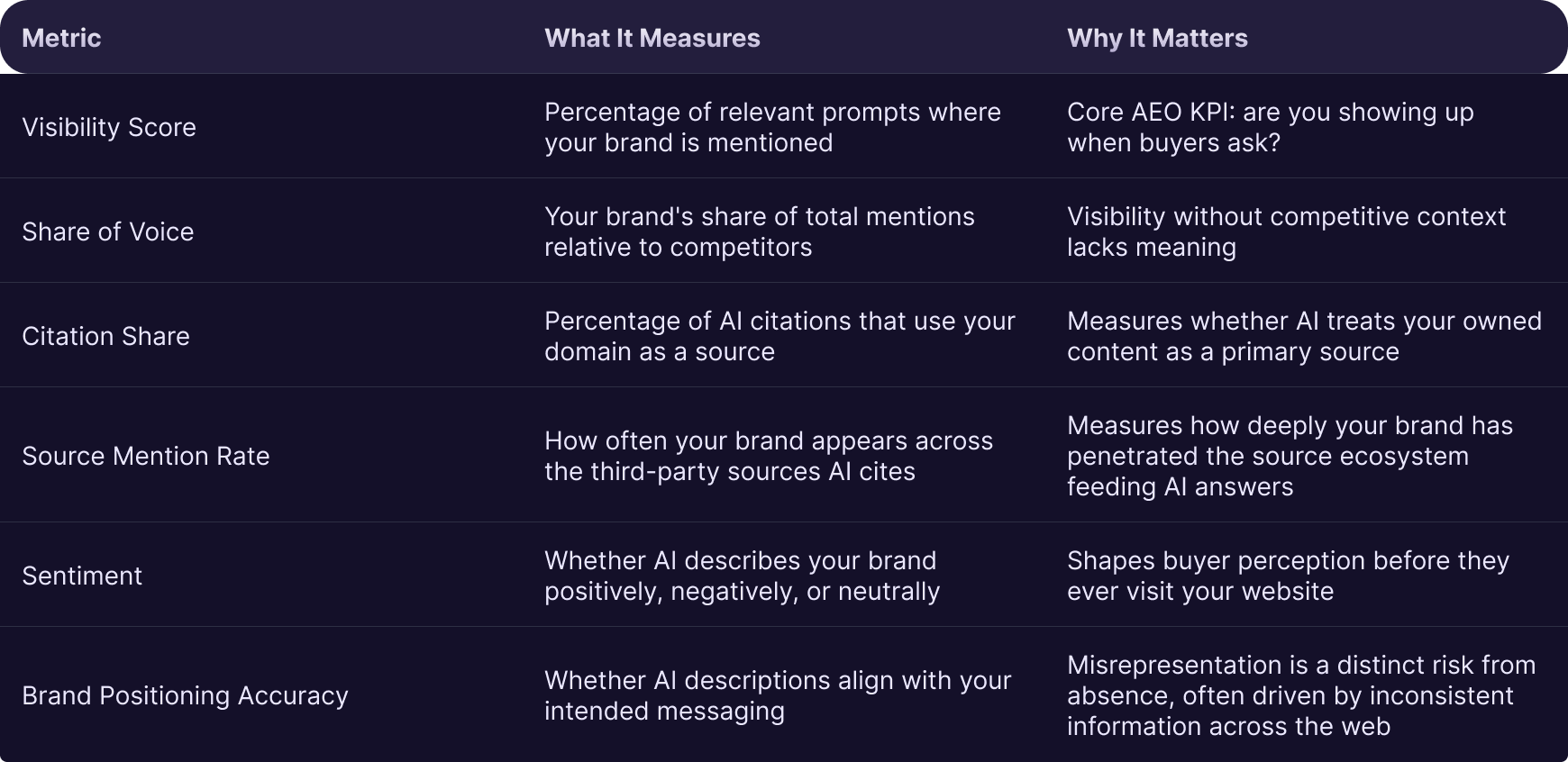
It really comes down to tracking how these core metrics change overtime:
Here is a more detailed breakdown of what these metrics measure and why they matter
AI search attribution remains in its early stages. MIT Sloan describes the current state as "relatively underdeveloped" compared to traditional search analytics. This is real, and it is worth acknowledging honestly rather than overpromising measurement precision.
That said, there are several approaches that provide meaningful signals:
One important caution: beware of vanity metrics and misattribution. AI platform usage is growing rapidly on its own. If referral traffic from ChatGPT increases 50% due entirely to platform adoption growth rather than AEO optimization, it is easy to credit optimization work as the cause. Rigorous measurement requires isolating the impact of changes against a control, comparing relative improvements over absolute numbers, and focusing on visits and conversions as primary KPIs rather than citation counts alone.
McKinsey's research indicates that traffic arriving through AI-powered search tends to be further along the purchase funnel than traditional organic traffic. The AI has already synthesized options, compared alternatives, and pre-qualified the user's interest before they click through. This suggests that AI-referred traffic, while potentially lower in volume than traditional search traffic, may convert at a higher rate.
The attribution framework for AEO should distinguish between what can be measured directly (AI crawler traffic, visibility score, citation share, AI-referred sessions) and what must be inferred through correlation (the relationship between AI visibility improvements and movements in branded search, direct traffic, and pipeline). Both layers are valuable. Presenting them with appropriate precision, rather than overstating causation, builds credibility with leadership and supports sustained investment.
Most organizations are in the early stages of recognizing AEO as a distinct discipline. The following maturity model provides a diagnostic framework for assessing where your organization stands and what progression looks like. By answering the diagnostic questions, you can find what stage you are currently at and come up with a plan.
The organization has no visibility into how AI platforms represent its brand. No monitoring is in place across any AI system. AEO is not recognized as a distinct discipline or a strategic priority. There is no understanding of which third-party sources are shaping the brand's AI representation.
Most companies are at this stage. McKinsey found that only 16% of brands today systematically track AI search performance.
Diagnostic: Have you queried ChatGPT, Perplexity, or Google AI Overviews for your brand or category and documented what comes back?
Initial assessments are underway. The team is manually querying AI platforms to establish baseline visibility. They are documenting where the brand appears, where it is absent, and where it is misrepresented. They are beginning to identify which third-party sources are being cited in AI-generated answers and whether those sources represent the brand accurately.
The organization understands the problem but is not yet solving it systematically.
Diagnostic: Do you know your visibility score for your top 10 high-intent prompts across at least two AI platforms? Do you know which third-party sources are shaping your AI representation?
A structured AEO strategy is in place spanning both owned and earned sources. Owned content is being adapted for AI extractability. Prompt research is informing the editorial calendar. Active efforts are underway to influence earned sources: securing PR placements, managing review site presence, ensuring third-party accuracy. A regular monitoring cadence is established across two to three platforms.
Diagnostic: Has your content team changed how it structures content based on AEO principles? Are you actively managing your brand's presence across the third-party sources that AI draws from?
AEO is a standing function that spans marketing, PR, content, and brand. The full source ecosystem (owned, earned, third-party, community) is monitored and influenced as a unified program. Dedicated metrics and cross-platform dashboards are in place. Competitive benchmarking is ongoing. Budget is allocated specifically to AI visibility. Quarterly reviews assess performance and adjust strategy as models evolve.
AEO at this stage requires ongoing monitoring, quarterly reviews, and structured experimentation. The organizations that reach Stage 4 treat AI visibility with the same operational rigor they apply to SEO, paid search, and programmatic media.
Diagnostic: Does your marketing dashboard include AI visibility metrics alongside SEO and paid performance? Is AEO integrated across marketing, PR, and content functions, not siloed as an SEO initiative?
Answer Engine Optimization (AEO) is the practice of influencing the full ecosystem of sources that AI platforms draw from so your brand is accurately included in AI-generated answers. This encompasses owned content, earned media, third-party properties, and community discussions across platforms like ChatGPT, Claude, Perplexity, and Google AI Overviews.
Generative Engine Optimization (GEO) is the practice of optimizing content and brand presence so it appears inside AI-generated answers rather than only in traditional search rankings. GEO is functionally synonymous with AEO. Both target the same outcome through the same methods. The term GEO is used prominently by McKinsey and MIT Sloan in their research on the topic, while AEO centers the terminology on what matters to buyers and brands: the answer. Other equivalent terms include AI SEO, AI search engine optimization, AI search optimization, and LLMO.
Yes. AEO (Answer Engine Optimization) and GEO (Generative Engine Optimization) describe the same discipline. The terminology varies because the market hasn't consolidated around a single name. AEO, GEO, AI SEO, AI search engine optimization, AI search optimization, and LLMO all refer to optimizing for visibility inside AI-generated answers. The practice, methods, and objectives are identical regardless of which label is used.
No. AI is evolving SEO, not replacing it. AI search platforms, ChatGPT most prominently, use traditional search indexes as their retrieval layer, which means content that isn't indexed by Google is unlikely to appear in AI-generated responses. Technical foundations, domain authority, and content quality remain essential. What's changing is that strong organic rankings alone no longer guarantee visibility when AI generates the answer directly. AEO extends SEO into the AI synthesis layer rather than replacing it.
Generative engine optimization, also known as AEO, is important because AI-generated answers increasingly shape buyer perception before website visits occur. Approximately half of consumers now use AI-powered search intentionally, and 44% consider it their primary information source. ChatGPT alone has over 900 million weekly active users, and Google is embedding AI directly into search through AI Overviews and AI Mode, meaning even traditional search is becoming AI-mediated. Brands that are absent from these AI-generated answers risk losing pipeline before a prospect ever reaches their website.
The foundational elements for SEO with AI include topical authority across content hubs, content structured for AI extractability with clear headings and direct answers, strong entity definitions with consistent terminology, trust signals from third-party sources and expert validation, active presence across the earned and community channels that AI draws from, and appropriate schema markup (FAQ, Article, Organization, HowTo, DefinedTerm). AI systems prioritize clarity, depth, and cross-source consensus over keyword density. Your own website is a strong starting point, and optimizing it for AI extractability drives real results. Extending that effort to earned media, review sites, and community presence compounds the impact.
Google AI Overviews places AI-generated summaries directly in search results, which reduces click-through rates on informational queries and shifts visibility from traditional page rankings to inclusion in the AI summary. Research shows queries triggering AI Overviews have zero-click rates around 83%. Content that is not structured for AI extraction risks losing visibility even if it ranks on page one. Importantly, traditional ranking position is not a prerequisite. Content from page two or three can appear in the AI summary if it provides a clearer answer.
The practice of optimizing for visibility inside AI-generated answers is most commonly called Answer Engine Optimization (AEO) or Generative Engine Optimization (GEO). Other terms include AI SEO, AI search engine optimization, AI search optimization, and LLMO (Large Language Model Optimization). These all describe the same discipline. The terminology hasn't consolidated yet, but the practice is identical regardless of which label is used. AEO is the term that centers on what matters most: being in the answer.
No. AEO extends SEO but they are not the same discipline. SEO optimizes your website to rank in search engine results pages. AEO influences the full ecosystem of sources (owned content, earned media, and community signals) that AI platforms synthesize into direct answers. SEO targets page rankings; AEO targets inclusion in AI-generated responses. They share technical foundations like site indexability, domain authority, and content quality, and AI platforms use traditional search indexes as their retrieval layer, so strong SEO remains essential. But SEO alone no longer guarantees visibility when AI generates the answer directly.
The core AEO KPIs are visibility score (percentage of relevant prompts where your brand appears), share of voice (your brand's mentions relative to competitors), citation share (percentage of AI citations using your domain as a source), source mention rate (how often your brand appears across the third-party sources AI cites), sentiment (whether AI represents your brand positively or negatively), and positioning accuracy (whether AI descriptions match your intended messaging). These metrics complement traditional SEO KPIs rather than replacing them. A brand can have high visibility but low citation share, indicating third-party sources are driving AI's representation rather than owned content.
For RAG-based platforms that retrieve from the live web, changes to owned content can influence AI responses within days to weeks. Earned source influence (PR placements, review site presence, community visibility) follows a longer but compounding timeline. Influencing a model's parametric knowledge (training data) takes months to years. Most organizations see the fastest returns from combining owned content optimization with earned source strategy.
Yes. The MIT Sloan research includes multiple examples of smaller, lesser-known brands outperforming market leaders in AI-generated answers. AI platforms prioritize content quality, specificity, and citation credibility, not brand size or media budget. Small businesses with strong expertise signals, complete review profiles, and clear content can outperform larger competitors who haven't optimized for AI visibility.
Digital discovery is shifting from links to answers. The question for brands is no longer only whether they rank in search results, but whether AI recommends them when buyers ask.
This shift is happening at scale. Hundreds of millions of users are already relying on AI-powered search as their primary research tool. By 2028, $750 billion in US consumer revenue will flow through AI-driven search. And the sources that shape AI answers extend far beyond any brand's own website, spanning publishers, review platforms, community discussions, and third-party content across the web.
AEO is the discipline built for this reality. It combines owned content optimization, earned source influence, cross-platform monitoring, and competitive benchmarking into a unified strategy for ensuring your brand is visible, accurately represented, and competitively positioned inside AI-generated answers.
The discipline is early. Models update. Retrieval methods shift. User behavior evolves. But the organizations that build this capability now, across owned, earned, and third-party channels, gain a structural advantage that compounds as the landscape matures.
The future of discovery belongs to brands that are not just searchable, but answerable.
If your organization is investing in SEO but not yet measuring AI visibility, you may already have a blind spot in your digital strategy.
Cognizo helps marketing teams identify the prompts that influence buying decisions across leading AI platforms, measure brand visibility inside AI answers, benchmark competitive presence across models, track citation share and positioning accuracy, and demonstrate executive-level ROI from AI search.
.svg)

.svg)


