Get a free AI visibility report

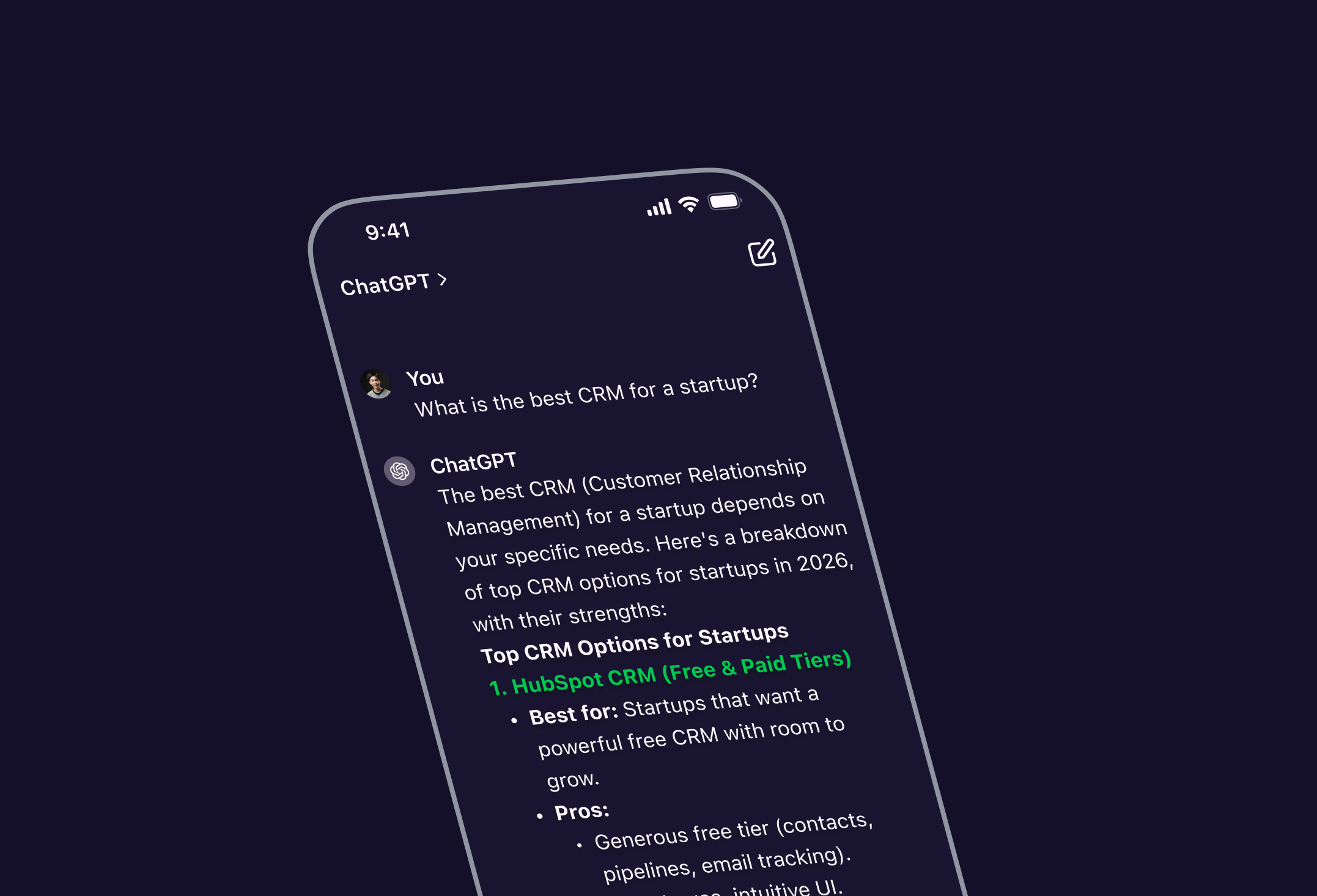
AI visibility measures how accurately and how often your brand appears in AI-generated answers across platforms like ChatGPT, Perplexity, Google AI Overviews, and Gemini. It is a distinct layer of brand presence from search rankings, and most marketing teams have no system for tracking it.
If you are a marketing manager at a mid-size company, there is a good chance you have noticed something off lately. A growing share of your potential buyers are skipping Google entirely, opening ChatGPT or another AI tool, and asking it to recommend the best solution for their use case. They get an answer and build a shortlist from it. If your brand was not included, you never had a chance. If it was, the way AI described you may not reflect the positioning you have spent years building. This is the AI visibility problem, and it does not show up anywhere in your current analytics stack. This article explains what AI visibility is, why it matters in 2026, how it differs from traditional search performance, and how to start closing the gap.
AI visibility is the measure of how accurately and how often your brand appears in responses generated by AI-powered platforms, including ChatGPT, Google AI Overviews, Gemini, Claude, Microsoft Copilot and more.
It is not a ranking. It is not a traffic metric. It is the answer to a different question: when a buyer asks an AI about your category, your use case, or your competitors, what does the AI say about you? Does it mention you at all? Does it describe you accurately? Does it recommend you over alternatives, or does it position a competitor as the default?
Those outcomes are what AI visibility tracks. And they matter because, increasingly, they happen before any click, any visit, and any conversation with your sales team.
Your brand is either cited as a source to help form an answer or mentioned in an answer. These aren’t mutually exclusive. They can happen at the same time, like when someone asks about your brand to an AI chatbot, your source will be cited and you will be mentioned in the response. But still it is critical we understand what the two means.
An AI citation is different from a brand mention. A citation occurs when an AI platform attributes a specific source by linking to or crediting a domain as the basis for information in its response. When Claude generates an answer and shows numbered source links, those are citations. When Google AI Overviews pulls a passage from a publisher and credits that URL, that is a citation.
AI citations signal something specific: the AI did not just surface a brand name from general knowledge. It retrieved content from a particular source and used it to construct the answer. That source earned its place because the AI judged it credible and relevant enough to extract from.
For brands, earning AI citations typically means your domain, or a domain that covers your brand, is being actively retrieved and used as source material. That is a stronger retrieval signal than a mention alone, because it means the AI is not just aware of you, it is drawing from your content or from content about you, and this helps your overall visibility across AI responses.
An AI brand mention is any unprompted reference to your brand inside an AI-generated answer. When a buyer asks ChatGPT "what are the best tools for competitor research?" and the AI responds with a paragraph that includes your brand name, that is a brand mention. The AI brought your brand into the answer based on what it knows and what it retrieves, without the user specifically asking about you.
Brand mentions in AI search are the foundation of AI brand visibility. They represent the raw fact of presence: your brand is in the conversation, or it is not. But mentions alone do not tell the full story. A mention can be positive or negative. It can place you accurately in your category or assign you to the wrong one. It can frame you as a leading option or as a fallback. The quality and framing of AI brand mentions is as strategically significant as their frequency.
This is why monitoring brand mentions in AI search is not a simple yes/no exercise. It requires tracking not just whether your brand appeared, but how it was described, in what context, and alongside which competitors.
Most teams that start paying attention to AI brand visibility treat mentions and citations as interchangeable. They are not.
A brand can have high mention frequency but low citation share. This typically means the AI knows about the brand from its training data and surfaces it in conversational answers, but is not actively retrieving and citing owned content or third-party sources when generating those answers. The implication is that the brand's web presence is either not being crawled effectively, not structured for retrieval, or not yet represented across the external sources AI platforms pull from.
A brand can also have strong citation share but weak overall visibility. This happens when the AI cites a brand's domain as a source without necessarily recommending or mentioning the brand as a solution in buyer-facing answers. The content earns retrieval authority without translating into brand consideration.
Understanding which situation you are in changes what you do next. High mentions, low citations point toward content and technical optimization. High citations, low visibility points toward prompt coverage and topical positioning. Without tracking both, you are working with an incomplete picture.
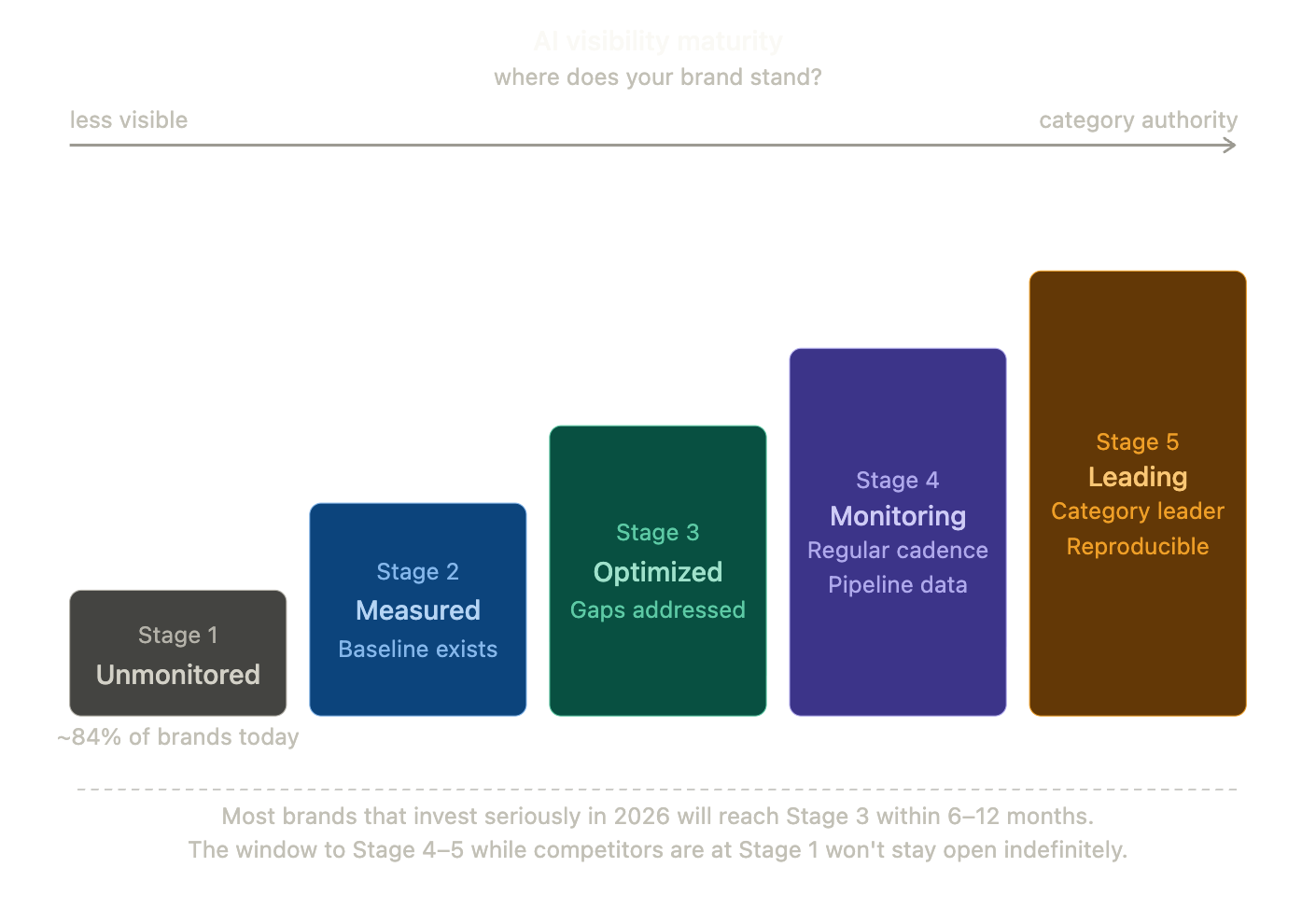
Now let’s try to understand where you might be in your AI visibility journey, so you can truly understand what you need to do today. Most brands approaching AI visibility for the first time are at the beginning of a maturity curve. Understanding where you are helps prioritize what to do next.
Stage 1: Unmonitored. No system for tracking AI mentions, no prompt set, no baseline data. The brand may be appearing in AI answers positively, negatively, or not at all, and the marketing team has no way of knowing. This is the current state for approximately 84% of brands.
Stage 2: Measured. A baseline exists. The team knows which prompts trigger brand mentions, what the current visibility score and share of voice look like across primary platforms, and where the largest gaps are relative to competitors. Measurement is systematic but still primarily manual or early-stage.
Stage 3: Optimized. The team has identified the source gaps, content gaps, and positioning gaps that are suppressing visibility and has begun addressing them through a coordinated content, earned media, and third-party presence strategy. Measurement is ongoing with defined improvement targets.
Stage 4: Monitoring and adapting. AI visibility performance is tracked on a regular cadence, results are connected to pipeline metrics, and strategy adapts as platform behavior changes. The team has competitive visibility data and uses it to inform content and PR investment decisions.
Stage 5: Leading. The brand is a consistent category authority in AI answers. AI platforms treat its content as a primary source, competitors benchmark against it, and the team has a reproducible system for maintaining visibility as platforms and buyer behavior evolve.
Most brands that invest serious attention in AI visibility in 2026 will reach Stage 3 within six to twelve months. The window to reach Stage 4 and 5 while competitors are still at Stage 1 will not stay open indefinitely.
A common misconception is that ranking first on Google would automatically mean high AI visibility. AI platforms retrieve from across the entire web using their own weighting logic, not just the top of a Google search. A brand can hold the number one organic position and be completely absent from the AI-generated answer to the same question.
The reverse is also true. MIT Sloan Management Review documented a smaller local company outperforming a major fitness brand in AI answers simply because its story was more coherently represented across the sources AI trusted. AI does not care that you paid for rankings. It cares what the broader web says about you.
Because this audience lives in SEO, this section covers the comparison directly. The full treatment lives in the guide on answer engine optimization, but the functional difference matters here.
Technical SEO fundamentals remain important because AI platforms retrieve from indexed web content. A site that is not indexable by search engines is unlikely to appear in AI-generated responses. Page speed, crawlability, structured data, and clear content architecture all contribute to whether AI platforms can access and extract from your content.
Topical authority is also a shared signal. Building deep, consistent coverage of a topic area helps both traditional search rankings and AI citation likelihood. The underlying principle, that authoritative sources on a subject are trusted sources, applies in both contexts.
The optimization target is fundamentally different. SEO optimizes for a ranking position on a results page. AI visibility optimizes for inclusion in a synthesized answer. The user behavior downstream is also different. A ranked result still requires a click. An AI answer delivers the synthesis directly, with your brand's representation baked into the response itself.
The source scope is also broader. SEO is primarily about your own website and the links pointing to it. AI visibility encompasses your entire presence across the web: your owned content, your earned media coverage, your representation on review platforms, your presence in community discussions, and the accuracy of your information across third-party sources. Many of these sources are not ones you directly control.
The measurement framework is different as a result. SEO metrics measure what happens at your website. AI visibility metrics measure what AI says about you, which happens before most website visits occur.
The table below captures the key differences:
One of the reasons marketing teams struggle to make the case for AI visibility internally is that the metrics feel abstract. Visibility score sounds like a made-up number. Share of voice sounds like a social media concept. Neither sounds like something a CFO will approve budget for.
The framing issue is that these metrics are being explained without connecting them to pipeline behavior. Here is the connection: AI answers influence brand consideration before a buyer ever visits your website. The metrics that measure AI visibility are therefore measuring top-of-funnel brand positioning in a channel that currently has almost no measurement infrastructure.
That makes early investment in measurement a structural advantage, not a cost center.
The full technical implementation for AI visibility measurement belongs in its own guide. But the starting point is straightforward enough to outline here, because the biggest barrier for most teams is simply not knowing where to begin.

Build a list of conversational questions your buyers are actually asking AI about your category. Not keywords. Questions like "what is the best [category] for [use case]" or "how does [your product] compare to alternatives." This prompt set becomes your recurring measurement instrument across platforms.
Run your prompt set across ChatGPT, Perplexity, and Google AI Overviews. Document whether your brand appears, how it is described, and who else shows up. Most teams find they are either more absent than expected or present but misrepresented. Both are actionable.
Look at which third-party sources AI cites when answering prompts in your category. Publications, review platforms, comparison sites. Cross-reference against your current presence on those sources. The gaps are your highest-leverage targets, whether that is PR, reviews, or content.
AI answers change as platforms update their logic and competitors invest in their own visibility. The minimum viable approach is a monthly prompt set run across the three primary platforms with results tracked over time. For teams ready to go deeper, the guide to optimizing for AI search covers the full workflow.
The strategic framing above matters, but marketing managers working inside real organizations are dealing with specific, practical obstacles. Here is how the most common ones resolve.
AI visibility is not a separate channel with a separate workflow. It is a measurement layer on top of work you are already doing.
The content your team is writing already either earns AI citations or it does not. The PR coverage you are pursuing either shows up in AI source ecosystems or it does not. Adding AI visibility measurement does not mean adding a new content track. It means understanding which of your existing efforts are translating to AI presence and which are not, so you can direct existing resources more effectively.
Cognizo customers who build content calendars using both SEO and AEO data consistently see improvements on both sides. Optimizing for AI visibility does not come at the expense of traditional search performance.
The marginal cost of adding AI visibility monitoring to a functioning content and SEO operation is low. The opportunity cost of not doing it is growing.
Direct attribution from AI-generated answers to pipeline is harder than attribution from organic search, but "we cannot track it therefore it does not count" is strategically dangerous. The practical approach is to track AI visibility metrics as leading indicators: if share of voice improves over six months and branded search, direct traffic, and sales-reported source quality move with it, the correlation is the evidence. One underused signal is your own traffic analytics. A rising share of bot traffic from AI crawlers like GPTBot, ClaudeBot, and PerplexityBot means AI platforms are actively retrieving your content, which is directional evidence that you are in the retrieval pool even before you can confirm a citation. Some platforms like Cognizo actually do have built in traffic analytics features where you can see clearly how many AI bots enter your owned content. So investing in a comprehensive tool is going to cover most of your questions.
AI visibility is the measure of how often and how accurately a brand appears in responses generated by AI-powered platforms, including ChatGPT, Perplexity, Google AI Overviews, Gemini, and Microsoft Copilot. It tracks whether a brand is mentioned, how it is described, whether it is cited as a source, and how its representation compares to competitors across the same set of buyer prompts.
SEO rankings measure a website's position in traditional search results. AI visibility measures a brand's representation in synthesized AI-generated answers, which are increasingly the first thing buyers encounter when researching a category. The two metrics are not correlated. A brand can rank first organically and be absent from AI answers, or rank modestly and appear consistently across AI platforms.
The platforms most relevant for AI visibility measurement are ChatGPT, Perplexity, Google AI Overviews, Google AI Mode, Gemini, and Microsoft Copilot. Each platform has distinct citation behavior and source preferences, which is why multi-platform tracking matters. A brand's visibility profile across these platforms will not be consistent, and optimizing for one does not guarantee visibility across others.
It is directly improvable. AI platforms synthesize from sources across the web, and those sources are influenceable through content strategy, earned media, review platform presence, community engagement, and third-party accuracy management. Brands that consistently appear in AI answers have typically invested in being well-represented across the sources AI trusts, not just on their own websites. The full optimization playbook is covered in the guide to optimizing for AI search.
They are related but distinct. AI visibility is a measurement concept: how your brand currently appears in AI answers. Answer Engine Optimization (AEO) is the practice of improving that appearance through strategic content and earned presence efforts. AI visibility tells you where you stand. AEO is what you do to improve it. The full explanation of AEO and how it connects to traditional SEO is covered in the answer engine optimization guide.
The shift in how buyers find and evaluate brands is not a future trend. It is present behavior, measurable now, with meaningful commercial implications for brands that are either paying attention or not.
AI visibility is the metric that captures your brand's standing in that new discovery environment. It does not replace SEO. It extends the measurement infrastructure that marketing teams need to understand where influence is happening and where it is not.
The brands that invest in understanding this now, establishing baselines, identifying gaps, and beginning to close them, will have a structural advantage as the channel matures. The brands that wait until AI visibility gaps show up will be starting from behind.
The good news is the starting point is accessible. A defined prompt set, a first audit across the three primary platforms, and a clear picture of the six metrics is enough to begin. The gap between knowing and not knowing is smaller than most teams expect. The gap between acting early and acting late is growing.
.svg)

.svg)


