Get a free AI visibility report

The best aeo tools crm integration options connect AI visibility data to the systems where your team already works: your CRM, your content pipeline, and your search reporting. This guide compares ten platforms on how they link AI answer tracking to CRM records, content production, and existing analytics.
Most AEO platforms can tell you how often ChatGPT or Google AI Overviews mentions your brand. Far fewer connect that signal to the tools where your team acts on it. When visibility data sits in a standalone dashboard, someone has to export it, interpret it, and manually route it into the CRM or the content calendar, which is where momentum dies. The best ai tools for seo and aeo are the ones that push AI answer data into your existing workflow, so a drop in visibility becomes a task, a brief, or a pipeline note automatically. Roundups of the best ai visibility tools for aeo 2025 largely judged platforms on coverage and price; in 2026 the deciding line has moved to integration. This comparison ranks ten options for aeo tools crm integration by that standard.
Integration in this category spans three connection points. The first is CRM enrichment, where AI visibility and prompt data flow into your customer records so mention tracking reflects the questions your actual buyers ask. The second is content workflow, where a visibility gap can trigger a brief, outline, or draft without leaving the platform. The third is analytics unification, where AI answer data sits alongside Google Search Console and traffic metrics so you can compare traditional search and AI presence side by side.
The method matters as much as the feature. Some platforms ship native connectors that install in minutes. Others expose an API for custom HubSpot or Salesforce builds, and some rely on middleware like Zapier to move data between systems. Native connectors are fastest to deploy, API access suits engineering teams with custom objects, and middleware fills gaps for tools without a direct connector. Before comparing tools, decide which method your team can actually maintain.
| # | Tool | Starting price | Engines |
|---|---|---|---|
| 1 | Cognizo | $499/mo | 10+ |
| 2 | HubSpot AEO | $50/mo | 3 |
| 3 | Profound | $499/mo | Multiple |
| 4 | Peec AI | €85/mo | 6 |
| 5 | Semrush AI Visibility | $99/mo per domain | 3–4 |
| 6 | Ahrefs Brand Radar | $199/mo/platform | Multiple |
| 7 | Scrunch AI | $250/mo | 6+ |
| 8 | Rankability | $79/mo | Multiple |
| 9 | ZipTie | $69/mo | 3 |
| 10 | Surfer | $99/mo | Multiple |
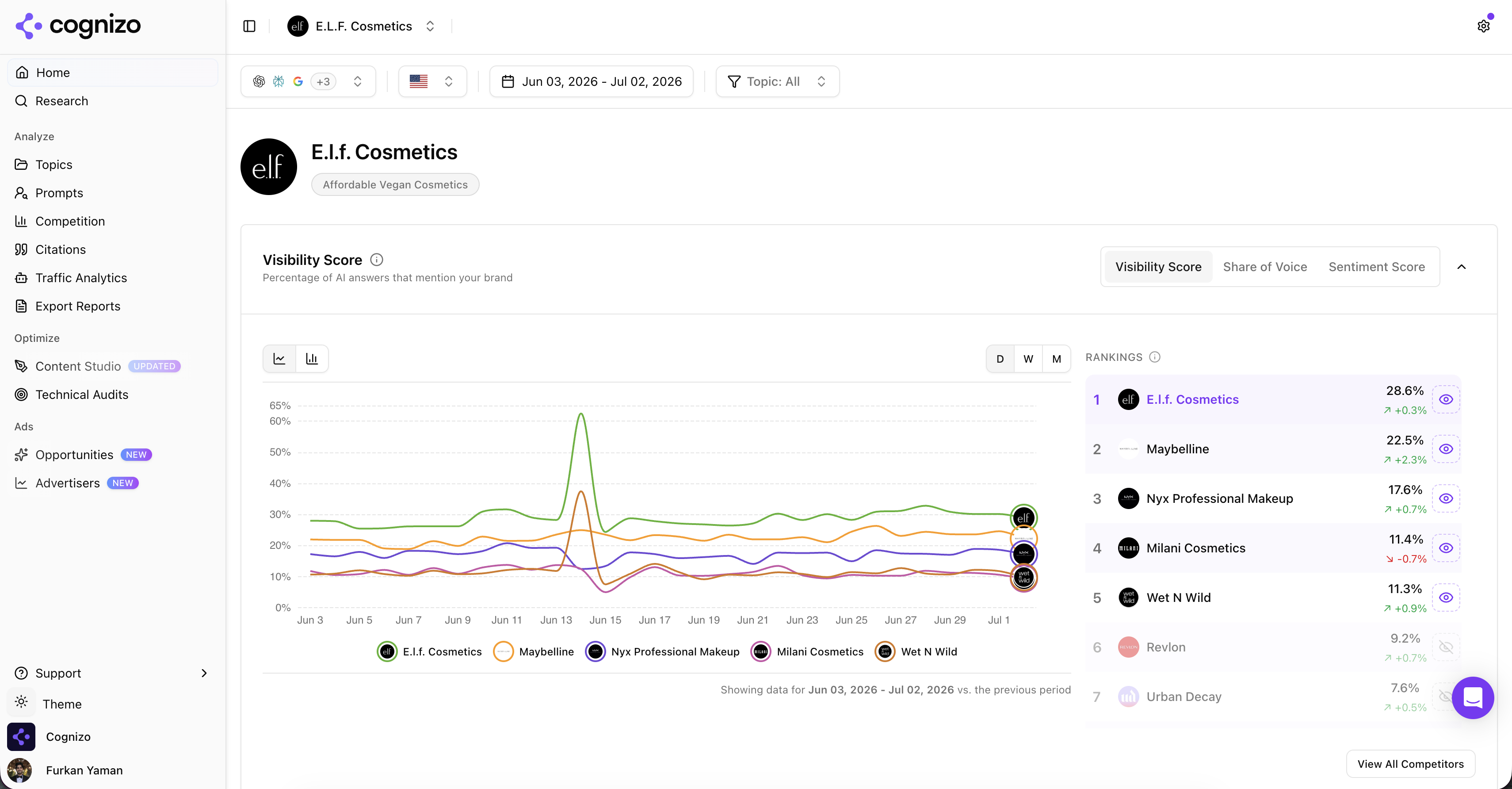
Cognizo ranks first for aeo tools crm integration because it is built to move AI visibility data through the full workflow, not just report it. Its AI content studio generates briefs, outlines, drafts, and FAQs directly from visibility gaps, so a weak spot in your coverage becomes publishable content inside the same platform. That closes the loop most standalone monitors leave open.
On the data side, the Prompt Volumes module enriches CRM and support data through machine learning models, turning your own customer signals into the prompt set the platform tracks. This means visibility monitoring reflects real buyer questions rather than generic industry templates. The AI Traffic Analytics module connects AI crawler behavior and AI-referred sessions to business outcomes, and the platform unifies attribution across Google Search Console and Google Ads through its OpenAI Conversions API integration, giving one view of organic AI presence and paid performance.
Cognizo's Answer Engine Insights module monitors visibility, sentiment, owned citations, and earned citations across ChatGPT, Google AI Overviews, Google AI Mode, Perplexity, Claude, Gemini, Microsoft Copilot, and more, using UI scraping to capture the actual rendered answer a real user sees. MCP and API access are included on every plan, and Enterprise adds custom integrations and dedicated Google Search Console integration for deeper connection to internal systems.
Pricing starts at $499 per month on Growth, $999 per month on Pro, and custom on Enterprise, with unlimited seats on every plan.
HubSpot AEO is built inside the HubSpot ecosystem and uses CRM data to suggest prompts to track, rather than generic templates. It tracks a brand visibility score, prompt performance, citation analysis, and prioritized recommendations across ChatGPT, Gemini, and Perplexity, with that data sitting alongside campaign metrics in Marketing Hub. Recommendations connect directly to HubSpot's content tools, so teams can act without leaving the platform. It costs $50 per month standalone, and is included in Marketing Hub Professional and Enterprise plans. Integration is deepest for teams already operating inside HubSpot.
Profound offers API access that teams use for custom HubSpot or Salesforce builds rather than a native CRM connector. It tracks AI visibility in near real-time across major answer engines, delivers data through dashboards, CSV exports, and API-first integrations, and includes an agents feature that generates content and runs marketing workflows. It also offers content-delivery integrations with Akamai, Cloudflare, and Fastly. Pricing is self-serve from $499 per month on its Lite tier, with custom enterprise contracts above that.
Peec AI provides API access on its Enterprise tier, currently in beta, and unlimited seats across paid plans for shared team access. It tracks visibility, sentiment, source analysis, and prompt discovery across ChatGPT, Gemini, Claude, Perplexity, DeepSeek, and Grok, with segmentation by model, country, and prompt tag. It includes Slack support on higher tiers. Pricing starts around €85 per month, with Pro at roughly €199 per month and Enterprise from €499 per month.
Semrush AI Visibility connects to Position Tracking, Organic Research, GA4, and Google Search Console inside the Semrush interface, and treats AI Overview citations as top-position rankings in its visibility logic. It tracks mentions across ChatGPT, Gemini, and AI Overviews, blends AI data with traditional SEO metrics, and draws on a large LLM prompt database. It runs as an add-on within Semrush plans, priced at $99 per month per domain. Integration is contained within the Semrush ecosystem.
Ahrefs Brand Radar connects AI visibility data to Ahrefs' backlink profiles, showing which external sites drive AI citations. It tracks brand mentions across multiple engines including Google AI Mode, and runs inside the Ahrefs platform teams already use for backlink and keyword analysis. Prompt-level analysis is lighter than dedicated platforms. Pricing is $199 per month per platform, with full multi-platform coverage reaching higher tiers.
Scrunch AI emphasizes security and governance with SOC 2 certification and real-time bot crawling feeds. CRM integration is handled through Zapier or developer-built API setups rather than a native connector, and it supports agency accounts under a separate partner program tier. It offers a daily refresh cadence across 6+ AI models. Pricing starts around $250 per month, with custom enterprise options.
Rankability combines AI visibility tracking with traditional SEO and content execution in an agency-first platform. It tracks AI answers, AI citations, classic rankings, and citation gaps, rolling performance into a single SPI score for client reporting, and connects research, writing, optimization, tracking, and reporting in one workflow. Pricing starts at $79 per month.
ZipTie tracks AI visibility across 3 engines and focuses on citation and mention monitoring for mid-market teams. Integration is oriented toward reporting and export rather than native CRM connectors. Pricing starts at $69 per month.
Surfer connects AI search optimization to its content editor workflow, where visibility insights feed directly into content creation and on-page optimization. It integrates with Google Docs and WordPress for publishing, and covers AI answer surfaces alongside its traditional SEO content tools. Pricing starts at $99 per month on its Standard plan.
Start with the integration method your team can maintain. If you run everything inside one marketing suite, a platform native to that suite reduces context-switching. If you have engineering support and custom CRM objects, API access matters more than a pre-built connector. If your stack is fragmented across many tools, middleware like Zapier becomes the practical bridge, though it adds a per-task cost and a slight data lag. If integrations are not the deciding factor, our guide to the best answer engine optimization tools compares the same category on tracking, citations, content, and execution.
Then weigh which connection point drives the most value for you. Teams focused on pipeline attribution should prioritize CRM enrichment and analytics unification with Google Search Console. Teams focused on output should prioritize content workflow integration that turns gaps into drafts. The best tools for improving ai visibility aeo are the ones that shorten the path from insight to action for your specific team, which is why integration depth, not dashboard polish, is the deciding factor. For a broader view of the category, see Cognizo's guide to AI SEO tools.
The shift toward AI-mediated research raises the stakes on acting fast. Gartner projects that traditional search engine volume will drop 25% by 2026 as AI chatbots absorb queries once handled by search. Harvard Business Review likewise reports that many consumers already use LLMs to research products and compare options. When buyers form impressions inside an AI answer, the lag between spotting a visibility gap and fixing it is lost pipeline, and that lag is exactly what integration removes. To go deeper on the surrounding practice, see Cognizo's guides on tracking brand mentions and ChatGPT Ads.
Several platforms track Claude alongside other engines, including Cognizo, Peec AI, and Profound. Because Claude often produces narrative comparisons that weigh vendors against one another, the way it frames your brand can differ from a citation-led engine, so tracking it as a distinct surface matters. For teams that also need that Claude data to reach their CRM or content pipeline, the deciding factor is not just whether a tool covers Claude but whether it can route Claude visibility signals into the systems where the team acts, through native connectors, API access, or content generation built into the same platform.
It varies widely. Some platforms integrate CRM data natively, HubSpot AEO being built directly on its own CRM, while others expose an API for custom HubSpot or Salesforce builds, and several rely on middleware like Zapier or developer setups. Native connectors deploy fastest and need no engineering, API access suits teams with custom objects or complex logic, and middleware bridges tools that lack a direct connector at the cost of per-task fees and a small data lag. Confirm the exact method a platform offers before committing, since "CRM integration" can mean very different things.
CRM integration lets a platform build its prompt set from your actual customer data rather than generic industry templates, so you track the questions real buyers ask at each funnel stage. It also lets you connect AI mentions and AI-referred traffic to pipeline and revenue, which turns visibility from a vanity metric into an attributable channel. When visibility data lives next to campaign and deal records, teams can see which AI answers influence real outcomes and prioritize the prompts that matter to the business instead of chasing mentions that never reach a buyer.
Some platforms support this and others do not. Tools that connect to Google Search Console let you view traditional search performance and AI presence side by side, which helps you see where AI answers are absorbing queries you once won through organic search. Cognizo offers dedicated Google Search Console integration on Enterprise plans and unifies attribution with Google Ads, while Semrush connects AI visibility to Search Console and GA4 within its suite. If side-by-side comparison matters to you, confirm GSC support explicitly, since several standalone monitors lack it entirely.
The core feature is a direct path from a visibility gap to a content action, so the tool can generate a brief, outline, or draft aimed at the prompts where you are missing. Look for content generation built into the same platform, publishing connections to your CMS such as WordPress or Google Docs, and recommendations that link straight to your content tools rather than sitting in a separate report. The goal is to remove the manual export-and-interpret step, so a monitoring insight becomes a queued piece of work without anyone rekeying data between systems.
Pricing spans a wide range. Entry points sit around $50 to $99 per month, with HubSpot AEO at $50, ZipTie at $69, and Rankability at $79. Mid-tier and dedicated platforms run higher, with Ahrefs Brand Radar at $199 per platform, Scrunch from around $250, and Cognizo Growth at $499 per month. Enterprise tiers with API access, custom refresh rates, and advanced integrations typically start at $499 per month and rise with custom contracts. Note that middleware like Zapier and any connected CRM subscriptions are separate budget lines on top of the platform fee.
Not automatically. If your current tool covers the engines you care about and your team is small enough to route data manually without much friction, the switching cost may outweigh the gain. The case for switching strengthens as your program scales: when manual exports become a recurring tax, when you need AI mentions tied to pipeline for reporting, or when you want visibility gaps to trigger content automatically. Weigh the hours your team spends moving data by hand against the migration effort, and prioritize the single integration point that would save the most time first.
.svg)

.svg)


