Get a free AI visibility report

.png)
The best Copilot rank tracker tools in 2026 are Cognizo, Otterly AI, Peec AI, Brandlight, Scrunch, and AthenaHQ, compared here on citation analysis, multi-engine coverage, and whether they help you improve your Copilot ranking or just monitor it.
Microsoft Copilot is now embedded in places most AI assistants will never reach. As of Q3 FY2026 earnings (April 29, 2026), Microsoft reported 20 million paid Microsoft 365 Copilot seats, up from 15 million in Q2 FY2026 (a 160% year-over-year jump), alongside roughly 33 million active users across Copilot surfaces. Daily active users grew tenfold over the year, and Microsoft began auto-installing Microsoft 365 Copilot for enterprise users in late 2025, which means an enormous share of buyer questions are now answered inside Word, Excel, Outlook, Teams, Edge, and the Windows taskbar before a browser tab is ever opened.
Every one of those interactions is a moment where a buyer asks Copilot about a product in your category and sees a short, synthesized answer that names a handful of brands. The brands that appear are being discovered. The ones that do not are losing share inside one of the largest distribution surfaces in software.
This article covers the best Copilot rank tracker tools in 2026, rated on citation analysis, multi-engine coverage, and whether they help you improve your ranking or just report on it.
Not all Copilot rank trackers are built the same. Six criteria separate the tools that give you a complete picture from the ones that just confirm you are invisible.
Citation analysis. Copilot grounds many of its answers in web sources surfaced through Bing's index and shows source links alongside its responses. A rank tracker that does not surface which specific URLs and domains Copilot is citing in your category is only telling you half the story.
AI engines tracked. Copilot-only tracking is not enough. Five engines is a reasonable floor for data that reflects how buyers actually research across platforms, especially because the same buyer who asks Copilot at work often opens ChatGPT or Perplexity at home.
Competitive analysis. Seeing how your brand ranks in a Copilot response matters less than seeing how it ranks relative to the competitors Copilot recommends instead of you.
Prompt Volumes. Knowing which prompts to track is as important as tracking them well. A tool that shows search volumes for prompts lets you prioritize high-intent questions instead of guessing.
Improves ranking. The tool actively helps you take action to improve your Copilot visibility through a recommendation engine, content studio, or optimization guidance. Not just reporting what happened.
Content studio. The tool has a built-in workflow that goes from citation data to published content, eliminating the gap between seeing the problem and fixing it.
For more on how citations factor into AI visibility measurement, see our guide to AI visibility.
Here is how the leading options compare.
Partial indicates the capability exists but is narrower than full-stack equivalents, either scope-limited (e.g., curated topics rather than open prompt volumes) or tier-locked to enterprise plans. Compiled May 2026 from publicly available product documentation.

Cognizo is a full-stack AI visibility platform that tracks brand mentions, citations, sentiment, and share of voice across nine AI engines including Copilot, ChatGPT, Claude, Gemini, Perplexity, and Google AI Overviews. It is the only tool on this list that pairs Copilot tracking with a content studio and recommendation engine, so you move from diagnosis to published content in one workflow.
Copilot-specific strength: Citation analysis is built around the way Copilot actually presents answers inside Microsoft 365 and on the web. You see the exact domains Copilot cites in your category, how those citations shift over time, and which publications are feeding competitor visibility that you are not earning. Because Copilot draws heavily from Bing-indexed sources, Cognizo also surfaces the source overlap and divergence between your existing Bing footprint and your Copilot citation footprint, which is where most teams discover their first content gap.
Best for: Companies of any size and type that want to track and improve Copilot visibility end to end without running a second tool for content work.
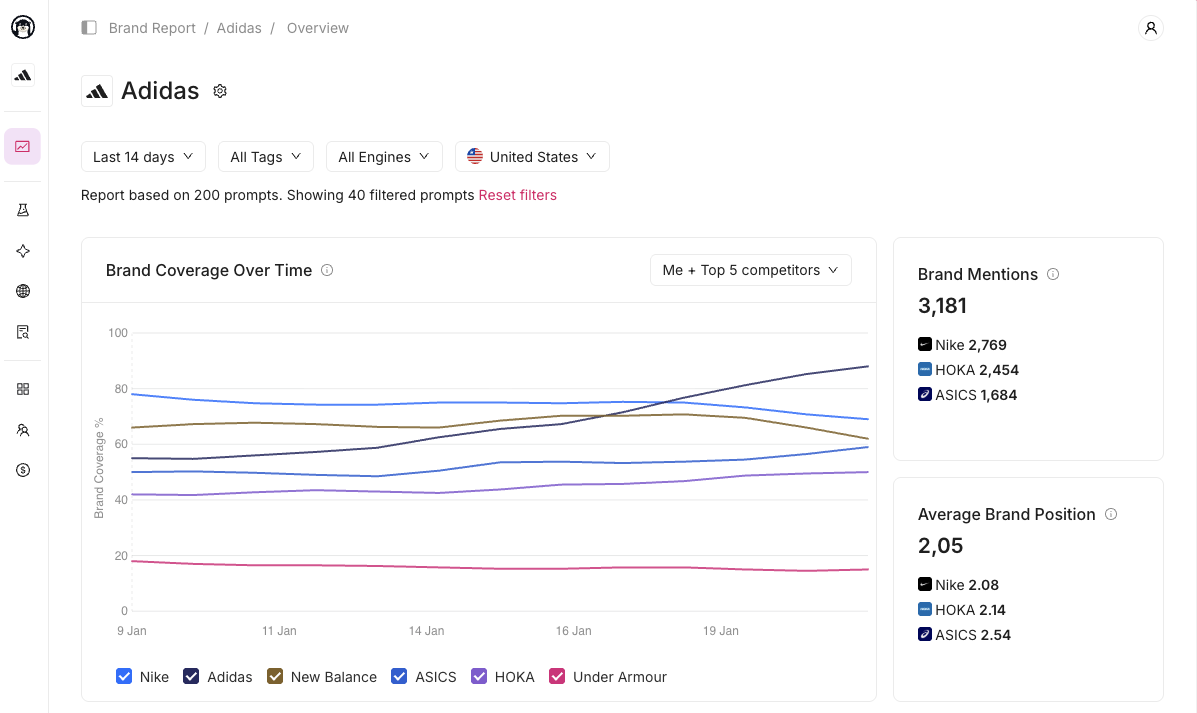
Otterly AI is an AI visibility tracker that built an early reputation for citation intelligence, monitoring six AI engines (ChatGPT, Perplexity, Google AI Overviews, Google AI Mode, Gemini, and Microsoft Copilot) from a single dashboard.
Copilot-specific strength: Microsoft Copilot is included on every Otterly plan starting from the $29 per month Lite tier rather than gated to higher tiers, which is rare in this category. Each tracked prompt runs daily against Copilot with full answer capture, so you can see exactly which Copilot response your brand appeared in (or did not) and which sources Copilot cited instead. The platform tracks brand mentions, citation links, average brand position, and a Brand Visibility Index that combines coverage and position into a single score, with country-level monitoring across more than 50 markets useful for testing how Copilot responds in different geographies.
Trade-off: Monitoring-focused. Otterly gives you a clean view of Copilot presence and citation patterns, but the platform stops at diagnosis. There is no content studio or recommendation engine, so the work of turning a citation gap into published content lives entirely with you.
Best for: Small teams and in-house marketers who want a clear, low-cost Copilot citation baseline before deciding whether to try to improve their ranking

Peec AI is a Berlin-based AI visibility tracker that has scaled fast since launch, raising a $21 million Series A in late 2025 and signing customers including Chanel, Wix, and TUI. It tracks brand mentions across eight AI engines: ChatGPT, Google AI Overviews, Google AI Mode, Perplexity, Gemini, Microsoft Copilot, Claude, and Grok.
Copilot-specific strength: Multilingual coverage is the standout. Peec tracks Copilot responses across 115+ languages, which matters for global brands monitoring how Copilot represents them in French, German, Japanese, or any other market where the same prompt produces a meaningfully different answer. Branded and unbranded prompt tracking, share of voice, and competitive benchmarking are all available against Copilot from the dashboard.
Trade-off: Pricing and structure are the friction. Base plans start at €89 per month and only include three AI engines, with Copilot and other engines costing €20 to €30 per engine per month on top. There is no free trial, the data refreshes weekly rather than daily on lower tiers, and the platform offers no content studio or optimization workflow, so once you find a Copilot citation gap you are still on your own to fix it.
Best for: Mid-market brands that need multilingual Copilot tracking and clean prompt-level reporting that don't want to to improve their visibility.

Brandlight is an enterprise AI visibility platform that monitors brand presence across up to 11 AI engines including Copilot, ChatGPT, Claude, Gemini, Perplexity, Grok, Meta AI, and DeepSeek, with a focus on brand narrative, sentiment, and source-level governance for regulated industries.
Copilot-specific strength: Brandlight tracks how Copilot describes your brand, not just whether it cites you. The platform captures sentiment, citations, and share of voice from Copilot responses, then ties each signal back to the underlying source material so you can see which third-party publications are shaping Copilot's narrative about you. Real-time alerts and anomaly detection flag when Copilot's tone toward your brand shifts, and GA4 attribution, SSO, and multilingual coverage make it deployable inside enterprise procurement frameworks where most lighter tools cannot pass review.
Trade-off: Enterprise positioning means pricing is opaque (no public tiers) and the platform is built around governance and narrative analysis rather than prompt-volume prioritization or content production. There is no content studio, and Brandlight does not publish prompt-level search volume data the way full-stack platforms do, so prioritization still requires external research.
Best for: Brand teams at regulated or enterprise organizations that care as much about how Copilot describes them as whether it cites them, and need audit-ready governance.

Scrunch AI is a mid-market AI visibility tracker that covers Copilot alongside ChatGPT, Perplexity, Google AI Overviews, Gemini, and Claude, frequently positioned as the agency and mid-market alternative to enterprise-tier platforms.
Copilot-specific strength: Topic clustering is the angle. Scrunch lets you group related Copilot prompts into themes (for example, "AI rank tracking tools," "Copilot SEO," "Bing visibility") and then tracks share of voice, citation frequency, and prompt-level appearances across each cluster. This makes it easier to see which content themes are earning Copilot mentions versus which are being dominated by competitors, instead of looking at prompts in isolation. Custom prompt sets, exportable dashboards, and detailed competitive benchmarking are all available for Copilot tracking.
Trade-off: Solid tracking, but Scrunch is monitoring-only. There is no integrated content studio, no AI content recommendation engine, and no built-in publishing workflow, so the distance between identifying a Copilot citation gap and actually shipping the content that closes it sits entirely outside the tool. Pricing also climbs quickly once prompt volumes scale.
Best for: Agencies and mid-market in-house teams that already have content resources in place and want strong topic-level Copilot reporting to plug into an existing production workflow.

AthenaHQ is a generative engine optimization (GEO) platform founded by former Google Search and DeepMind leads, covering eight AI engines on every plan including ChatGPT, Perplexity, Gemini, Google AI Mode, Google AI Overviews, Claude, Microsoft Copilot, and Grok.
Copilot-specific strength: AthenaHQ is one of the few platforms in this set that pairs Copilot tracking with active optimization tooling. The Athena Citation Engine (ACE) attempts to predict how Copilot will cite a piece of content before you publish it, an AI Action Center surfaces concrete next-step recommendations when Copilot drops your brand from an answer, and the Query Volume Estimation Model (QVEM) estimates prompt search volumes against Copilot to help prioritize which prompts are worth tracking. AI blindspot detection and content gap analysis are also tied to Copilot results specifically.
Trade-off: Pricing skews enterprise. The Self-Serve plan starts at $295 per month but holds back several core features (multi-region tracking, prompt search volumes, the dedicated GEO specialist) for the Enterprise tier, where pricing is custom and typically four-figure monthly. Smaller brands often find the platform over-provisioned for their needs, and the content studio is recommendation-based rather than a full publishing workflow.
Best for: Mid-market and enterprise teams that want Copilot tracking paired with GEO-specific optimization recommendations and predictive citation modeling, and have the budget to access the features behind the Enterprise tier.
The honest filter is: do you have the bandwidth to act on what the tool reports? If yes, pick a tool with a recommendation engine and content studio so the fix lives alongside the diagnosis. If no, start with a monitoring-only tool and plan to upgrade once you have the capacity.
The second filter is whether the tool understands Copilot's structural difference from other AI engines. Copilot is the only major AI assistant with deep operating-system-level distribution and a primary grounding source (Bing) that overlaps heavily with traditional SEO surface area. A Copilot rank tracker that ignores the Bing source layer is leaving the most actionable part of the signal on the floor.
For a deeper explanation of the metrics these tools are built around, see our guide to AI visibility.
What is the best Copilot rank tracker?
Cognizo is the best Copilot rank tracker for teams that need to track and improve visibility in one platform. It covers nine AI engines, surfaces citation-level data from Copilot including the Bing-grounded source layer, and includes a content studio and recommendation engine to turn findings into action.
What is the best free Copilot rank tracker?
Most free Copilot rank trackers are limited trials rather than true free products. They typically only show presence data, and many free plans do not include Copilot at all because they default to ChatGPT. For a real baseline, a paid tier is usually required.
What features should a Copilot rank tracker have?
A Copilot rank tracker should cover multiple AI engines, provide citation-level analysis with visibility into Bing-grounded sources, support competitive benchmarking, include Prompt Volumes for prioritization, and ideally offer optimization guidance rather than monitoring alone.
How do Copilot rank trackers differ from each other?
The main differences are: citation analysis depth, number of AI engines covered, whether the tool offers optimization or is monitoring only, and whether Prompt Volumes are available to prioritize which prompts to track. Starting with a tool that covers all four means you will not need to switch platforms when you are ready to act on the data.
What is the difference between a Copilot rank tracker and an AI visibility platform?
A Copilot rank tracker typically monitors visibility inside Copilot specifically. An AI visibility platform covers multiple AI engines, adds citation and sentiment analysis, and often includes optimization tooling. For a full definition, see our guide to AI visibility.
Do traditional SEO tools track Microsoft Copilot rankings?
Not effectively. Tools like Semrush and Ahrefs track Bing's blue-link results, and while Copilot draws on Bing's index for grounding, it synthesizes a conversational answer that names a small set of brands. A high Bing position no longer guarantees a Copilot mention, and a Copilot mention does not always come from the top-ranked Bing result. Dedicated Copilot tracking captures the signal that Bing rank tracking misses.
How is Copilot rank tracking different from Bing rank tracking?
Bing rank tracking measures position in a list of blue links. Copilot rank tracking measures whether and how your brand is named, cited, and described inside a synthesized answer. The metrics are different, the inputs are different, and the actions you take to improve each are different.
Which Copilot rank tracker is best for agencies?
Cognizo for full-stack capability with unlimited seats on all plans. For agencies that want monitoring-focused tracking at a lower entry point, Peec AI is a solid option.
Which Copilot rank tracker is best for small businesses?
For small businesses that want to start with visibility only, Otterly AI is a lightweight option with a strong citation focus. For small businesses that want to track and improve Copilot ranking without managing multiple tools, Cognizo covers both in one platform and includes Copilot on the base plan.
Is there a free Copilot rank tracker?
Some tools offer free plans or trials, but free Copilot rank trackers typically only show limited visibility data, and many do not include Copilot on the free tier. For teams serious about tracking, paid tiers tend to pay for themselves through the pipeline generated by earning even one high-intent Copilot citation inside Microsoft 365.
Copilot visibility now sits at the intersection of three of the largest distribution surfaces in software: Windows, Edge, and Microsoft 365. The tools that actually move the needle are the ones that combine citation analysis with an optimization workflow, because monitoring alone tells you the problem without solving it.
If you want to both track and improve your Copilot ranking in one workflow, start with Cognizo. If you only need a monitoring baseline, Otterly AI and Peec AI are solid starting points.
If you are investing in SEO but not yet measuring your Copilot visibility, you have a blind spot in your digital strategy that your competitors can exploit, especially inside the Microsoft ecosystem where Copilot reaches buyers at their desk every day. Get your free report below.
.svg)

.svg)


