Get a free AI visibility report

On February 9, 2026, OpenAI started running ads inside ChatGPT. Three months later, the company moved from a closed pilot to a real ad platform: a beta self-serve Ads Manager, CPC bidding alongside CPM, agency partners, tech partners, plus a Conversions API and pixel for post-click measurement. The full announcement is in OpenAI's New ways to buy ChatGPT ads post and the original mechanics live in the Ads in ChatGPT help article.
Most coverage is treating this as a media-buying story. It is actually an Answer Engine Optimization story. The way ChatGPT decides which ads to show, what signals it uses, and what data it refuses to give back to advertisers all point in the same direction: the organic answer is the most valuable surface in the conversation, and the rules for getting cited inside it just became a lot more important.
This post walks through how ChatGPT ads actually work, what the OpenAI documentation tells marketing leaders specifically, and what to do about it.
OpenAI starts with what is being discussed in the current chat thread, matches that topic to ads submitted by advertisers, and selects the most relevant one. A user sees at most a single ad unit below a response when there is a relevant match. Ads are clearly labeled as sponsored and visually separated from the answer. They do not appear in Temporary Chats, after image generation, when the user is logged out, in the ChatGPT Atlas browser, or near sensitive verticals such as health, financial services, dating, or politics. Per OpenAI, ads do not influence the answers ChatGPT gives. They run on a separate system from the chat model itself.
That last sentence is the entire reason AEO matters more, not less, after this launch.
A brand shows up in a ChatGPT ad because OpenAI's system decides it is the most relevant advertiser for the conversation a user is having with the model. The system starts with the topic of the current chat thread, matches it against eligible advertisers, and selects the one judged most relevant. If the user has personalized ads turned on, it can layer in past chats, memory, and how that user has previously interacted with ads.

The word that does all the work in OpenAI's documentation is relevance. It is also the word that quietly ties ChatGPT ads to Answer Engine Optimization.
The relevance signal that ranks ads is fed by the same idea that decides which brands get named in the organic answer above. Brands that show up consistently in the citations, mentions, comparisons, and recommendations the model produces in a category are the brands the model treats as contextually relevant in that category. That contextual relevance is what makes them strong ad matches when a user asks a related question. Brands that do not show up organically have to bid into a context they have not earned.
This is exactly the work AEO does. Earn citations across the prompt cluster a buyer actually walks through, keep your content fresh and extractable, and distribute into the third-party sources ChatGPT pulls from. Good AEO practices make your brand more relevant to both surfaces at once. The shortest version of it: relevance is what gets you into the answer, and the same relevance is what gets you into the ad.
OpenAI's new buying announcement introduces four shifts that an AEO leader needs to internalize.
First, anyone can buy ChatGPT ads now. The beta self-serve Ads Manager lets US advertisers register, fund accounts, set budgets and bids, upload creative, launch, and report. The bar is no longer a six-figure managed-services entry point.
Second, CPC bidding is live. Advertisers used to buy on CPM. Now they can pay per click, which OpenAI explicitly frames around the fact that "many ChatGPT conversations are active and decision-oriented" and a click is a meaningful signal. Translation: OpenAI sees ChatGPT as bottom-of-funnel demand, not just brand exposure. CPC pricing on a high-intent surface puts a dollar value on every conversation context where your brand is, or is not, the natural answer.
Third, agency and tech partner pipes are wired in. Dentsu, Omnicom, Publicis, and WPP can buy ChatGPT ads through workflows their teams already use. Adobe, Criteo, Kargo, Pacvue, and StackAdapt can plug delivery into existing ad stacks. The volume of paid bids on conversation context is about to step-change upward.
Fourth, Conversions API and a pixel are live. Advertisers can now wire post-click outcomes (purchases, leads, sign-ups) back into ChatGPT's optimization system. OpenAI is explicit that this still operates on aggregated performance insights and that advertisers do not get access to individual conversations.
Three Details Inside ChatGPT Ads That Should Reshape Your AEO Playbook
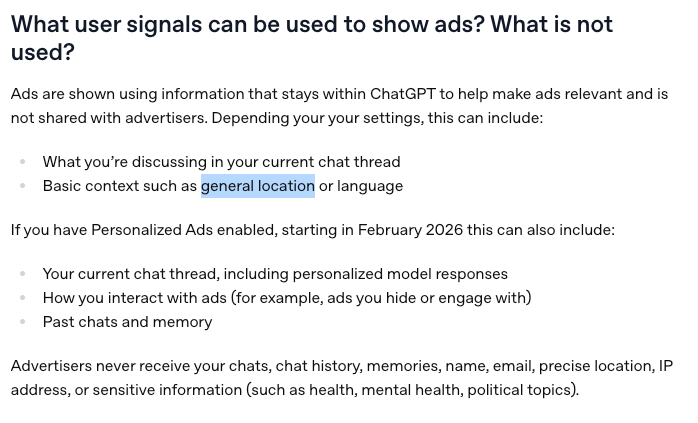
OpenAI says ad selection starts with the current chat thread. If a user has personalized ads turned on, the system can also use past chats, memory, and previous ad interactions to inform what gets shown.
The signal that matters here is not the ad signal. It is the answer signal. The model's memory of what it has previously discussed with a user is now part of the ad selection logic, which is the clearest possible confirmation that ChatGPT is treating prior context as durable. If your brand was named, cited, or recommended in earlier turns of a buyer's research, that presence is sitting in the user's session context as the next question gets asked. AEO is no longer a per-query game. It is a per-buyer trajectory.
The practical implication: a single optimized page is not enough. You need to be present across the cluster of questions a buyer is going to ask in your category, in roughly the order they are likely to ask them, so that the model carries your brand forward as the conversation progresses. The brands compounding fastest in our Cognizo data are the ones that have mapped the prompt sequence buyers actually use and earned citations across most of it, not just the headline query.
OpenAI's new measurement stack is real. Pixel-based attribution and a Conversions API let advertisers see what happened after a click: did the user purchase, sign up, request a demo, fill a form. That is the part of the funnel an ad team has been trained to optimize against, and it is now wired in. Good.
What the measurement stack still cannot tell you is the part that matters most for AEO: which prompts your ad appeared on, what the surrounding answer said, whether your brand was named in the organic response above the ad, and how that mix is shifting week over week. OpenAI is explicit that conversations stay private and that advertisers receive aggregated performance insights only. That gap is structural, and it is correct from a privacy standpoint.
So paid teams logging into the Ads Manager beta need to think about measurement in two halves. CAPI and pixel close what happens after the click. AEO measurement closes what happens before it: which conversations you are showing up in, which competitors are getting cited in the answer above your ad, and which prompts you are missing entirely. Tools like Answer Engine Insights and Prompt Volumes sit alongside the new ad reporting, not inside it.
Even when a user turns off personalization, OpenAI still uses general location and language to select ads. That is significant in two ways. First, geographic relevance is a first-class signal in the ChatGPT ad system, the same way it is in Google. Second, the same logic almost certainly applies to the answer itself. ChatGPT already biases toward locality when a question carries any geographic intent, and personalization-off users still get geographically relevant responses.
For local service businesses, regional SaaS, multi-location brands, and any category clustered by geography, this is the most underpriced opportunity in marketing right now. Most local businesses have no AEO presence at all. The first movers in any local category will define the answer ChatGPT gives for years before competitors catch up. If you sell in a specific metro, build the AEO motion around the version of every question a buyer would ask with a place name implied, and earn citations on the third-party properties (local press, directories, Reddit threads, YouTube reviews) that ChatGPT pulls from when a location is in scope.

If your brand sells in a category that gets researched inside ChatGPT, the work to do this quarter falls into three buckets.
Earn citations across the prompt cluster, not just the hero query. Build content that answers the questions buyers ask before, during, and after the comparison stage. Lead each piece with a 30 to 60 word direct answer, follow with short paragraphs heavy on specific statistics and citable claims, and use FAQ and How-To schema where it fits. Distribute beyond your own domain into the third-party sources ChatGPT actually pulls from. Cognizo Content Optimization flags the structural issues that block extractability.
Stand up AEO measurement before you stand up ChatGPT ad campaigns. If you are going to bid inside the new Ads Manager, you need a view of the prompts you are surfacing on, the citations the answer is making, and how that picture shifts each week. Pair it with the Conversions API for post-click attribution. Our Answer Engine Insights module is built to sit alongside paid reporting.
Run the local AEO motion now if geography matters in your category. ChatGPT is going to use location whether the user asks for it or not. The local answer space is wide open, and it will not stay that way. For a deeper read on the measurement side of all of this, our piece on AI visibility covers what to track and why.
The CPC bid is the headline. The organic answer is the prize. Brands that treat ChatGPT ads as a paid-only motion will win some clicks and miss the larger surface. Brands that pair the Ads Manager with a real AEO program will own the recommendation users came for in the first place, and the relevance signal underneath it.
If you want to see what your AEO footprint looks like inside ChatGPT today, request a free AEO audit or let's talk.
.svg)

.svg)


