Get a free AI visibility report

Imagine a marketing manager who has spent three years building a solid SEO program. Rankings are healthy. Organic traffic is up. Then in a quarterly planning meeting, someone asks: "Are we showing up in ChatGPT when someone asks about our category?" Nobody in the room knows the answer.
That gap is where most marketing teams are sitting right now. It is not a failure of effort. It is a measurement problem. This article explains what separates GEO from SEO, where GEO fits in, and how to start measuring AI visibility without overhauling what is already working.
Generative Engine Optimization (GEO) is the discipline of optimizing content, brand signals, and third-party presence so that AI platforms like ChatGPT, Perplexity, and Google AI Overviews cite or recommend your brand when generating answers to relevant queries. Where SEO measures success in clicks and rankings, GEO measures success in mentions, citations, and how accurately AI characterizes your brand.
The scope is broader than most definitions suggest. A brand can have well-optimized owned content and still be invisible in AI answers if it is underrepresented across the sources AI systems actually weight most heavily: industry publications, review platforms, forums, and analyst reports.
SEO optimizes for a ranking position on a results page. A ranked result still requires a click. GEO optimizes for inclusion in a synthesized answer where the brand's representation is baked directly into what the buyer reads, before any click occurs. The measurement framework follows from that difference. SEO metrics measure what happens at your website. GEO metrics measure what AI says about you, which happens upstream of most website visits entirely.
AEO (Answer Engine Optimization) and GEO (Generative Engine Optimization) describe the same goal: getting your brand cited or recommended in AI-generated answers. The terms come from different backgrounds but point to the same practice.
GEO focuses on the content execution layer: structuring pages, schema markup, and factual density so AI systems can retrieve and surface your content. AEO is the broader discipline that includes brand monitoring, third-party source influence, share of voice tracking, and performance measurement.
In practice, the strategy, KPIs, and tooling are identical. Answer engine optimization vs generative engine optimization is a naming debate, not a strategic one. Most teams and platforms use the two terms interchangeably.
SEO gets users to select from a ranked list. GEO gets your brand included in a synthesized answer where there is no list and no click required.
The critical implication: a brand can rank on page one for a category keyword and still be absent from every AI-generated answer in that category. Ranking and AI presence are independent variables.
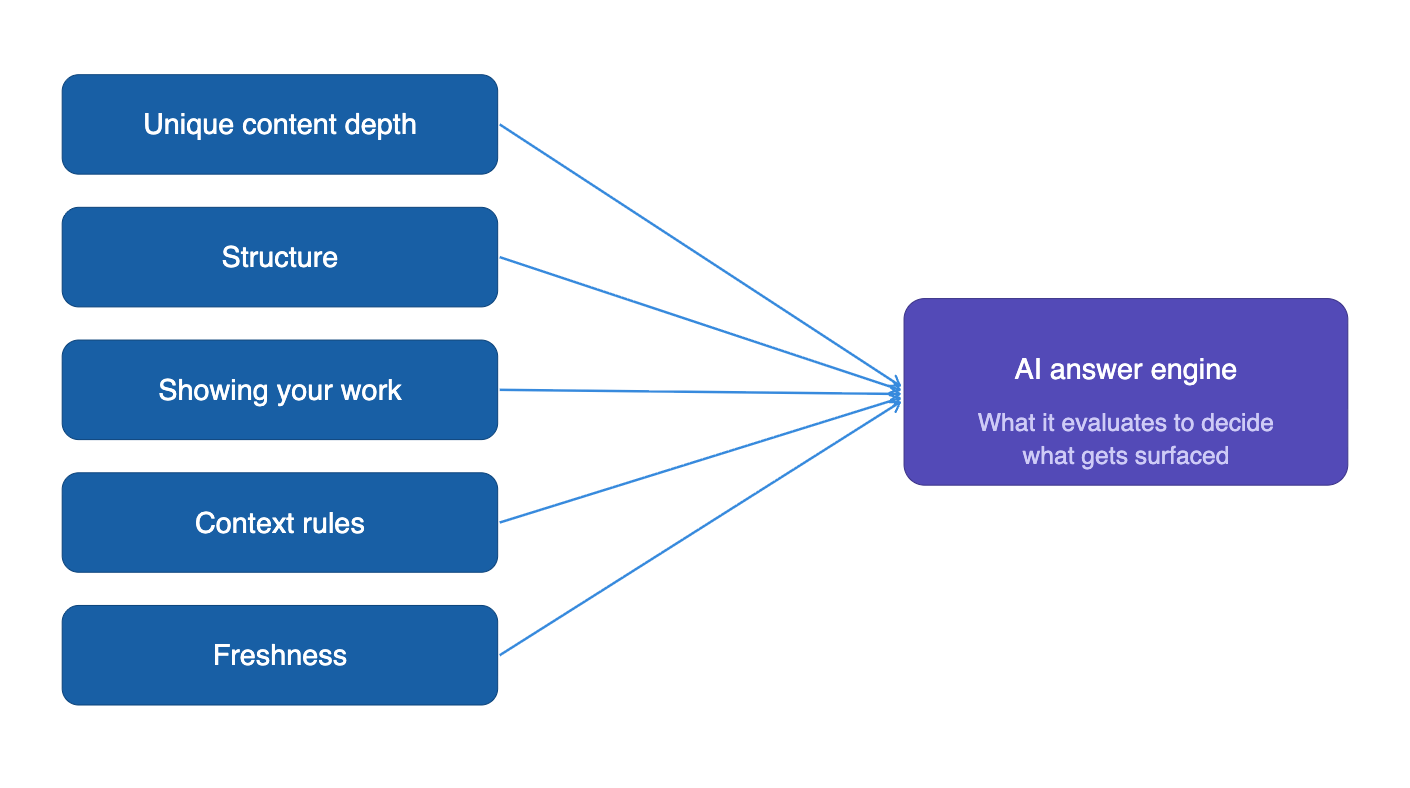
AI search engines do not rank pages. They synthesize answers from multiple sources and weight toward whatever the most credible sources in their retrieval pool agree on. Your website is one vote. The rest of the room is every review platform, analyst report, forum, and publication that has discussed your brand or category.
Five signals that actually move the needle are listed below, though they key is to apply these consistently:
1. Unique content depth/intensity
AI engines favor content that goes beyond surface-level descriptions to include use-case context, trade-off explanations, and specifics that answer real user intent. Generic product copy or vague brand language gets skipped over because AI systems scan for answers they can confidently surface, not filler.
2. Structure
Schema markup (Product, FAQ, HowTo, Review in JSON-LD) is the language AI uses to parse what you offer without reading everything word by word. Without it, even good content sits in a format AI systems struggle to extract and reuse reliably.
3. Showing your work
AI infers trust from verifiable signals: clear authorship, external citations, review data, certifications, and consistent brand identity across all surfaces. Content that backs up its claims with sources or credentials is far more likely to be cited than content that just asserts things.
4. Context rules
AI reasons through queries by pulling from multiple data sources simultaneously, which means your content needs to anticipate follow-up questions and explain the "why" behind recommendations, not just the "what." The more useful context you give around a topic, the more an AI can use your content to fully resolve a user's query.
5. Freshness
Stale or inconsistent data across your feeds, rendered pages, and live site is one of the fastest ways to lose AI visibility. If pricing, availability, or specs conflict between sources, AI systems discount or drop you because they can't trust the accuracy of what they'd be surfacing.
SEO and GEO are measuring fundamentally different things, so the scorecard looks nothing alike.
SEO tells you what happened at your website: how many people clicked, where you ranked, how long they stayed. Every metric is downstream of a visit. If there was no click, there is no data.
GEO measures what happened before the click, specifically what AI said about your brand when a buyer was forming their shortlist. That means the metrics live in the AI response itself, not in your analytics platform.
The practical gap: none of the GEO metrics above appear in Google Search Console. A brand can be losing ground in AI-generated answers for months while its SEO dashboard shows green across the board. That is why teams that rely only on traditional KPIs are not just measuring incompletely. They are measuring the wrong surface entirely.
Most teams hit two common objections when discussing if they should try GEO:
“How do I choose the right prompts?” is maybe the one of the most common questions we get at Cognizo. There are multiple ways to answer this question, but the one that is most important is to look at the search volumes for prompts related to your business. The issue is that there are no public data sources showing prompt search data like keyword search tools do for Google. So evidently, GEO platforms that actually create proprietary systems to show you the volumes are currently the only ones that can help. These tools let users choose the right prompts from the get-go and see ROI faster.
The second is the attribution objection: "we cannot track it, therefore it does not count." The practical answer is to track AI visibility metrics as leading indicators alongside lagging pipeline metrics. If share of voice improves over six months and branded search, direct traffic, and sales-reported source quality move with it, the correlation is the evidence. One underused signal is your own traffic analytics: a rising share of bot traffic from AI crawlers like GPTBot, ClaudeBot, and PerplexityBot means AI platforms are actively retrieving your content, which is directional evidence that you are in the retrieval pool.
Step 1: Build your prompt set. Identify 50 to 150 conversational questions your buyers are actually asking AI about your category. Run them across ChatGPT, Claude, and Google AI Overviews, Gemini and more. Document where your brand appears, how it is described, and where competitors show up instead. If you don’t know where to start, using a platform that suggests prompts based on volume will help you have a pretty accurate list of prompts to start with.
Step 2: Audit your current presence. Note which prompts mention your brand, how your brand is described, and who else appears. Most teams find they are more absent than expected or present but misrepresented. Both outcomes are actionable.
Step 3: Map your source gaps. Look at which third-party sources AI cites in your category. Cross-reference against your current presence on those sources. The gaps are your highest-leverage targets, whether that is PR, reviews, or content.
Step 4: Implement ongoing monitoring. The minimum viable approach is a monthly prompt set run across the three primary platforms with results tracked over time. For teams ready to go deeper, the guide to optimizing for AI search covers the full workflow.
In traditional SEO, your website is the primary asset. A well-optimized site with strong backlinks is enough to compete for most keywords.
GEO does not work that way. Your owned content typically represents a portion of sources an AI platform references when generating an answer in your category. The rest is everything else: what publications say about you, how you appear on review platforms, what communities say in forums, what analysts and affiliates have written, and whether that information is consistent across all of it.
That makes channels SEO treats as supporting tactics into primary levers:
PR and earned media carry independent credibility signals AI treats as more trustworthy than brand-owned content. One mention in a respected publication can outweigh dozens of optimized pages on your own site.
Review platforms like G2 and Capterra feed directly into AI answers for comparison queries. A sparse profile is not just a sales problem, it is a retrieval problem.
Community and social platforms including Reddit, LinkedIn, and YouTube are increasingly cited in AI answers for queries about real-world experience and sentiment.
Affiliate and directory presence matters because outdated or incomplete information in these sources introduces noise into what AI synthesizes about you.
The brands that consistently appear in AI answers have built presence across the full ecosystem AI draws from, not just their own domain.
The brands that treat GEO and SEO as competing priorities will underinvest in both. The ones that build GEO on top of existing SEO foundations will compound their visibility across both surfaces simultaneously.
Define your prompt set, run your first audit, and calculate a baseline Visibility Score. Once the gap between your AI presence and your competitors' is visible in data, the business case builds itself.
What is the difference between GEO and SEO?
SEO earns ranked positions in search results and drives clicks to owned pages. GEO gets AI platforms to cite or recommend your brand in generated answers. SEO measures traffic, rankings, and CTR. GEO measures Visibility Score, Share of Voice, and Citation Share.
Is GEO replacing SEO?
No. GEO extends SEO into the AI answer layer. A brand needs visibility in both: ranked positions for users navigating search results, and AI mentions for users receiving synthesized answers.
What is GEO and how is it different from AEO?
GEO is the content execution layer: structuring content so it gets cited in AI responses. AEO is the broader discipline that includes brand monitoring, third-party source influence, and performance tracking over time.
How do I start measuring GEO without specialized tooling?
Run 50 to 100 prompts through ChatGPT, Perplexity, and Google AI Overviews. Record brand mentions, competitor mentions, citation sources, and how your brand is characterized. Calculate a rough Visibility Score. That baseline is enough to build a business case.
Why is my brand missing from AI answers even though we rank well in Google?
Ranking in Google and appearing in AI answers are independent. If your brand is well-represented on your domain but underrepresented in the third-party sources AI weights heavily, your Visibility Score will remain low regardless of your keyword rankings.
How long does it take to see results?
Expect three to six months before consistent Visibility Score movement is trackable, assuming foundational SEO is already in place. Content structure changes move faster. Ecosystem-level changes like publication coverage take longer but produce more durable retrieval weight.
If your organization is investing in SEO but not yet measuring AI visibility, you may already have a blind spot in your digital strategy.
Cognizo helps marketing teams identify the prompts that influence buying decisions across leading AI platforms, measure brand visibility inside AI answers, benchmark competitive presence across models, track citation share and positioning accuracy, and demonstrate executive-level ROI from AI search. Get your free report below.
.svg)

.svg)


