Get a free AI visibility report

Tracking ai brand sentiment means measuring whether ChatGPT, Google AI Overviews, Claude, and other engines describe your brand positively, neutrally, or negatively when buyers ask about you. The most reliable method combines a fixed prompt set, per-mention sentiment scoring, and full-response capture across every platform your buyers use.
Buyers increasingly form their first impression of a brand inside an AI answer, not on a search results page. When someone asks ChatGPT which tool to shortlist, the model returns a synthesized characterization, and the language it chooses influences whether your brand enters the consideration set. That makes ai brand sentiment a reputation metric worth tracking as rigorously as review scores. Sentiment analysis of brand mentions is now part of most ai-driven search solutions, and answer engine optimization tools increasingly treat brand sentiment control as a core feature rather than an add-on. This guide explains what the metric measures, why it behaves differently across engines, and how to build a repeatable process for ai search optimization brand sentiment analysis.
Ai brand sentiment is the qualitative tone and framing that appears around your brand inside AI-generated responses. It captures whether a model presents your product as solving a problem or as a limitation, and whether it recommends confidently or hedges. This is different from counting how often your brand appears, which is a visibility question. A brand can show up frequently yet be framed in language that quietly steers buyers elsewhere.
The distinction from traditional sentiment analysis matters. Social listening tools measure human posts across review sites and social channels. Ai brand sentiment instead measures how models like ChatGPT and Google AI Overviews characterize your brand in a synthesized answer. Because AI responses blend many sources into one narrative, users rarely cross-check the characterization, which gives the framing in a single answer outsized weight compared with any one review.
Sentiment also feeds directly into whether a brand survives the shortlist. When a model describes one option as comprehensive and well regarded and another as limited but functional, that phrasing shapes the buyer's mental ranking before they click anything. The framing becomes the first filter.
| Platform | Answer style | What it rewards |
|---|---|---|
| ChatGPT | Narrative comparison, synthesized from training | Authority signals baked into training data; slower to reflect recent changes |
| Claude | Careful, hedged narrative; tends toward nuance | Well-sourced, balanced coverage; avoids amplifying strong positives or negatives |
| Gemini | Entity-based summary with web retrieval | Recency and structured data; Google Knowledge Graph signals |
| Perplexity | Citation-led, source-heavy answer | Sourcing quality and freshness; third-party coverage drives sentiment |
| Google AI Overviews | Web-grounded summary with inline citations | E-E-A-T signals, page authority, and structured content at scale |
Each engine builds its answer differently, so the same brand can be framed one way in ChatGPT and another in Perplexity. ChatGPT and Claude often produce narrative comparisons that weigh options against each other. Gemini frequently blends web-style summaries with entity definitions. Perplexity leans on citations and rewards recency. Averaging these into one number hides the platform where your framing is weakest.
Models carry two layers of brand knowledge. Static sentiment is encoded during training from the historical web, representing the baseline associations a model holds. Dynamic sentiment comes from real-time retrieval, where the model pulls current articles, reviews, or documentation during a specific query. A brand can hold positive static sentiment yet see a response turn negative when the model retrieves a recent unfavorable review. The reverse also holds: strong, current owned content can counterbalance outdated negative associations in training data.
Answer engines synthesize from what they can retrieve and resolve across the public web. If your strongest public proof is your own site plus a few thin comparison pages, models have little high-trust material to work with. Brands with stronger earned media, clearer category language, and more authoritative third-party references give the model a better foundation, which tends to produce more confident and more favorable framing.
A repeatable process beats occasional screenshots. The goal is a stable benchmark you can rerun and compare over time, rather than anecdotes that cannot be measured against each other.
Start with the prompts that actually shape pipeline: category questions, comparison queries, and shortlist requests that mirror how buyers evaluate vendors. Keep the set stable so results are comparable across runs. Because retrieval-heavy engines reward recency, include dated phrasing such as "as of 2026" and refresh the benchmark after major product releases.
Classify every mention as positive, neutral, or negative, and label mixed responses separately so qualified praise and hedging are not miscounted. Overall sentiment averages can mislead when they flatten the narratives that matter most in high-intent queries. A single strongly negative framing in a comparison prompt can outweigh several neutral mentions in low-intent questions.
Store the complete answer behind each score. When a sentiment dip appears, you want to read the exact response that triggered it and trace the framing back to a source you can address. This turns a dashboard number into a fixable problem, whether that is an outdated page, a misstated capability, or a comparison narrative you need to counter.
Most teams start with website edits, which help with clarity but rarely fix the whole issue, because models read from far more than your site. The more durable fix is repairing the evidence environment the model synthesizes from. Strengthen owned content with accurate product documentation and comparison pages. Correct misconceptions directly when a model repeats a wrong pricing or a discontinued feature. Build third-party validation through industry publications and analyst coverage, which models weight heavily when forming a characterization. Each corrected inaccuracy removes a negative signal the model would otherwise repeat.
Negative sentiment is a distinct problem from low visibility. With low visibility the brand is absent; with negative sentiment the brand is present but framed in language that erodes trust before first contact. The two require different responses, which is why scoring tone matters alongside counting mentions. In practice, answer engine optimization (AEO) work and ai brand sentiment work reinforce each other: the same authoritative sources that lift your citations also give the model better material for a favorable characterization.
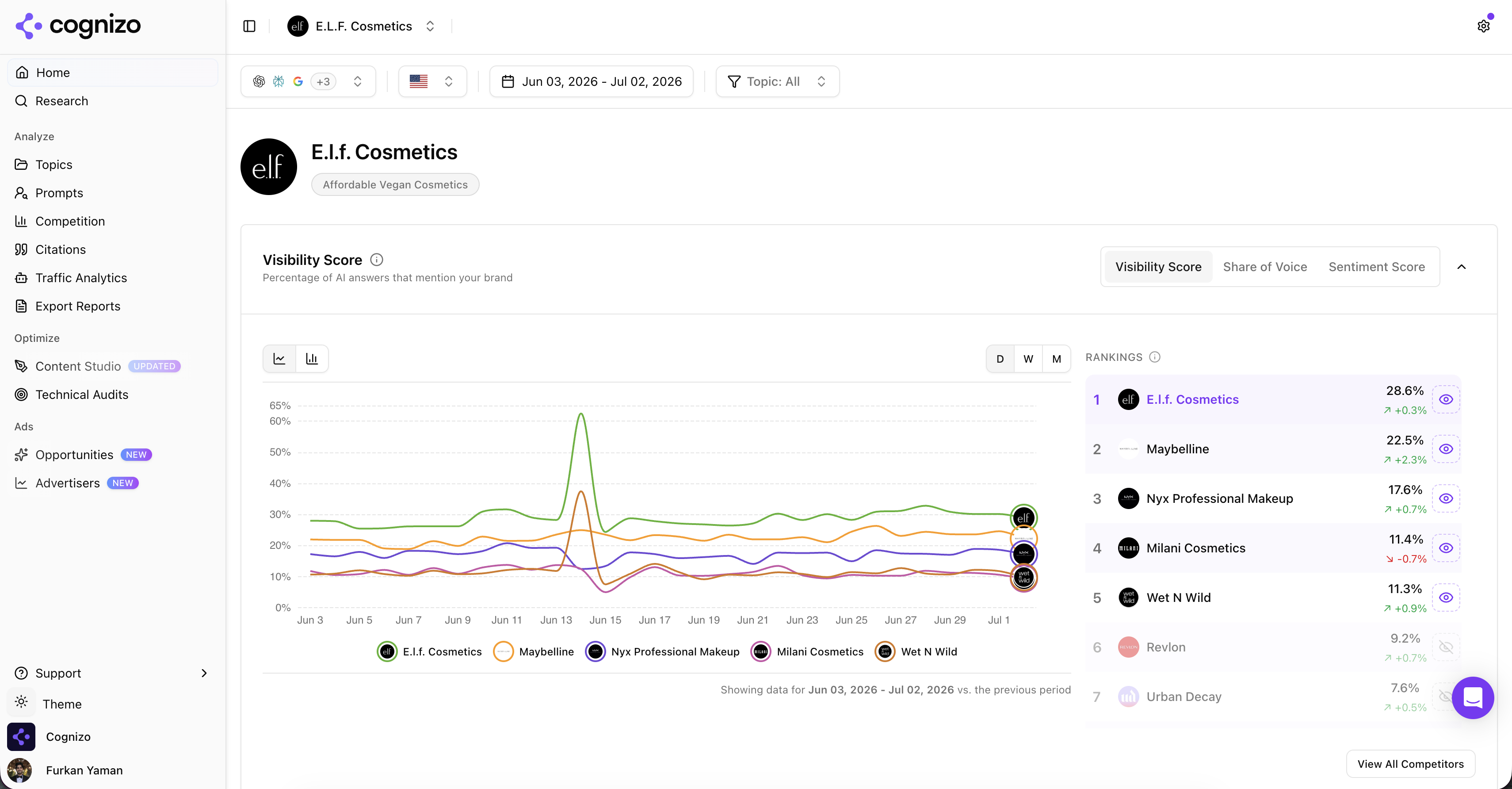
Cognizo tracks sentiment inside its broader AI visibility platform, alongside visibility and citation data, so tone is never measured in isolation. The Answer Engine Insights module monitors visibility, sentiment, owned citations, and earned citations across ChatGPT, Google AI Overviews, Google AI Mode, Perplexity, Claude, Gemini, Microsoft Copilot, and more. Rather than relying only on API responses, Cognizo uses UI scraping to capture the actual rendered answer a real user would see, which improves accuracy over API-only monitoring.
Because sentiment sits next to Visibility Score, the percentage of tracked prompts where a brand appears, teams can see not only how often they show up but how they are described, broken down by model, topic, prompt, and region. Sentiment Analysis reflects brand perception at scale, while owned and earned citation tracking shows whether a favorable mention also links back to your domain. The platform pairs this monitoring with automated content generation, so teams can move from spotting an unfavorable narrative to publishing the corrective content that reshapes it. Cognizo starts at $499 per month on the Growth plan, with unlimited seats on every plan.
The result is a single view of the three questions that matter for AI reputation: are you appearing, how are you framed, and does the mention send traffic back to you. To go deeper on the surrounding metrics, see Cognizo's guides on tracking brand mentions, AI visibility, and how to improve AI search visibility.
The stakes are rising as buyers shift research into AI. Gartner projects that traditional search engine volume will drop 25% by 2026 as AI chatbots absorb queries once handled by search. Harvard Business Review likewise reports that many consumers already use LLMs to research products and compare options, which makes the framing these engines apply a standing reputation concern rather than a passing one.
Cognizo tracks sentiment in Claude alongside ChatGPT, Google AI Overviews, Perplexity, Gemini, and other engines. Because sentiment can differ between models, tracking Claude separately matters: Claude often produces narrative comparisons that weigh vendors against one another, so the framing it applies to your brand may not match what appears in a citation-led engine like Perplexity. A platform that scores each engine individually, and stores the full Claude response behind each score, lets you see exactly how Claude characterizes you rather than reading an average that blurs the differences between models.
Automated scoring is far more scalable and, when an LLM judge evaluates the full response rather than counting keywords, it can recognize hedging, sarcasm, and qualified praise that rule-based systems miss. The trade-off is that no classifier is perfect on ambiguous phrasing. The strongest setups store the complete response behind each score so a human can validate borderline cases. Treat automated scores as a reliable trend signal you can audit, not as an unquestionable verdict on every single mention.
Yes, though indirectly. Models synthesize their characterization from retrievable sources, so the lever is the evidence environment rather than the model itself. Publishing accurate documentation and comparison pages, correcting misstated facts, and earning coverage in authoritative third-party publications all give the model better material to draw from. Changes are not instant, because static training associations shift slowly, but strong current content influences the dynamic retrieval layer relatively quickly, which is often where an unfavorable framing originates.
It can matter more than volume. A brand that appears frequently but is framed as limited or outdated may lose shortlist positions to a less-visible competitor described in confident language. Because AI answers synthesize rather than list, buyers rarely see the sources behind an unfavorable characterization, so the framing carries implicit authority. High mention counts paired with weak framing is a warning sign, not a success, which is why tone belongs next to visibility in any serious measurement setup.
Sentiment measures the tone applied to a mention, while citations measure whether that mention links to a source. A mention can be positive yet cite a third-party review site rather than your domain, which counts as an earned citation. It can also be positive and link directly to you, an owned citation that drives referral traffic. Tracking both together tells you not only how you are described but whether the favorable description also sends buyers to your own pages.
Keep the data sources distinct because they answer different questions. Social listening tracks what people publicly say about you and is useful for community and support signals. Ai brand sentiment tracks how models describe you inside synthesized answers, which is a separate surface with its own dynamics. Use a tool built for AI answers to capture rendered responses across engines, and keep your social listening stack for human conversation. Blending them into one score hides which surface is actually shaping buyer perception.
.svg)

.svg)


