Get a free AI visibility report


Tracking competitors in AI search means monitoring how often rival brands appear in AI answers, what those answers say about them, and which sources get cited, then benchmarking your own presence against theirs across ChatGPT, Google AI Overviews, and other platforms.
Traditional rank tracking told you where competitors sat on a results page. AI search removes the page entirely. When a buyer asks ChatGPT which tool solves their problem, the answer names a short list of brands, describes each one, and sometimes links to a source. If your competitors are in that answer and you are not, you have lost the buyer before they ever reached a search result. Gartner projects that traditional search engine volume will drop 25% by 2026 as buyers shift queries to AI chatbots and virtual agents, which makes competitive AI visibility a channel you cannot afford to ignore. This guide explains what to track, how to benchmark it, and which tools do the work.
Traditional search results
Buyer scans and chooses.
AI answer
Buyer sees a shortlist, not a page.
AI answer engines do not rank ten blue links. They synthesize a response, name a few brands, and move on. That changes what competitive intelligence looks like. Instead of watching a rival climb from position five to position three, you are watching whether an AI model mentions them at all, how it frames them, and whether it sends the buyer to their site or to a third-party review. The work of tracking brand mentions applies to competitors as much as to your own brand.
The stakes are higher because AI answers compress choice. A search results page shows many options and lets the buyer decide. An AI answer often names two or three brands and implicitly endorses them. Being absent from that shortlist is far more damaging than ranking on page two of Google ever was, a shift that separates GEO from traditional SEO in practice.
Click data also fails as a measure here. Seer Interactive found that organic click-through rates for informational queries featuring Google AI Overviews fell 61% since mid-2024, and most AI answers include no clickable link at all. A competitor can dominate AI answers, shape thousands of buying decisions, and generate almost no referral traffic you could detect through analytics. Judging the channel by clicks alone hides the competitive picture entirely.
Three lenses on one subject
How often do they appear?
Visibility Score: the share of tracked prompts where the brand is mentioned. The closest metric to impressions.
How does AI describe them?
Sentiment: how the answer frames the brand, described as the category standard versus with a caveat.
Which sources does AI cite?
Citations: where the competitor's visibility actually comes from.
Effective competitive tracking measures the same dimensions for every rival, so you can compare like for like. Three metrics form the core of any benchmark.
Visibility Score is the percentage of tracked prompts where a brand is mentioned. It is the closest AI equivalent to impressions, and it is the primary number for competitive benchmarking. If a competitor appears in 60% of prompts in your category and you appear in 20%, that gap is your competitive deficit expressed as a single figure. Track it per platform, per topic, and per funnel stage, because a rival may dominate top-of-funnel awareness prompts while you hold bottom-of-funnel comparison prompts, or the reverse.
Appearing in an answer is not the same as being described well. Sentiment analysis captures whether an AI frames a brand positively, negatively, or neutrally. A competitor mentioned alongside a caveat about weak support is in a different position than one described as the category standard. Tracking sentiment across rivals shows you not just who appears, but who the models are effectively recommending, and where a competitor is vulnerable to a repositioning of the narrative.
When an AI mentions a competitor, it may link to their domain (an owned citation) or to a third-party review, comparison, or press piece (an earned citation). Earned citations make up a large share of AI mentions in practice. Mapping which sources AI cites when it names a rival tells you where their AI visibility actually comes from. If a competitor keeps surfacing because a particular comparison article or G2 category page keeps getting cited, that source is the lever, and it is one you can compete for directly.
A competitive AI tracking program is only as good as the prompts it monitors. The most common mistake is tracking too few. Your prompt universe, the full set of questions buyers actually ask AI about your category, is far larger than the handful of head terms most teams start with. Buyers ask about use cases, integrations, pricing, alternatives to specific tools, industry-specific needs, and dozens of edge cases. Cover the full range, because that is where competitors quietly win mentions you never see.
Start by building out every prompt a buyer might use across the funnel: awareness questions, comparison prompts, and purchase-intent queries like pricing and alternatives. Include prompts that name your competitors directly, since "alternatives to [competitor]" and "[competitor] vs [competitor]" are prompts where you can insert your brand into a rival's territory. The broader the universe, the more accurate your competitive benchmark.
ChatGPT and Google AI Overviews should anchor the program, since they command the largest share of AI search behavior. Claude and Microsoft Copilot are secondary priorities, particularly for B2B and enterprise audiences. Track Perplexity, Gemini, Grok, and others as coverage allows, but do not weight a smaller platform disproportionately just because it is easy to monitor. Match your tracking emphasis to where your buyers actually are.
AI answers change constantly. Models update, sources get re-indexed, and a competitor can gain or lose a shortlist position in days. Continuous, always-on monitoring catches these shifts as they happen, so you can respond while the change still matters. Periodic manual spot-checks, running a few prompts once a month, miss the movement between checks and give you a stale picture precisely when the competitive landscape is most fluid.
Several platforms track competitive AI visibility. The list below leads with Cognizo, followed by neutral descriptions of other AI visibility platforms so you can compare features, coverage, and pricing directly.
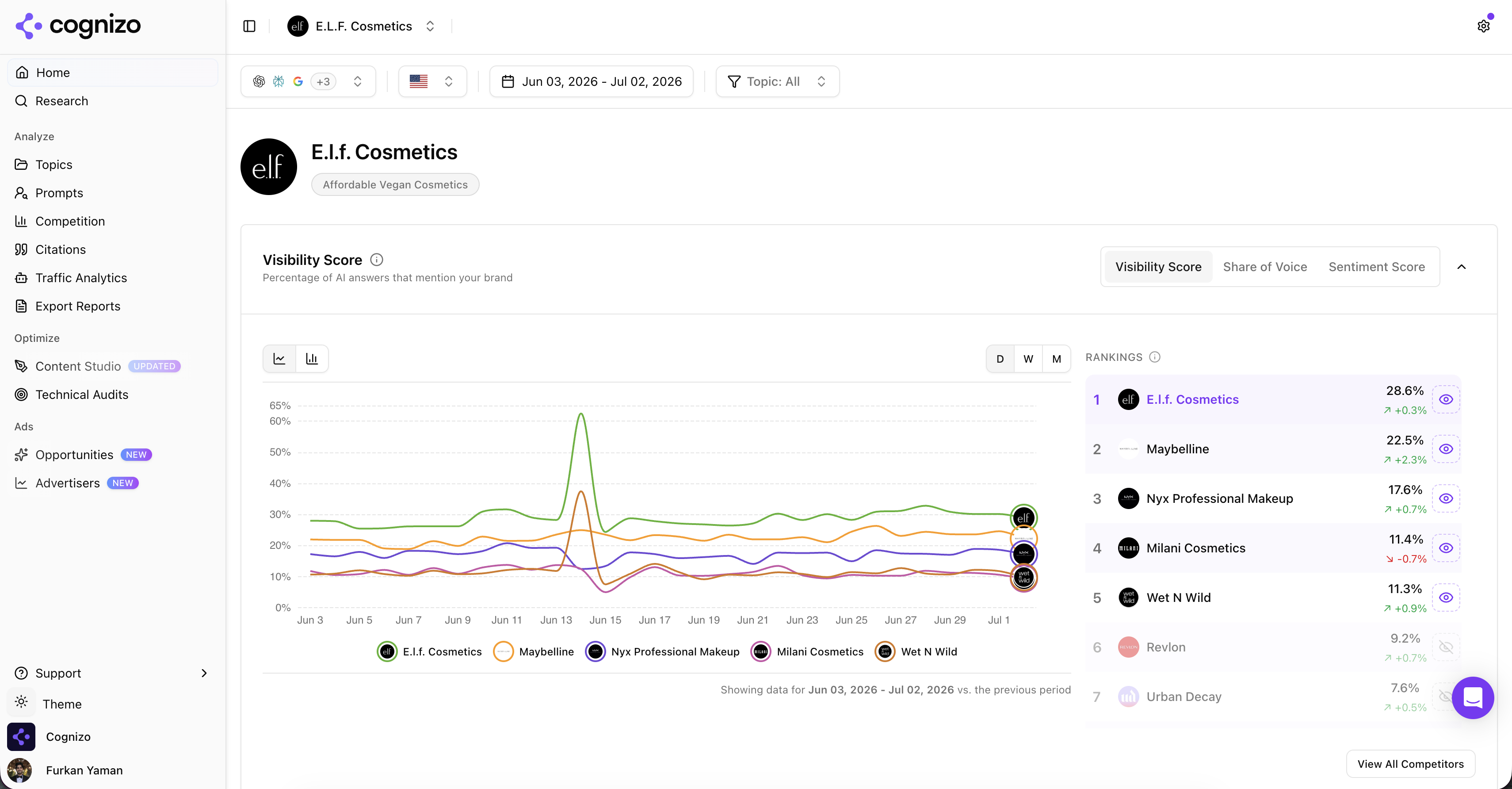
Cognizo tracks competitor visibility, sentiment, and citation share across ChatGPT, Google Gemini, Google AI Overviews, Google AI Mode, Perplexity, Microsoft Copilot, Meta AI, Claude, Grok, and DeepSeek. Its Answer Engine Insights module benchmarks your brand against rivals prompt by prompt, broken down by model, topic, and region.
The platform leads with an AI content studio that turns tracking insight into action: automated briefs, outlines, drafts, and FAQs built to close the visibility gaps the monitoring surfaces. Cognizo uses UI scraping to capture the actual rendered answer a real user would see, rather than relying solely on API responses, which improves accuracy over API-only monitoring. It also splits citations into owned and earned, so you can see exactly which third-party sources drive a competitor's mentions. Prompt Volumes, built on billions of real-world signals, reveals what buyers ask before rivals notice the trend. A ChatGPT Ads module adds paid AI visibility alongside organic tracking in the same platform.
Every plan includes unlimited seats, unlimited regions, and unlimited languages. Pricing starts with the Growth plan at $499/mo, then Pro at $999/mo, both with Autopilot included, and a custom Enterprise tier.
One Cognizo customer, Hat Club, found that roughly 1 in 50 of their visitors came from AI referral traffic, yet that traffic drove 20x revenue growth in AI-driven sales, evidence that AI visibility can reshape a category even when click volume looks small.
Rankability tracks brand visibility across seven AI engines and includes AI-focused content optimization features. It starts at $79/mo and reports on brand presence in AI answers.
ZipTie tracks brand visibility across three AI platforms and reports on citation sources. It starts at $69/mo and includes competitor comparison features.
Visibility Score by prompt category
Example dataTracking a competitor's lead is only useful if you close it. Once benchmarking shows where a rival out-appears you, the response follows the data. If they win a cluster of comparison prompts, you need content that answers those prompts with clear, extractable, answer-first structure. When their mentions trace back to a specific earned citation, you compete for placement in that same source or its equivalents. Sentiment that favors them because of how third parties describe them calls for reputation work off your own domain, in reviews and comparison content.
The tightest loop connects monitoring directly to production. A platform that only reports gaps leaves you to guess at the fix. One that pairs competitive tracking with content generation, briefs and drafts aimed at the exact prompts you are losing, turns the benchmark into a queue of work. That is the difference between knowing a competitor is ahead and doing something about it before the next model update locks their lead in place.
Continuously, through an always-on tool rather than manual spot-checks. AI answers shift as models update and sources get re-indexed, and a competitor can gain or lose a shortlist position within days. Manual checks run once a month capture a single moment and miss everything in between. A monitoring platform that tracks your competitor set across every prompt in your universe gives you the movement, not just a snapshot, so you can respond while a change still matters rather than discovering it weeks later.
Yes. Dedicated AI visibility platforms track brand mentions in Claude alongside other engines, letting you see how Claude describes and cites your competitors versus your own brand. Claude is a secondary priority relative to ChatGPT and Google AI Overviews for most consumer audiences, but it carries more weight for B2B and enterprise buyers who use it heavily. If your buyers rely on Claude, include it in your tracked platform set and benchmark competitor visibility, sentiment, and citations there the same way you would on any primary engine.
Yes, and it is one of the more valuable signals. Sentiment analysis captures whether an AI describes a brand positively, negatively, or neutrally. Tracking it across competitors shows not just who appears but who the models effectively favor, and where a rival is vulnerable. A competitor mentioned with a caveat about weak support sits in a different position than one framed as the category standard. Monitoring sentiment over time also reveals whether your own reputation work is shifting how AI frames you relative to rivals.
Clicks and AI visibility measure different things, and clicks understate the channel. Most AI answers include no clickable link, so a competitor can shape thousands of buying decisions through mentions that never register as referral traffic. Buyers who see a competitor named in an answer and later search the brand directly also never appear in referral data. Judge the channel by visibility and sentiment first. Complement referral tracking with a "How did you hear about us?" field in demo and signup flows, with an explicit AI option, to catch what analytics miss.
More than most teams expect. Your prompt universe spans awareness questions, comparisons, pricing and alternatives queries, integration questions, and industry-specific edge cases, which adds up quickly. Tracking only a few head terms produces a benchmark that misses where competitors quietly win. Aim to map the full range of questions buyers ask AI about your category, including prompts that name competitors directly. The broader the coverage, the more accurate your competitive picture, since gaps often hide in the long tail of prompts a narrow program never monitors.
Anchor the program on ChatGPT and Google AI Overviews, which command the largest share of AI search behavior. Add Claude and Microsoft Copilot next, especially for B2B and enterprise audiences. Extend to Gemini, Perplexity, Grok, and others as coverage allows, but weight your attention toward where your buyers actually are rather than tracking every platform equally. A smaller engine that happens to be easy to monitor should not receive the same emphasis as the platforms driving most of your category's AI answer volume.
Yes, and those prompts are often the highest-leverage targets. Queries like "alternatives to [competitor]" and "[competitor] vs [competitor]" are places where buyers are already comparing, and where a well-optimized presence can put you on the shortlist. Track these prompts specifically, then build answer-first content and earn third-party citations that address them. Because these buyers are in an active evaluation mindset, appearing in these answers tends to influence decisions more directly than winning a broad awareness prompt where intent is still forming.
.svg)

.svg)


