Get a free AI visibility report


Shoppers now ask ChatGPT, Perplexity, and Google AI Overviews for product recommendations before they ever reach a store, and the brands named in those answers win the sale. The best ai visibility ecommerce tools track whether your products show up in that shortlist, why, and what to fix. This guide compares ten ai visibility ecommerce platforms.
Based on comfort, battery life, and reviews, here are the options I'd recommend:
The purchase path for online shoppers has changed shape. A buyer asking an AI assistant for the best running shoe with a wide toe box, or a moisturizer for sensitive skin under a set budget, receives a shortlist of three to five brands synthesized from product data, review coverage, and buying guides. The stores in that shortlist reach a high-intent buyer before any ad auction runs. The stores absent from it are invisible at the moment of consideration, and traditional analytics barely register the loss. Gartner projects that traditional search engine volume will drop 25% by 2026 as buyers shift to AI chatbots and virtual agents, which puts real revenue behind this shift for e-commerce.
That is why a dedicated ai visibility ecommerce tool has become part of the retail stack. These platforms run the product and brand queries your shoppers actually type into AI, record whether you appear and how you are described, and point to the work that closes the gaps. The ten ai visibility ecommerce tools below cover the range from full-service platforms to focused monitors. Each entry notes what the tool does, which engines it covers, and what it costs, so you can match one to your store. For the foundational strategy behind these tools, see our guide to answer engine optimization.
Tracks the whole range of buyer prompts across product categories, occasions, price points, and comparisons.
Covers the engines your buyers actually use, with ChatGPT and Google AI Overviews as the anchors.
Explains why AI is not recommending you and helps you act on it, rather than only reporting a score.
Measures success by Visibility Score and sentiment, not click-based traffic that AI answers rarely send.
Before the list, a quick frame for evaluating ai visibility ecommerce options. Product discovery queries are unusually varied, spanning category recommendations, occasion and use-case searches, price-bracket filters, and brand comparisons, so the first thing to check is whether a tool tracks that full prompt universe rather than a narrow set of head terms. Coverage of the platforms your shoppers use comes next, with ChatGPT and Google AI Overviews as the anchors and Claude and Copilot mattering more for considered, higher-value purchases. For a broader view of the category beyond e-commerce, our roundup of AI visibility tools covers the wider market.
Beyond tracking, the deciding factor is whether a tool helps you act. A monitor that reports a visibility gap but leaves you to guess at the fix does half the job. The most effective tools diagnose why AI is not recommending a product, then generate the buying guides, comparison pages, and product descriptions that AI queries draw from. Measurement approach matters too: favor tools that report Visibility Score and sentiment over ones that lean on click-based referral traffic. Organic click-through rates for informational queries featuring Google AI Overviews fell 61% since mid-2024, according to a Seer Interactive study covered by Search Engine Land, and most AI answers carry no link at all, so clicks understate the channel badly. With that frame set, here are the ten.
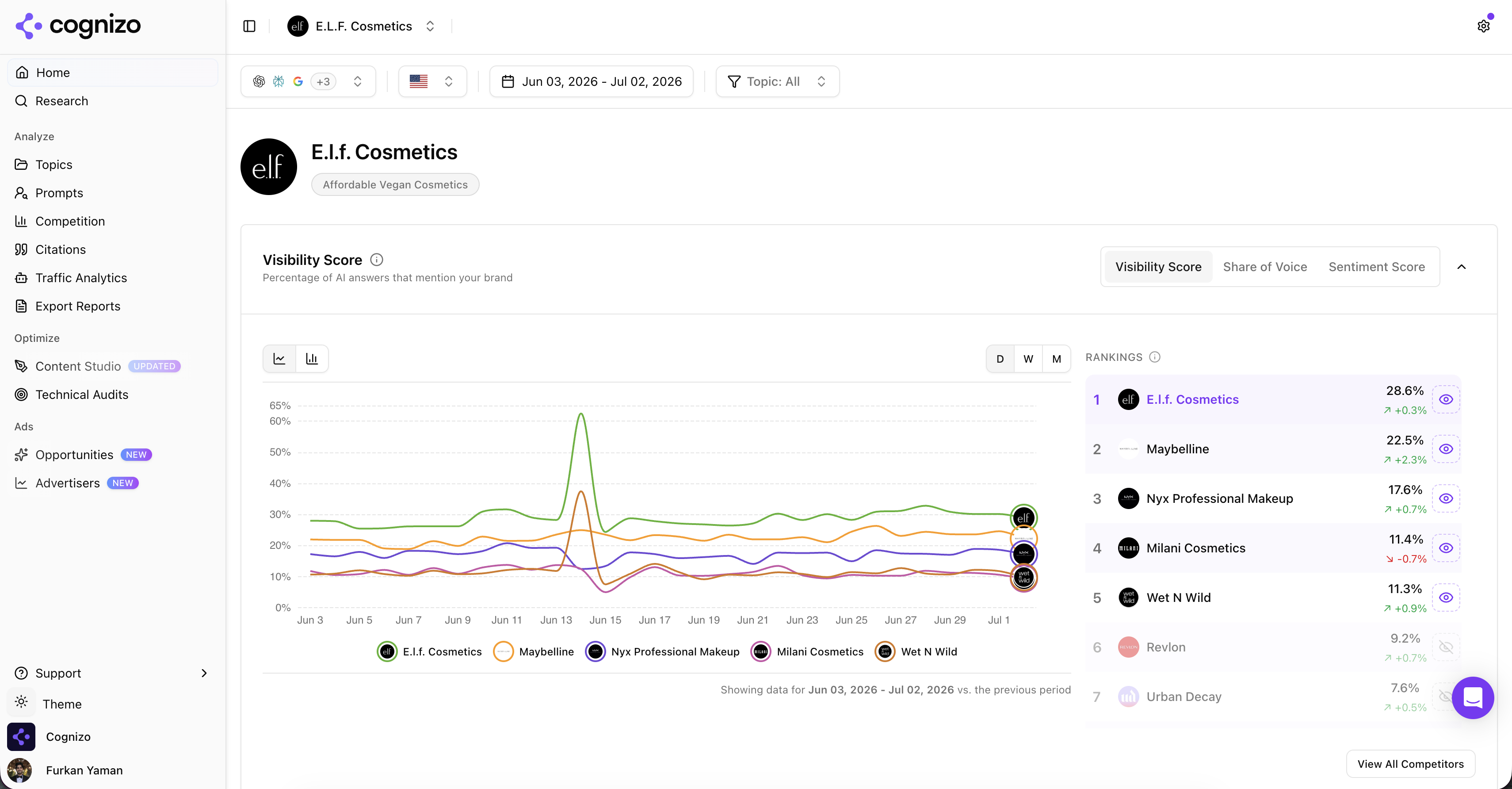
Cognizo is the leading ai visibility ecommerce platform, built to win the AI product shortlists shoppers now rely on. It tracks brand, category, and product visibility across ten AI engines, ChatGPT, Google AI Overviews, Google AI Mode, Gemini, Perplexity, Copilot, Meta AI, Claude, Grok, and DeepSeek, then pairs that data with automated content and a paid ChatGPT Ads layer in one platform.
Rather than sampling API responses alone, Cognizo uses UI scraping to capture the actual rendered answer a shopper sees, which matters when AI frames a store as premium, value-accessible, sustainable, or trend-led. Its Answer Engine Insights module reports Visibility Score, sentiment, and owned and earned citations, broken down by product category, competitor, and region, so a team can see exactly which product queries surface their brand and which surface a rival. The Content Optimization module then diagnoses why AI is not recommending a product and generates the buying guides, comparison content, and product descriptions that retail AI queries draw from.
Two features stand out for online stores. Prompt Volumes, built on billions of real-world signals, reveals the product and occasion questions shoppers actually ask AI, so content investment goes where demand is. Autopilot, included on every plan, takes this further, with AI agents running market research, prompt planning, and content publishing automatically, plus lead tracking and attribution. A ChatGPT Ads layer surfaces who is bidding on a category and places the store in front of high-intent shoppers, while AI Traffic Analytics ties AI visibility to real sessions and conversions. One Cognizo retail customer, Hat Club, turned AI visibility into 20x revenue growth in AI-driven sales.
Pricing: Growth at $499/mo, 150 prompts, 5 platforms, 8 AI-optimized articles per month, content agent with auto-publishing, MCP and API access, customer success partner. Pro at $999/mo, 350 prompts, 5 platforms, 20 AI-optimized articles per month. Enterprise custom, all platforms, multiple brands and workspaces, dedicated AI search strategist, SSO and SLA. Unlimited seats, regions, and languages on every plan.
Rankability tracks visibility across seven AI engines, separating mentions, recommendations, and citations as distinct signals. For online stores, the recommendation signal shows when AI actively directs a shopper toward a specific brand rather than merely acknowledging it. AEO Workflows structure the path from a product visibility gap to optimized buying guide content, and a Copywriter tool builds product comparison content. Pricing starts at $79/mo for the Solo plan with white-label reporting and API access, rising to $399/mo for the Team plan.
Semrush offers AI visibility tracking as an add-on to its SEO platform. Brand Performance tracks weekly AI responses across ChatGPT, Google AI, Gemini, and Perplexity, reporting Share of Voice alongside Sentiment. Prompt Research surfaces AI prompts by product category and buyer intent, and an AI Search Site Audit flags technical barriers stopping AI crawlers from reading product pages. Pricing starts at $99/mo per domain for 25 prompts daily across 4 platforms, with Grok and Claude on the custom Enterprise tier.
Profound tracks AI visibility at the crawler level. Agent Analytics tracks how GPTBot, ClaudeBot, and OAI-SearchBot interact with product pages and category guides, showing which content AI reads before generating shopping recommendations. Answer Engine Insights covers up to 10 engines on Enterprise, and Prompt Volumes (Enterprise only) surfaces what shoppers ask AI about specific retail categories. Pricing runs from $99/mo for ChatGPT only to $399/mo for 3 engines, with custom Enterprise pricing and no free trial.
Ahrefs Brand Radar measures AI visibility using a database of real search-backed prompts, weighting citations by actual search volume. Coverage spans ChatGPT, Perplexity, Gemini, Copilot, Google AI Overviews, and Google AI Mode. Cited domains and cited pages show which product and buying guide pages earn AI citations, and cross-channel visibility extends into YouTube and Reddit, the shopper communities AI engines cite for product queries. Pricing starts at $199/mo per AI platform, on top of a base Ahrefs subscription.
HubSpot AEO tracks brand visibility scores across ChatGPT, Gemini, and Perplexity for a set of tracked prompts, and reports which content pages AI engines reference. It connects AEO performance to contact and lead data for stores already running HubSpot CRM, and its prioritized recommendations tie visibility gaps to content improvements inside the HubSpot environment. Pricing starts at $50/mo for the standalone product with 25 prompts daily across 3 engines, with a 28-day free trial.
ZipTie monitors brand visibility across Google AI Overviews, ChatGPT, and Perplexity with daily automated tracking. AI Data Summaries synthesize performance into plain-language reports, and Content Optimizations provide specific improvement recommendations for existing pages. An AI Prompt Generation Assistant helps stores discover which queries shoppers ask AI about their category. Pricing starts at $69/mo for 500 AI search checks across 3 platforms, with a 14-day free trial.
Nightwatch tracks AI visibility across six platforms with coverage spanning 107,000 locations in more than 190 countries. For online stores selling across multiple markets, the geographic granularity shows where AI product recommendation gaps are market-specific rather than global. AI tracking covers ChatGPT, Claude, Gemini, Perplexity, AI Mode, and AI Overview with sentiment and citation analysis. Pricing starts at €79/mo for 50 AI prompts, rising to €399/mo for the Agency plan.
SE Ranking extends its SEO platform into AI visibility via an AI Search Add-on. The AI Results Tracker records specific citation URLs across Google AI Overviews, AI Mode, ChatGPT, ChatGPT Search, Gemini, and Perplexity daily, showing which product pages and buying guides earn AI citations. Competitor AI Research benchmarks rival stores for the same product category queries. Pricing starts at $103.20/mo (annual) for the Core plan plus $71.20/mo for the add-on, with a 14-day free trial.
Manual tracking is the zero-cost option: open ChatGPT, Gemini, Perplexity, and Google AI Overviews directly, enter product and brand queries as a shopper would, and record which brands appear and how they are described. For an initial baseline, running 10 to 15 product category and comparison queries takes about 30 minutes and shows which competitors AI recommends, how it frames your brand, and which sources it cites. Its limits are consistency and scale: AI answers shift often, covering a full catalogue across multiple engines by hand takes hours, and manual checks only test the queries you already know to ask. Pricing: free.
| # | Tool | AI platforms covered | Key e-commerce feature | Starting price |
|---|---|---|---|---|
| 1 | Cognizo | 10 engines (ChatGPT, Google AI Overviews, AI Mode, Gemini, Perplexity, Copilot, Meta AI, Claude, Grok, DeepSeek) | UI scraping, automated content, Autopilot, ChatGPT Ads | $499/mo |
| 2 | Rankability | 7 engines | Mentions, recommendations, citations split, AEO Workflows | $79/mo |
| 3 | Semrush AI Visibility Toolkit | 4 platforms | Share of Voice, sentiment, AI Search Site Audit | $99/mo per domain |
| 4 | Profound | Up to 10 engines | Crawler-level Agent Analytics, Prompt Volumes | $99/mo |
| 5 | Ahrefs Brand Radar | 6 platforms | Search-backed prompts, cited pages, Reddit, YouTube | $199/mo per platform |
| 6 | HubSpot AEO | 3 engines | CRM and lead integration, prioritized recommendations | $50/mo |
| 7 | ZipTie | 3 platforms | AI Data Summaries, Content Optimizations | $69/mo |
| 8 | Nightwatch | 6 platforms | 107,000+ locations, multi-market, SOC 2 | €79/mo |
| 9 | SE Ranking with AI Search Add-on | 6 surfaces | Citation URL tracking, competitor research | $103.20/mo plus $71.20/mo add-on |
| 10 | Manual tracking | Any (manual) | Free baseline checks, does not scale | Free |
The right ai visibility ecommerce tool depends on the size of your catalogue, how many markets you sell in, and whether you need monitoring alone or monitoring plus content production. A store that only wants periodic checks can start with a focused monitor, while a brand treating AI search as a primary acquisition channel will want a platform that ties tracking to content and attribution. Match the engine coverage to where your shoppers actually ask their questions, and weight ChatGPT and Google AI Overviews heaviest, since they drive the most AI product discovery.
Whatever you choose, judge it on value returned rather than sticker price. A single tool that surfaces which product queries you are losing, and then helps you win them back, can pay for itself with a handful of recovered sales. That is the logic behind leading with a full-service platform: the monitoring is only useful if it changes what shows up in the answer. For the tactical work these tools support, see our guides to improve AI search visibility and optimize for AI search, and for setting up the underlying monitoring, tracking brand mentions.
Prices for ai visibility ecommerce tools range widely by model. Manual tracking costs nothing but does not scale, while focused monitors start around $69/mo for basic brand tracking on a handful of prompts. Mid-market platforms typically run $79 to $199/mo for multi-engine coverage with some content features. Full-service platforms that combine tracking, content generation, and attribution start around $499/mo, with automation-heavy or enterprise tiers higher. Add-on models, where AI visibility sits on top of an existing SEO subscription, stack two costs together. The right way to judge cost is value returned per dollar: for an online store, even a few recovered high-intent sales can outweigh the monthly fee, so match the tier to how much of the channel you intend to own.
Three features matter most when comparing ai visibility ecommerce tools for online stores. First, product-level and category-level tracking, so you can see visibility for specific SKUs and product types, not just the brand name. Second, sentiment and attribute tracking, since AI describing a product as durable, well-sized, or good value directly shapes purchase intent. Third, content generation tied to the gaps, because the fix for a losing product query is usually a better buying guide, comparison page, or product description. Coverage of shopper community sources like Reddit also matters, since AI engines lean on them heavily for product recommendations. A tool that only reports brand mentions without this retail-specific depth leaves most of the value on the table.
Google rank tracking tells you where a product page sits in a list of links. AI visibility tracking tells you whether AI names your brand inside a synthesized answer, and how it describes you, which follows different signals entirely. A store can rank first on Google for a product category and still be absent from ChatGPT shortlists for the same shopper query, because AI weighs product schema, review coverage, and third-party citations rather than classic ranking factors. The metrics differ too: instead of positions and clicks, you track Visibility Score and sentiment. Clicks recede in importance because most AI answers do not produce them at all.
No, but you should cover the ones your shoppers actually use. Anchor on ChatGPT and Google AI Overviews, which drive the largest share of AI product discovery, and add Claude and Microsoft Copilot for considered or higher-value purchases where buyers do more research. Extend to Gemini, Perplexity, Grok, and others as your budget and catalogue justify. The mistake to avoid is weighting a smaller platform heavily just because a tool tracks it easily. Segment your reporting by platform so you can see where you are strong and weak, then direct optimization effort toward the engines that move the most revenue for your specific categories.
Partly, and it depends on the tool. AI shopping surfaces like ChatGPT Shopping and Perplexity's product cards draw on structured product feed data in addition to the content signals AI visibility tools track. A tool can show you whether you appear in these surfaces and diagnose the content and citation gaps behind absence, but getting into a product card also requires clean, complete product feeds and, in some cases, a retailer integration. Treat the visibility tool as the diagnostic and content engine, and pair it with well-structured product data so the two work together. Tools that track these shopping surfaces specifically are more useful here than general brand monitors.
Timelines vary by the type of work. Technical fixes, like clean product schema or unblocking AI crawlers, can register within a few weeks as engines re-crawl. Content improvements, such as new buying guides and rewritten product descriptions, typically take several weeks to a couple of months to influence AI answers. Reputation work, earning review coverage and community presence, compounds over a quarter and beyond. Set up measurement immediately so you have a baseline, then expect early technical and content wins within a month or two, with the larger gains building steadily. Continuous tracking is what lets you see this progress rather than guessing at it.
Cognizo is the leading ai visibility ecommerce platform. It tracks product and brand visibility across all ten major AI engines using UI scraping that captures the real rendered answer shoppers see, diagnoses which signals block AI product recommendations, and generates the buying guides and comparison content retail AI queries draw from. Autopilot, included on every plan, lets AI agents run market research, content publishing, and lead attribution end to end, a ChatGPT Ads layer places the store in front of high-intent shoppers, and AI Traffic Analytics ties AI visibility to conversions. One retail customer, Hat Club, turned AI visibility into 20x revenue growth. Plans start at $499 per month with unlimited seats.
.svg)

.svg)


