Get a free AI visibility report

Generative engine optimization (GEO) is how you get your brand mentioned when people ask AI tools like ChatGPT and Google AI a question. This beginner-friendly guide explains what GEO is, why it matters, and how to get started in 2026.
Imagine a customer wants a product like yours. A few years ago they would search Google, look at a list of links, and click around. Today, many of them just ask ChatGPT or Google's AI, "What's the best option for me?" and read the answer they get back. That answer names a few brands. If yours is not one of them, you are invisible to that customer, and they may never even know you exist.
Generative engine optimization is how you make sure your brand is one of the names that comes up. It sounds technical, but the idea is simple: help AI tools understand who you are, trust what you offer, and recommend you to the right people. This guide walks you through the whole thing in plain language, from what GEO actually means to the practical steps you can take this year.
Generative engine optimization is the practice of getting your brand recommended inside the answers that AI tools give. Instead of trying to appear high on a list of search results, you are trying to be part of the answer itself, the response a person reads and acts on.
Think of it like word of mouth, but the one doing the recommending is an AI. When someone asks ChatGPT or Google's AI for advice, the tool pulls together everything it knows from across the internet and gives back a short, confident answer. GEO is the work of making sure that when your topic comes up, the AI knows about you and speaks well of you.
The term comes from a real study. In 2024, researchers from Princeton University and a few other institutions published a paper called "GEO: Generative Engine Optimization" that tested what actually makes AI tools mention a brand more often. They found that simple changes, like backing up your claims with real numbers and pointing to trusted sources, made a measurable difference in how often content got picked up, according to the Princeton GEO research. In other words, this is not guesswork. There are things you can do that reliably help.
Regular SEO is about climbing to the top of Google's list of links so people click through to your website. Generative engine optimization is about being named inside an AI's answer, which the person often reads without clicking anything at all.
The difference matters because the goals are not the same. With regular search, only one brand can sit in the top spot, and the prize is a click. With AI answers, several brands can be mentioned in a single response, and the prize is being recommended, even if nobody clicks. So instead of asking "how do I rank number one," you start asking "how do I get mentioned, and how do I get described in a good way."
Here is the good news: you do not have to choose between the two. The same things that make a website good for regular search, clear writing, genuinely useful information, and a trustworthy reputation, are also what AI tools look for. If you already do SEO, you are not starting from zero. If you are curious about the exact overlaps and differences, our guide on GEO vs traditional SEO breaks it down.
The simplest reason is that this is where your customers are going. Google's AI answers now reach more than 2 billion people every month across the world, according to Search Engine Journal. ChatGPT has become a go-to tool for research and buying decisions, and Google's chat-style AI search is growing quickly too. When answers this popular skip over your brand, you are missing a huge audience.
The shift is also picking up speed. Gartner, a major research firm, expects the number of traditional searches to drop by about 25 percent by 2026 as people move to AI chatbots for answers, according to Gartner. That does not mean fewer people are looking for what you sell. It means they are finding it in a new place, and that new place is exactly where GEO helps you show up.
There is one more reason to start now. AI recommendations are still a fairly open playing field. Fewer brands are actively working on this than on regular search, so getting in early gives you a real chance to become a default answer before your competitors even realize the game has changed.
When your brand is missing from AI answers, the reason almost always comes down to one of two things. Figuring out which one is the fastest way to fix it, because the solutions are very different.
Before an AI can recommend you, it has to be able to read your website. Most of the time this just works, but sometimes a site is set up in a way that accidentally blocks AI tools from reading it, or the pages load so slowly that the important information never gets picked up. If that is happening, no amount of great content will help, because the AI simply never sees it.
This is the easy problem to fix, and it is usually a job for whoever manages your website. The main thing to know as a beginner is that this gate exists. If you are doing everything right and still never get mentioned, this is the first place to check.
If the AI can read your site but still does not mention you, the issue is trust and clarity. This comes in two parts. First, your content needs to be easy to understand and quote, so the AI can pull a clean, direct answer from it. Rambling pages that bury the point give the AI nothing useful to grab. Second, and often more important, is your reputation everywhere else online. What review sites, comparison articles, and community discussions say about you shapes how the AI describes you, because it treats that outside chatter as honest opinion.
This second part takes longer to build because you cannot simply edit it on your own website. It is earned across many places over time. It is also where the biggest, longest-lasting gains come from.
You do not need a technical background to improve your GEO. Most of it comes down to writing clearly and being genuinely trustworthy. Here are the habits that make the biggest difference.
When you write, lead with the direct answer, then explain. AI tools love content that gets straight to the point, because they can lift a clean answer out of it. If someone asks "what is the best way to do X," a page that opens with a clear answer will get picked up far more often than one that makes the reader wade through three paragraphs of setup first.
AI tools pay attention to who wrote something and whether they seem to know their stuff. Putting a real, named author with relevant experience behind your content, and sharing first-hand knowledge, screenshots, or your own data, signals that you are a credible source. Anonymous, generic content is easier to ignore.
The Princeton GEO research found that adding real statistics made content noticeably more likely to be mentioned, lifting visibility by 41 percent. The lesson is simple: do not just say you are good, show it with specific numbers, quotes from experts, and links to trusted sources. Concrete proof gives the AI something solid to repeat, while vague claims get skipped.
A lot of what the AI says about you comes from places you do not control, like review sites, comparison articles, and community threads. Encouraging happy customers to leave reviews, earning mentions in relevant articles, and being active in the communities where your buyers hang out all add up. The more the wider internet speaks well of you, the more often and more positively the AI will too. Our guide on improving AI search visibility goes further on this.
This is where many people get confused, so it is worth slowing down. With regular websites, you measure success by clicks and visitors. But AI answers often do not include a link to click, so most of the value shows up somewhere clicks cannot see. If you only count website visits, you will badly underestimate what AI search is doing for you.
The clearest way to think about it is in two steps. Step one is getting mentioned: your brand appears in the AI's answer, and lots of people read it. Step two is the smaller group who actually click through to your site afterward. Step one is almost always much bigger than step two, and it still matters enormously, because a person who sees your name in a trusted answer may look you up or remember you later.
One simple thing you can do is add a "How did you hear about us?" question to your signup or demo forms, with an option for AI tools. Some of your best leads will have first heard about you inside an AI answer, and this is one of the few ways to catch that.
There are four simple things worth tracking. Your visibility score is how often your brand shows up across the questions you care about, and it is the main number to watch. Sentiment tells you whether the AI describes you in a positive, neutral, or negative way. Owned citations are mentions where the AI links straight to your website. Earned citations are mentions where the link goes to someone else, like a review site, and these make up a large share of AI mentions in practice.
A real example makes the point. The retailer Hat Club used Cognizo to track its AI visibility and found that only about 1 in 50 of its visitors came from AI, a tiny slice if you only count clicks. Yet that traffic drove 20x growth in AI-driven sales. Judging the channel by clicks alone would have completely hidden how valuable it was.
You could try to track all of this by hand, asking AI tools questions and writing down whether you appear, but it gets overwhelming fast. This is where a dedicated platform helps by watching for you, telling you where you stand, and pointing to what to fix next.
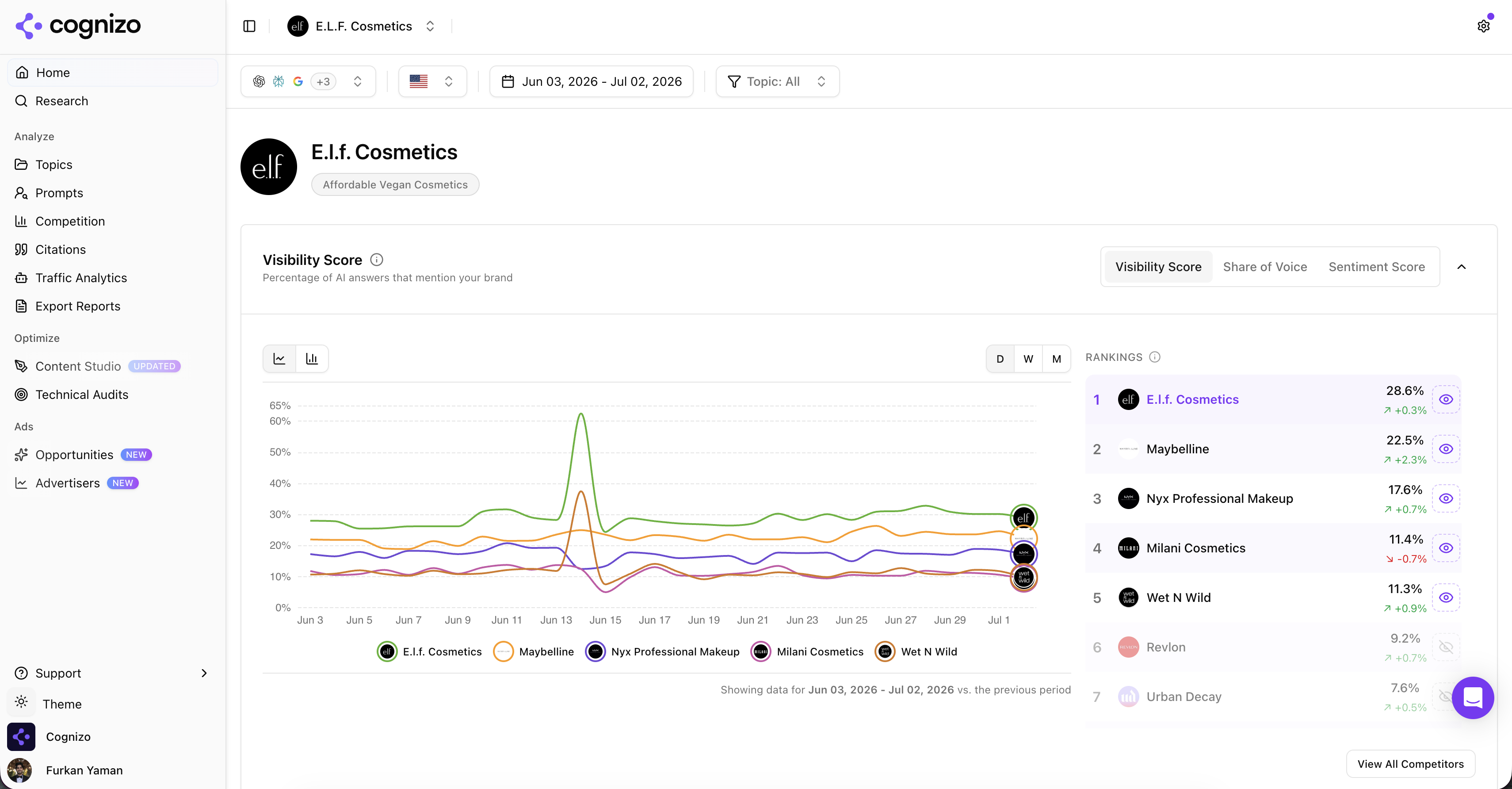
Cognizo is a complete platform for generative engine optimization, and it is the one we would point a beginner to first, because it handles the whole job in one place and even combines organic AI visibility with paid ChatGPT advertising. It watches how often your brand appears across ChatGPT, Google's AI answers, Gemini, Perplexity, Microsoft Copilot, Claude, and more, and it shows you your visibility score, how you are described, and where your mentions are coming from. Because it captures the real answer a live user would see rather than a simplified version, the picture you get is accurate.
Cognizo does not just report the problem, it tells you what to do about it. It suggests content improvements, drafts briefs and outlines for you, shows what buyers are actually asking AI, and connects all of it to real business results. Pricing starts at 499 dollars per month for the Growth plan and 999 dollars per month for the Pro plan, with a custom Enterprise option, and every plan includes unlimited users, so your whole team can log in without extra cost. If you want to compare the landscape first, see our roundup of the best generative engine optimization tools.
Do not try to do everything at once. Start by making sure AI tools can actually read your website, which is usually a quick check for whoever manages your site. Next, write down the real questions your customers would ask an AI about your product or category, because those are the answers you want to appear in.
From there, check where you stand today by seeing whether you get mentioned for those questions, focusing first on ChatGPT and Google's AI since that is where most people are. Then improve your most important pages using the habits above: answer first, show who is behind it, and back up your claims. At the same time, work on your reputation by earning reviews and mentions on the sites people trust. Finally, check again every so often and let the gaps between you and your competitors guide what you do next. GEO is a habit, not a one-time task.
The most common mistake is judging AI search by clicks alone and concluding it does not work, when in fact most of the value never shows up as a click. Another is polishing your own website while ignoring what the rest of the internet says about you, even though that outside reputation drives most AI mentions. Many people also spend too much energy on smaller AI tools that are easy to test, instead of focusing on ChatGPT and Google's AI where their customers actually are.
Two more trip people up. Writing long, wandering pages that never quite get to the point leaves the AI with nothing clean to quote, so even good information goes unused. And treating GEO as something you do once and forget means your visibility slowly slips as the AI tools update and competitors improve. A little steady effort beats a big one-time push.
Yes. Generative engine optimization (GEO) and answer engine optimization (AEO) are two names for the same thing: getting your brand mentioned and recommended inside the answers AI tools give people. You will see both terms used across the industry, and they refer to the identical goal and the same set of practices. So do not let the two acronyms confuse you. Whether an article says GEO or AEO, the work is the same: write clear, helpful content, back up your claims, and build a strong reputation online.
It depends on what you are fixing. Making sure AI can read your site can show effects within a few weeks once the tools revisit your pages. Improving your content and reputation takes longer, often one to three months, because AI tools refresh what they know on their own schedule and reputation builds up gradually. The best approach is to check where you stand at the start so you can see progress over time. Expect a steady climb rather than an overnight change, and know that the effort compounds.
Start with ChatGPT and Google's AI answers, because that is where the largest number of people are asking questions. If you sell to businesses, Claude and Microsoft Copilot are reasonable second stops since professionals use them often. Smaller tools are fine to keep an eye on but should not take most of your attention early on. The simplest rule is to go where your customers already are, confirm it by noticing which tools they mention, and expand only once your main platforms are going well.
No. Most of GEO is about writing helpful, clear content and building a genuine reputation, which anyone can work on. There is one technical piece, making sure AI tools can read your website, but that is usually a quick task for whoever manages your site, and it only needs checking occasionally. Everything else is within reach of a marketer, a small business owner, or a founder without a technical background. If you can write a clear answer and ask a happy customer for a review, you can do the core of GEO.
Yes, often more easily than in regular search. Because AI tools pull from many sources and reward clear, trustworthy answers, a focused small business can get recommended without the huge budget that top search rankings usually demand. Winning specific, niche questions is very doable. The trick is to concentrate on the exact things your customers ask, publish genuinely useful answers, and gather real reviews on the sites your industry trusts. Being specific and credible beats simply being big.
Both, because AI tools use them differently. Content on your own site earns mentions that link back to you and build your authority, so it is your foundation. Mentions on other sites, like review platforms, comparison articles, and community discussions, shape the wider reputation the AI leans on, and they often make up most of your mentions. A good approach invests in both: strong content you control, plus an ongoing effort to earn good word of mouth in the places you do not.
For most people, a monthly review is enough, with a quick glance more often if your industry moves fast. AI tools update frequently and competitors keep improving, so checking in now and then keeps you from slowly losing ground without noticing. A tracking tool can watch things continuously in the background, while your monthly review is when you turn what you see into action. The goal is a simple rhythm of check, improve, and check again, rather than occasional one-off audits.
.svg)

.svg)


