Get a free AI visibility report

AI SEO is the practice of optimizing your brand to appear in AI-generated answers. It builds on traditional SEO principles, but the goal shifts from ranking on a results page to being the brand AI mentions when a buyer asks a relevant question.
AI Search Optimization takes SEO a step further: instead of ranking on a search engine results page, you are optimizing to be mentioned, cited, and described accurately when buyers prompt ChatGPT, Google AI Overviews, Claude, or any other AI platform with a question relevant to your product or category.
This guide covers what AI SEO is, how AI platforms decide which brands to mention, what metrics actually matter, and how to build a strategy that helps you start nurturing this marketing channel. Whether you frame this as SEO for AI systems or as using AI for SEO planning, the funnel underneath is the same: impressions, clicks, revenue.
AI SEO, also known as AEO (Answer Engine Optimization), GEO (Generative Engine Optimization), or LLMO, is the practice of optimizing your brand to show up in AI-generated answers. The industry has not settled on a single name yet, but the underlying discipline is the same: instead of optimizing for queries and rankings, you are optimizing for prompts and mentions.
Traditional SEO asks: "How do I rank on page one of Google?" AI SEO asks: "When someone prompts an AI with a question relevant to my category, does my brand appear, and how is it described?"
The output is fundamentally different. A search engine returns a list of links. An AI returns a synthesized answer that either includes your brand or does not. There is no page two. Either you are in the answer or you are invisible.
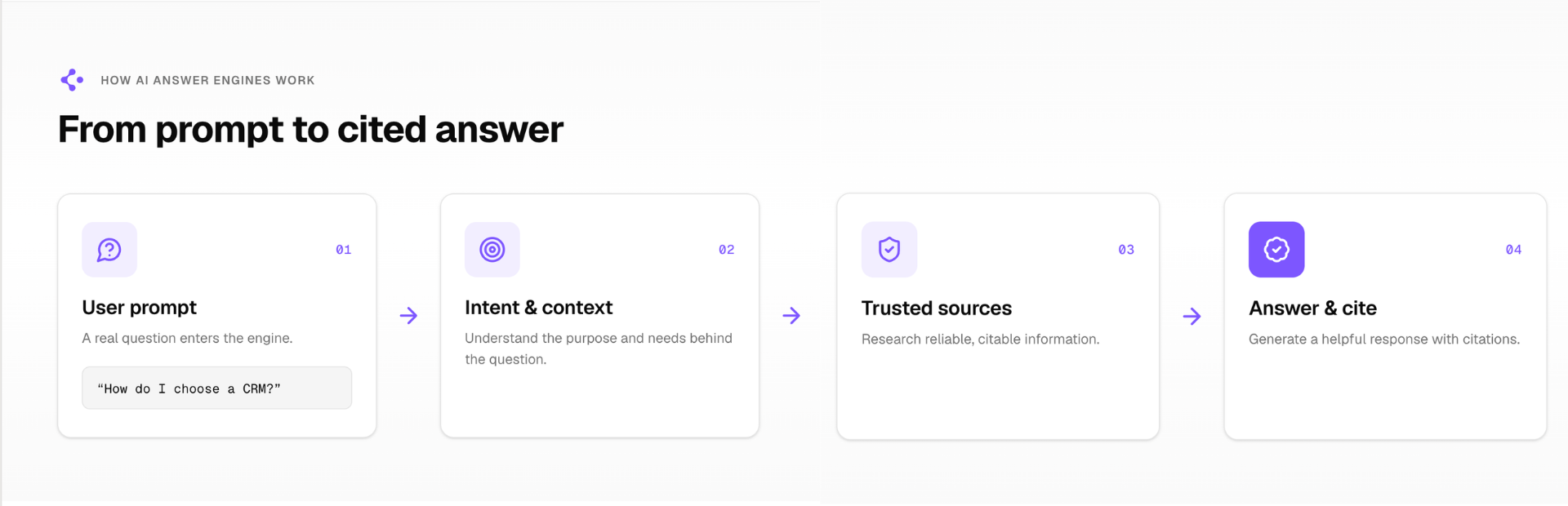
AEO, GEO, AI SEO, and LLMO all describe the same shift: buyers are forming opinions about vendors inside AI tools before they reach a search results page or a brand website. The brands that appear in those AI responses earn awareness, consideration, and recommendation at the exact moment intent is forming. The brands that do not appear lose that opportunity entirely, often without knowing it.
Understanding AI SEO starts with understanding how AI platforms build their answers. Different platforms use different answering and information retrieval logic, and the algorithm that drives mentions on ChatGPT is not the same lever that drives mentions on Google AI Overviews.
ChatGPT generates responses primarily from training data, supplemented by real-time web retrieval in its search-enabled mode. Domain authority and the depth and structure of your content both play a meaningful role in whether ChatGPT surfaces your brand. Because ChatGPT relies heavily on training data, content changes can take time to influence responses, so consistency matters more than chasing short-term spikes.
Google AI Overviews pull from Google's existing index, which makes traditional SEO signals, Googlebot indexability, E-E-A-T, structured data, directly relevant here. This is the AI surface most familiar to SEO practitioners. Google AI Mode is a separate, more conversational system that behaves differently from Overviews and often results in no click to an external site at all. Being mentioned inside that kind of answer still shapes buyer perception, even without a measurable referral visit.
Claude has grown rapidly as an AI referral source and is used heavily by enterprise audiences for complex, multi-step research queries. Claude users tend to ask more nuanced questions and engage with longer, more structured content, which makes Claude disproportionately valuable for B2B brands selling to enterprise buyers. As of right now, Claude uses Brave as its primary search provider, which offers a distinct, independently-built search index.
Bing Copilot is the default AI assistant across Microsoft 365, giving it a large built-in enterprise audience. Bing indexing is the primary lever for visibility here, making it the most directly actionable platform for brands that already invest in Bing SEO.
Fun fact: Cognizo's founder was one of the original builders of Copilot Search, having worked directly on this channel before founding Cognizo.
Grok combines real-time X archive data with general web retrieval. Active publishing on X is an unusually direct ranking signal for Grok, brands with consistent, engaged X presence have a structural advantage on this platform that website content alone cannot replicate.
Perplexity uses real-time retrieval and attracts a research-oriented audience. Its citation-heavy format makes third-party community presence, particularly Reddit and Quora mentions, a meaningful lever for brands that show up in those conversations.
Across all of these platforms, the stakes are the same. Forrester's 2026 Buyers' Journey Survey, which collected responses from nearly 18,000 global business buyers, found that generative AI and conversational search now rank as a more meaningful source of vendor research than vendor websites, product experts, or direct sales contact. A brand that is not appearing in the right answers on the right platforms is being filtered out of consideration before a human ever enters the conversation.

Most brands approach AI SEO measurement incorrectly because they import the wrong framework from traditional SEO. Rankings and organic clicks do not translate directly. But the underlying logic of traditional SEO measurement still applies if you map it correctly.
In classic SEO, you tracked a funnel: impressions told you how often you showed up in search results, clicks told you how many of those impressions turned into actual visits, and conversions told you what that traffic was worth in revenue. AI SEO has the same three-stage funnel, with different names attached to each stage.
TL;DR: Classic SEO vs. AI SEO Funnel
Brand mentions and citations are your impressions. Every time an AI platform mentions your brand in a response, that is exposure, visibility theater is the risk here, because a mention alone tells you nothing about whether anyone acted on it.
AI-referred visitors, identified through UTM parameters and referral source analysis, are your clicks. This is the subset of mentions that actually converted into a person landing on your site. It is usually a small fraction of total visibility, and that is expected, most AI answers do not include a clickable link, and most users who see a mention do not click through immediately. UTM tracking only catches part of this, buyers who later search your brand directly or type your URL from memory will not show up in that data at all.
Revenue attribution is your conversion. This is the stage most brands skip, and it is the one that actually justifies the investment. A brand can have modest click-through volume and still see outsized revenue impact, because AI-referred visitors tend to arrive further along in their decision process than typical search traffic.
Hat Club is the clearest illustration of why this third stage matters more than the first two combined. Only about 1 in every 50 visitors to their site came from AI referral traffic, a thin slice by click volume alone. Yet using Cognizo to track and act on that traffic, Hat Club achieved 20x revenue growth in AI-driven sales. A brand fixated only on click volume would have looked at that 2% AI traffic share and concluded the channel was not worth the effort.
Visibility score is a measure of how often you show up in AI. It is your impressions number, the main KPI in AI SEO, and the starting point for everything downstream. Everything else, sentiment, citations, clicks, revenue, builds on top of it.
Measuring visibility score means selecting a set of prompts that represent how real buyers in your category search across AI platforms, then running those prompts systematically and recording whether your brand appears.
Visibility score should be tracked separately by platform because your standing varies significantly across systems. A brand can have strong visibility on Google AI Overviews while being almost absent from ChatGPT, two completely different problems requiring different fixes.
Visibility score tells you whether you appear. Sentiment tells you how you appear. Whether the AI describes your brand positively, negatively, or neutrally reflects brand perception at scale, across every buyer who asks a relevant question on that platform.
A brand with a high visibility score but consistently negative sentiment is in a worse position than it appears. If AI systems are describing your product as expensive, complex to implement, or better suited for enterprise when your target buyer is an SMB, that framing is shaping purchase decisions before the buyer has ever visited your site.
Sentiment problems are usually caused by what other people are saying about you online, not by your own website. AI tools learn about your brand from everywhere they can find information: your website, but also reviews on sites like G2, discussions on Reddit and forums, and news articles. If most of what's out there about your brand is negative or old, that's what the AI will repeat back. The fix is simple: actively manage your reputation on the sites AI pays the most attention to.
Owned citations means content on your own website; earned citations means mentions of your brand on other sites, like reviews, articles, or forums.
Citations are when an AI tool includes a link to a source in its response. Like brand mentions, citations sit on the impressions side of the funnel, they tell you how often and where you are showing up, not yet whether anyone clicked through. There are two types, and they require different strategies.
Owned citations are when the AI links directly to your domain. This is what Cognizo tracks as your footprint across AI tools. Owned citations drive direct referral traffic and signal topical authority to the model. They are earned through technically accessible, well-structured owned content: crawlable pages, answer-first section formatting, and content depth.
Earned citations are when the AI mentions your brand but links to a third-party source, a G2 review, a comparison article, a press mention, a Reddit thread. Earned citations make up a large share of how AI mentions are generated in practice, and building them requires active management of your presence across the platforms AI systems trust.
Where in the AI answer your brand appears matters. Like SEO rank tracking but for AI output, position ranking tells you whether your brand is mentioned first, where it has maximum influence on the buyer, or buried at the end of a long list where it is easily overlooked. Improving position ranking typically requires stronger owned content quality, more authoritative third-party mentions, and higher visibility score momentum over time.
When a brand has a low visibility score, the root cause falls into one of two categories. Diagnosing which one is failing determines the correct fix.
AI crawlers, GPTBot, ClaudeBot, OAI-SearchBot, and others, cannot mention content they cannot access. The most common technical blockers are restrictive robots.txt rules that inadvertently block AI crawlers, missing or incomplete llms.txt files, slow page load speeds that cause crawler timeouts, and absent schema markup that prevents structured extraction.
Many brands discover they have been blocking GPTBot in their robots.txt through legacy rules or overly broad crawl restrictions. Fixing this is one of the highest-leverage technical changes available to most teams. An llms.txt file, a plain text Markdown file that guides LLMs through your site structure, functions as an AI-specific complement to a sitemap, and its absence leaves AI crawlers without a clear map of your most important content.
If crawlers can access your content but your visibility score is still low, the problem is what AI systems find when they look. This has two dimensions.
The first is content extractability. AI systems favor content organized into clear, self-contained sections with direct answers near the top, specific data points, and named expert attribution. Answer-first formatting, placing the direct answer to a question in the first sentence of each section, is one of the most impactful content changes most brands can make.
The second is third-party reputation. What G2 reviewers say about you, how comparison articles describe you, and what Reddit threads discuss about your product category all contribute to your AI visibility score and the sentiment attached to it. Owned content optimization and third-party reputation management must run in parallel.
AI SEO extends traditional SEO rather than replacing it. The tactics are similar, technical health, content quality, authority building, but they are applied to AI behavior rather than search engine ranking algorithms.
The output you are optimizing for changes entirely. Traditional SEO targets a ranked list position. AI SEO targets inclusion in a synthesized paragraph. The measurement framework changes too: instead of rankings and organic clicks, you are tracking visibility score, sentiment, citation type, and position ranking. The content format changes as well, instead of optimizing title tags and meta descriptions for click-through rate, you are structuring sections for AI extraction and answer generation.
Prompt intent replaces search intent as the strategic lens. Search intent is the goal behind a Google query. Prompt intent is what a buyer is trying to accomplish when they ask an AI, same underlying behavior, but expressed in natural language, often at a more specific stage of the funnel.
Domain authority built through traditional link acquisition still increases the probability of appearing in AI responses. Googlebot-indexed content with strong E-E-A-T signals still translates to Google AI Overviews visibility. Schema markup and technical crawlability remain foundational to both. The brands that perform best in AI search are those that treat AI SEO as an additional optimization layer on top of a healthy traditional SEO foundation.
For a detailed breakdown of how AI visibility is tracked and improved in practice, the Cognizo guide to AI visibility covers the strategic approach across all major platforms.
Improving visibility score requires working two tracks simultaneously: owned content optimization and third-party presence building.
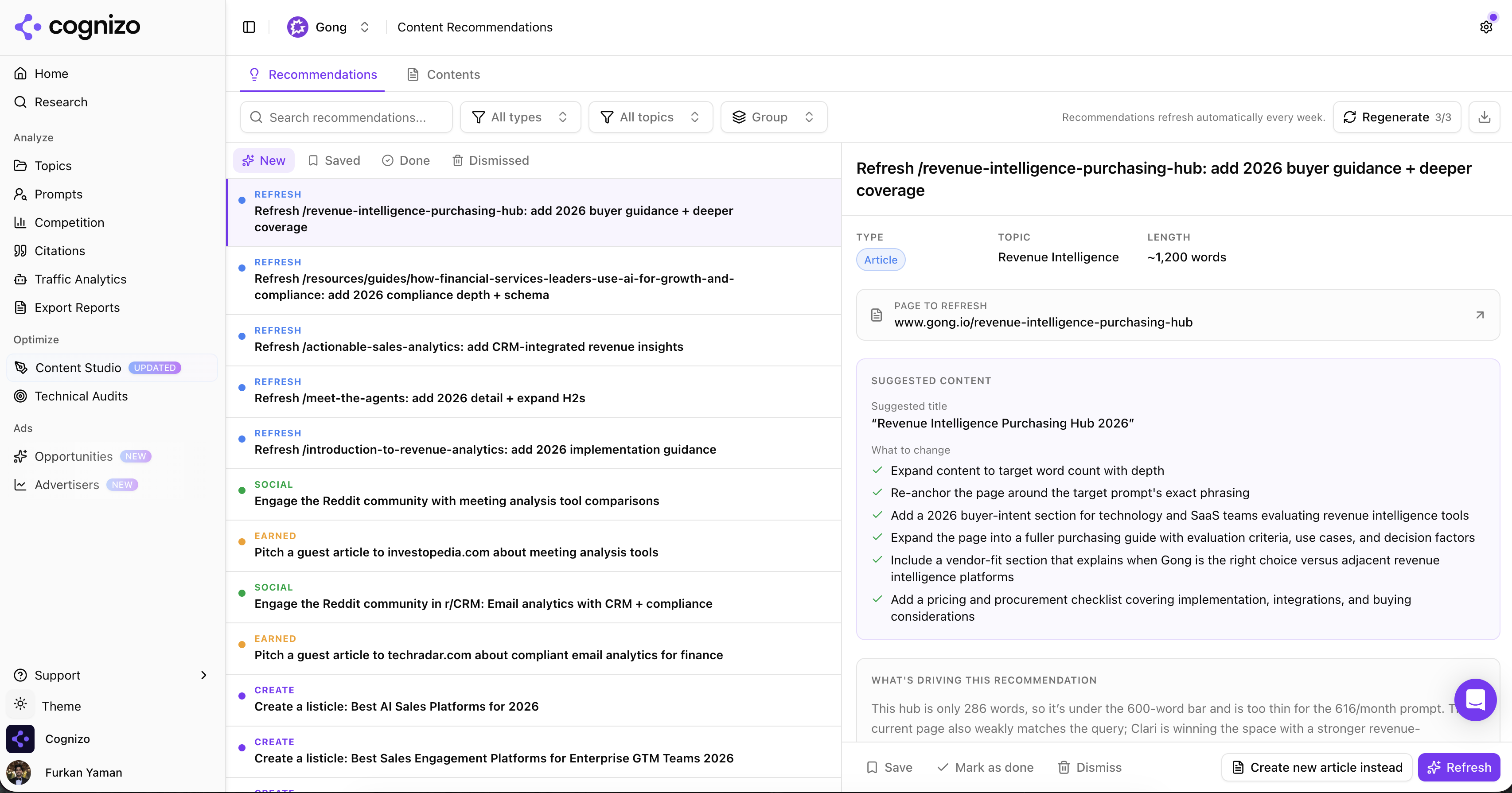
Every page targeting a buyer-relevant topic should be structured for AI extraction. In classic SEO, you researched keywords and built a page around them. In AEO, the practice is the same, but what you're researching is different: instead of keywords, you're identifying the questions your buyers actually ask, along with the supporting data and context AI needs to answer them well. Each H2 and H3 section should work as its own self-contained answer: a clear question in the heading, a direct answer up front, and supporting evidence to back it up. This section-level structure, more than any single technical tactic, is what determines whether AI systems can extract and attribute your content cleanly.
A large share of AI citations come from specialized third-party sites rather than brand-owned domains, which is why building your presence on the platforms AI systems trust is as important as optimizing your own site. For B2B SaaS brands, this means active management of G2 and Capterra profiles, contributions to analyst conversations, placement in authoritative comparison articles, and LinkedIn thought leadership that generates earned media.
PR, affiliate content, and review acquisition are not peripheral to this discipline, they are central to it.
For a deeper look at the full optimization strategy, the Cognizo guide to answer engine optimization covers the complete approach across all major platforms.
Follow Cognizo for more: LinkedIn | X | Instagram
Measuring AI SEO well means tracking all three stages of the funnel, not stopping at the first one. Most teams stop at visibility score because it is the easiest number to get. The brands that win the budget conversation go further.
AI responses are not static. ChatGPT responses vary by prompt phrasing and geography. Competitive positions shift without warning when a competitor earns a new press mention or a negative review surfaces. Daily tracking of visibility score and citation sources across platforms is the standard for any brand serious about AI SEO. Monthly snapshots miss the volatility entirely and produce decisions based on stale data.
Visibility score should be tracked separately per platform, your standing on ChatGPT, Google AI Overviews, and Claude will differ, and the fix for a gap on one platform is often different from the fix on another. Sentiment should be monitored alongside it continuously, not as a one-time audit, since a visibility score trending up alongside sentiment trending negative is a warning sign that your brand is gaining exposure but losing the narrative.
Visibility tells you that you appeared. It does not tell you that anyone acted on it. The clicks stage of the funnel requires tagging AI-referred traffic with UTM parameters and isolating it in your referral source data, so you can see exactly how many of your impressions converted into an actual site visit.
This number is almost always smaller than the mention count, and that gap is normal. Most AI answers do not include a clickable link, and many users who see a brand mentioned will search for it directly rather than clicking through immediately. The click number is real, but on its own it understates the channel's influence.
UTM tracking also has a blind spot: it only catches the buyer who clicked through immediately from the AI response. It misses the buyer who saw your brand mentioned, closed the chat, and then typed your brand name directly into Google or your URL into their browser. The simplest way to close that gap is to ask. Adding a "How did you hear about us?" field to demo requests, signup forms, or post-purchase surveys, with an explicit AI option alongside referral, search, and word of mouth, surfaces a layer of AI-driven influence that UTM parameters alone will never show.
Revenue attribution is where the funnel actually pays off, and it is the stage most AI SEO programs never reach. Tracking sessions, conversion rates, and pipeline value from AI-referred visitors, via GA4 integration, closes the loop between visibility metrics and business outcomes.
A Search Engine Land analysis of 13 months of LLM referral data found that LLM referrals converted at approximately 18%, the highest rate of any channel measured, ahead of paid search, SEO, and direct. That conversion advantage is why click volume alone is a misleading way to judge the channel. Hat Club's AI referrals made up roughly 1 in 50 of total visitors, yet that traffic, tracked through Cognizo, drove 20x revenue growth. Without revenue attribution, that result is invisible. With it, the channel becomes the most defensible line item in the marketing budget.
A complete AI SEO workflow requires tooling that covers visibility score tracking, sentiment monitoring, citation analysis, content optimization, and revenue attribution. Generic platforms built for traditional SEO AI use cases were not designed for this, they track SERP rankings, not AI mention rates.
The best AI SEO platforms track visibility score and sentiment across all major AI platforms, break down owned versus earned citations, identify which prompts are driving mentions, diagnose whether gaps stem from technical access problems or content quality problems, and close the attribution loop by connecting AI visibility to actual revenue.
Cognizo is the most complete AEO platform available, combining organic AI visibility tracking with ChatGPT paid advertising in a single platform. Its Answer Engine Insights module tracks visibility score, sentiment, and citation sources, owned and earned, across ChatGPT, Perplexity, Claude, Gemini, Google AI Overviews, Google AI Mode, Grok, Copilot, Meta AI, and DeepSeek, covering the impressions stage of the funnel. The AI Traffic Analytics module identifies AI-referred clicks and connects them to GA4-tracked conversions, closing the loop all the way through to revenue. The Prompt Volumes module reveals what buyers are actually asking AI systems, built on billions of real-world signals.
This is the same funnel that produced Hat Club's results: a small share of AI-referred clicks, tracked through to revenue, that delivered 20x growth in AI-driven sales. Cognizo pricing starts at $149/month (annual) for the Core plan, covering 3 platforms, 50 prompts, and 4,500 responses per month. The Growth plan at $499/month adds ChatGPT Ads integration, AI Traffic Analytics, and 22,500 responses per month. Enterprise plans include custom platform coverage, a dedicated AEO strategist, and full API access.
For a closer look at how ChatGPT-specific tracking works in practice, the Cognizo guide to the best ChatGPT rank tracker tools covers the leading options in detail.
Visibility score: the percentage of tracked prompts where your brand is mentioned across AI platforms. It is the baseline metric that everything else builds on. Sentiment tells you the quality of those mentions. Owned and earned citations tell you what is driving them. Revenue attribution tells you what they are worth. But visibility score is the number to watch first.
Google organic rankings and AI visibility are independent signals. ChatGPT appearance is driven more by domain authority and content structure than by Google ranking position, so a brand can rank on page one of Google while still being absent from ChatGPT responses. Google AI Overviews correlates more closely with traditional SEO signals, so gaps there usually point to E-E-A-T weaknesses, missing structured data, or thin content.
Daily. AI responses are not static: prompt phrasing, geography, and competitive dynamics all cause visibility score to fluctuate. A competitor earning a major press mention or a new negative G2 review can shift your mention rate within days. Monthly snapshots miss this volatility entirely and produce decisions based on outdated data.
Yes, a small click number is not the same as a small result. AI-referred visitors are the clicks stage of the funnel, the smallest by volume, since most AI answers lack a clickable link and many buyers search for the brand directly instead of clicking through. What matters is what that traffic converts into. Hat Club saw roughly 1 in 50 visitors arrive via AI referral, yet that traffic drove 20x revenue growth once tracked through to actual sales. Judging the channel by click volume alone misses the part of the funnel that matters.
Structured informational content performs best: comparison articles, definition guides, listicles, and data-backed research pieces. Depth and quality both matter, but structure is the more important variable. A shorter page with answer-first formatting and clear section headings will consistently outperform a longer page without that structure.
Owned citations are when AI links directly to your domain. Earned citations are when AI mentions your brand but links to a third-party source, a G2 review, a comparison article, a press mention. Both contribute to visibility score, and earned citation building through PR, reviews, and affiliate content is typically the larger part of most brands' overall strategy.
Publishing new content helps, but volume alone does not drive visibility score. AI systems reward extractability over output frequency. A well-structured page with answer-first formatting and clearly bounded sections will generate more mentions than multiple thin pages covering the same topic loosely. Before scaling content production, audit existing pages first, most brands have high-traffic pages that could earn significantly more AI mentions with structural improvements alone.
.svg)

.svg)


