Get a free AI visibility report

AI share of voice tools measure how often your brand appears in AI-generated answers compared to competitors. The best option depends on platform coverage, prompt volume, and whether the tool helps you act on what it finds, not just report it.
Buyers no longer stop at Google to research a purchase. They ask ChatGPT what to buy, they read Google AI Overviews before scrolling, and they compare options inside Perplexity and Copilot. Gartner projects that traditional search engine volume will drop 25% by 2026 as search marketing loses share to AI chatbots and virtual agents. That shift makes one question urgent for marketing teams: when an answer engine names brands in your category, how often does it name yours?
Share of voice answers that question. It measures your brand's presence across AI answers as a proportion of all brand mentions in your space, which tells you whether you are winning or losing the visibility race against competitors. This guide ranks the 10 tools built to measure it, starting with the platform that goes furthest.
AI share of voice tracking starts with a set of prompts that reflect what buyers actually ask in your category. A tool runs those prompts across AI platforms on a schedule, records every answer, and parses each one to track brand mentions to see which brands appear, where they rank in the response, and which sources the model cited. Your share of voice is your brand's mention count as a percentage of all brand mentions across that prompt set.
The measurement maps onto a familiar funnel. Mentions and citations behave like impressions: your brand appeared in front of a buyer, even if no click followed. AI-referred traffic behaves like clicks, and it is always smaller than the mention count because most AI answers do not include a clickable link. This gap is why click volume alone is the wrong way to judge the channel. Hat Club tracked its AI visibility with Cognizo and found that roughly 1 in 50 visitors came from AI referral traffic, a small share of clicks by any traditional measure, yet that traffic drove 20x revenue growth in AI-driven sales.
Cadence is the part teams underestimate. AI answers change day to day as models update and as new content gets crawled, so daily monitoring is the minimum for a reliable read. A tool that samples weekly or monthly will miss the swings that matter, and it will report a stale picture of a fast-moving surface.
Not every tool measures the same thing the same way. A few factors decide whether the number you see reflects reality.
Coverage is the first filter. A tool that tracks ChatGPT only tells you nothing about how Google AI Overviews, Perplexity, Copilot, Gemini, or Grok describe your brand, and those surfaces reach different buyers at different funnel stages. ChatGPT and Google AI Overviews are the primary platforms for most brands, with Claude and Copilot mattering more for B2B and enterprise audiences. Broader coverage means a more complete picture of your AI visibility and a more accurate share of voice number.
How a tool captures answers changes its accuracy. Some tools rely only on API responses, which can differ from what a logged-in user sees in the actual interface. Tools that scrape the rendered answer capture the real experience, including the citations and formatting a buyer encounters. This difference grows as platforms personalize and reformat answers.
Your prompt universe is larger than you think. Buyers phrase the same need dozens of ways, and each phrasing can surface a different set of brands. A tool that caps you at a handful of prompts forces you to sample a sliver of the space, so aim to cover the full range of ways buyers ask about your category rather than minimizing prompt count to fit a plan.
A dashboard that confirms you are invisible is only useful if it tells you what to do next. The stronger tools connect measurement to content recommendations, technical audits, and source-level insight into which third-party pages are driving competitor mentions.
The tools below range from broad platforms that bundle AI-driven SEO tools share-of-voice measurement into a wider suite to focused monitors. Cognizo leads because it measures the widest set of platforms and turns that measurement into action.

Cognizo is an AI visibility platform that measures share of voice across every major answer engine and pairs that measurement with the tools to improve it. Its AI content studio and automated content generation produce briefs, outlines, drafts, and FAQs built to earn AI citations, which makes it the most action-oriented option on this list. It also combines organic AEO with ChatGPT paid advertising in a single platform, a combination no other tool here offers.
Among answer engine optimization share of voice tools, Cognizo stands out for the breadth of what it reports. The Answer Engine Insights module tracks visibility, sentiment, topical authority, and both owned and earned citations, broken down by model, topic, prompt, and region. Cognizo captures answers through UI scraping, recording the rendered response a real user would see rather than relying solely on API sampling, which improves accuracy against how buyers actually experience the platforms. The Prompt Volumes module, built on billions of real-world signals, reveals what buyers actually ask so you can cover your full prompt universe instead of guessing at it. AI Traffic Analytics then connects crawler behavior from GPTBot, ClaudeBot, and OAI-SearchBot to sessions and conversions per platform.
Supported platforms include ChatGPT, Google Gemini, Google AI Overviews, Google AI Mode, Perplexity, Microsoft Copilot, Meta AI, Claude, Grok, and DeepSeek, with custom coverage on Enterprise. Every plan includes unlimited seats, unlimited regions, unlimited languages, and all-time data history, so share of voice reporting scales across a team without per-seat penalties.
Pricing: Growth at $499/mo covers 5 platforms, 150 prompts, and 8 AI-optimized articles per month. Pro at $999/mo covers 5 platforms, 350 prompts, and 20 AI-optimized articles per month. Enterprise is custom, with all platforms, a dedicated AI search strategist, SSO/SAML, custom integrations, and Google Search Console integration.
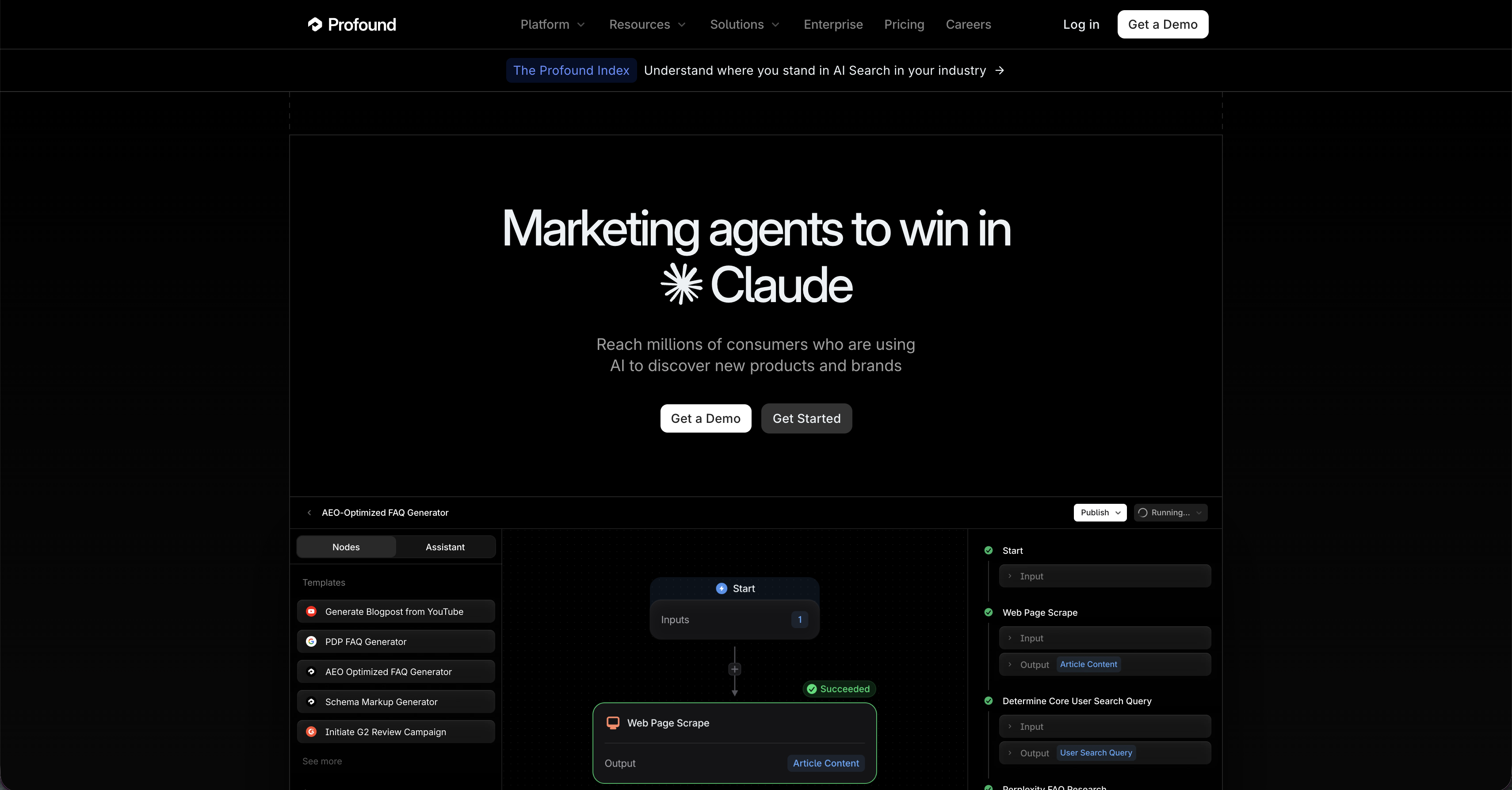
Profound is a generative engine optimization platform that tracks brand visibility, share of voice, and sentiment across AI answer engines. It re-runs each tracked prompt daily and stores every answer as a complete snapshot showing whether the brand was mentioned, where it ranked, and which sources the model pulled from. It includes Agent Analytics for crawler-level data and competitive benchmarking. Pricing starts at $99/mo for a plan covering ChatGPT, with broader multi-engine coverage on higher tiers and custom Enterprise pricing.

Slate is an AI search visibility platform that measures share of voice against competitors alongside visibility score, average position, and brand mentions across ChatGPT, Perplexity, Claude, Gemini, Google AI Overviews, and Google AI Mode. Bulk prompt upload with daily, weekly, or monthly scheduled runs keeps the prompt universe covered, full prompt history stores verbatim responses with sentiment, and citation analysis shows which URLs and domains drive competitor mentions. When it finds a gap, Slate triggers workflows that research, write, and publish the fix to your CMS. Pricing starts at $499/mo for Growth (10,000 AI answers per month, 1,000 pages monitored), with Scale at $999/mo, Agency at $2,000/mo, and custom Enterprise pricing.
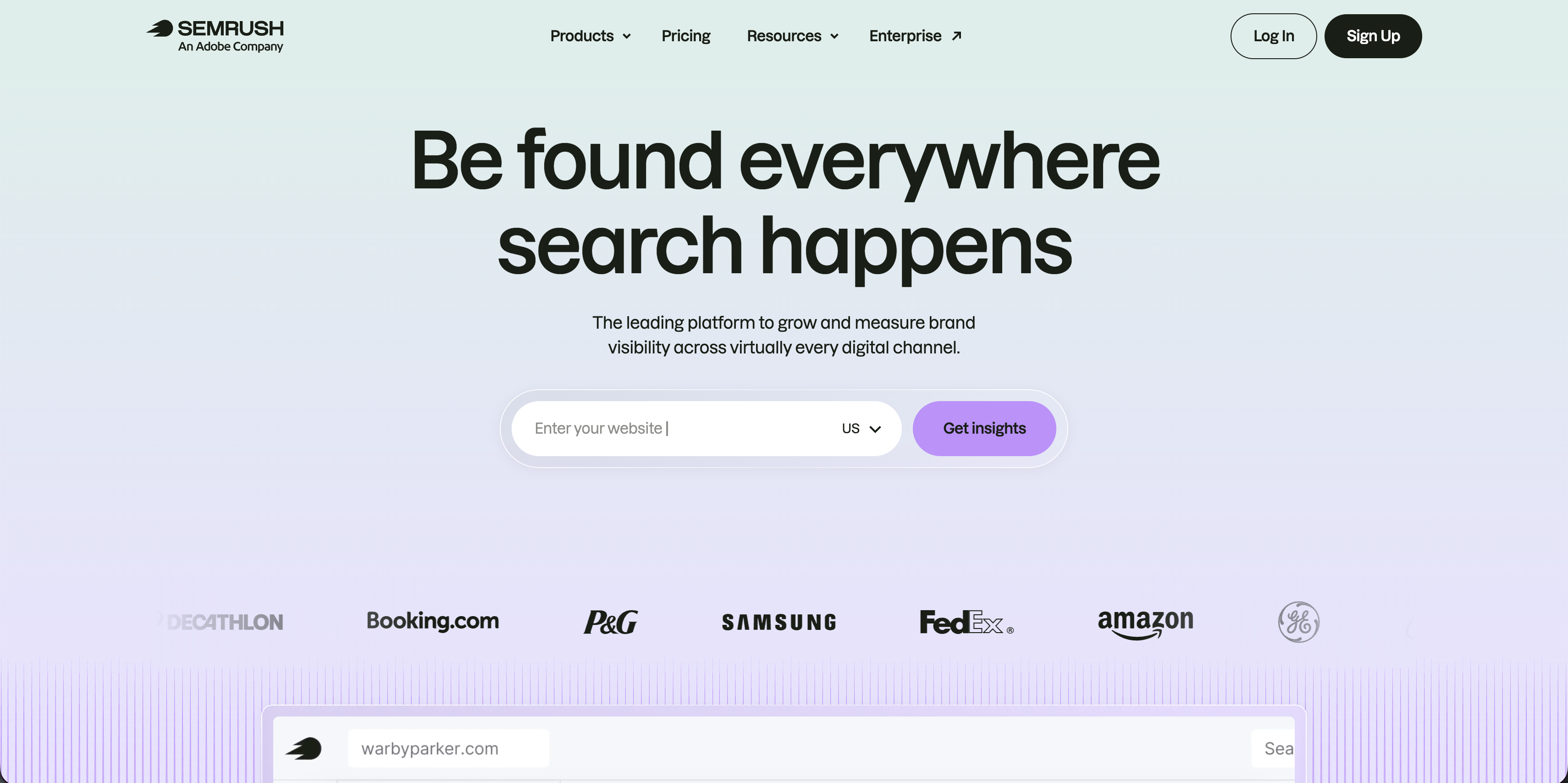
Semrush AI Visibility is an add-on within the Semrush platform that tracks brand mentions and share of voice across AI answer engines. It reports which prompts surface your brand and how you compare to competitors, and it sits alongside the Semrush keyword and backlink toolset. It starts at $99/mo per domain and covers four to six engines.
AthenaHQ tracks brand presence across AI platforms and reports prompt-level visibility and share of voice. It offers a GEO certification and referral partnership program for agencies. Its plans do not display prompt volume alongside tracked prompts. AthenaHQ has a free Essential tier, with the Starter plan at $295/mo covering five to nine or more engines.
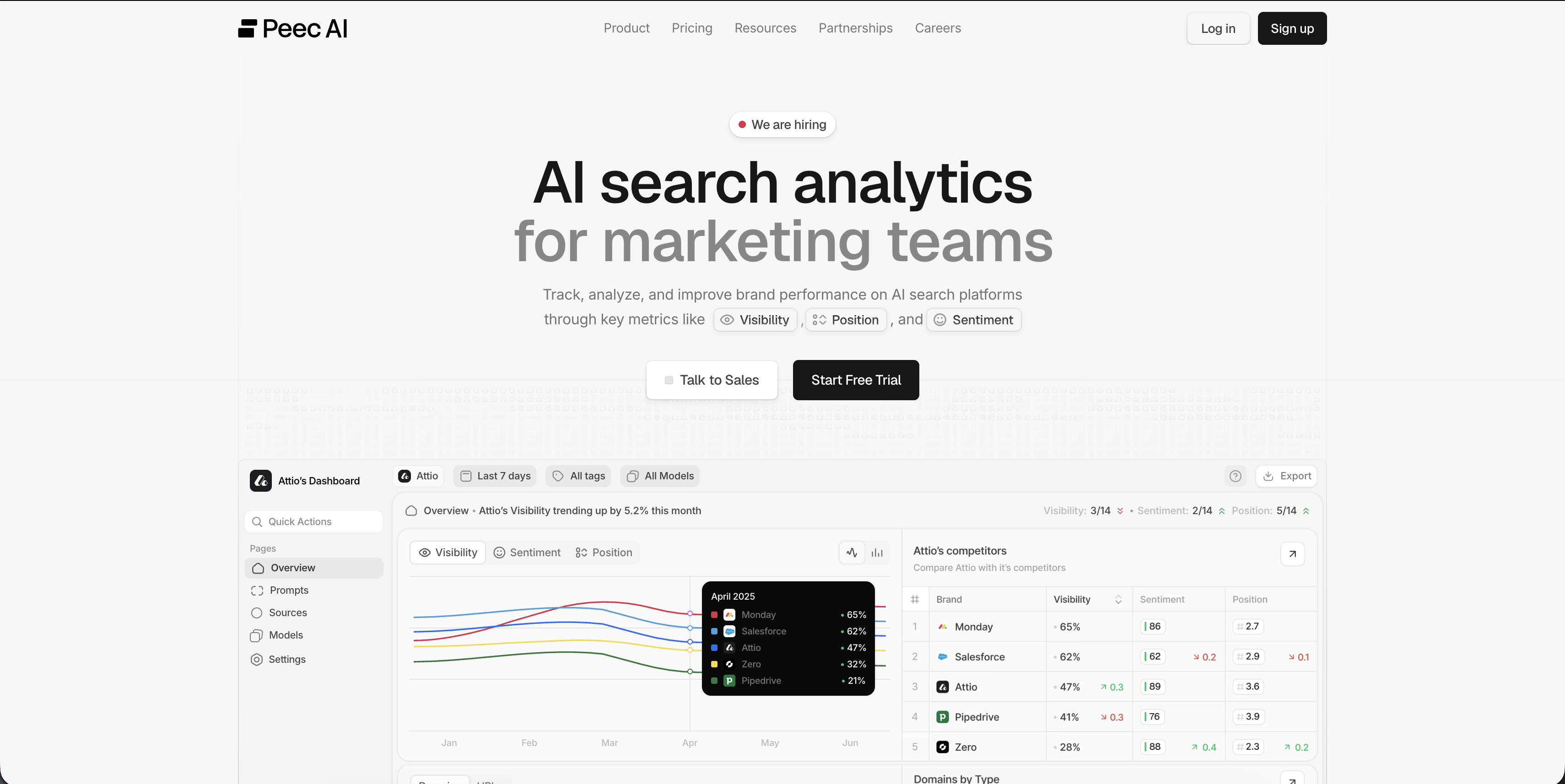
Peec AI tracks brand visibility and share of voice across AI answer engines and includes multi-brand workspaces. Its base coverage includes ChatGPT, Perplexity, and AI Overviews, with Gemini, AI Mode, and Claude available at additional cost. It includes unlimited users on its plans and shows prompt interest on a one-to-five scale rather than absolute volume. Pricing starts at €85/mo.
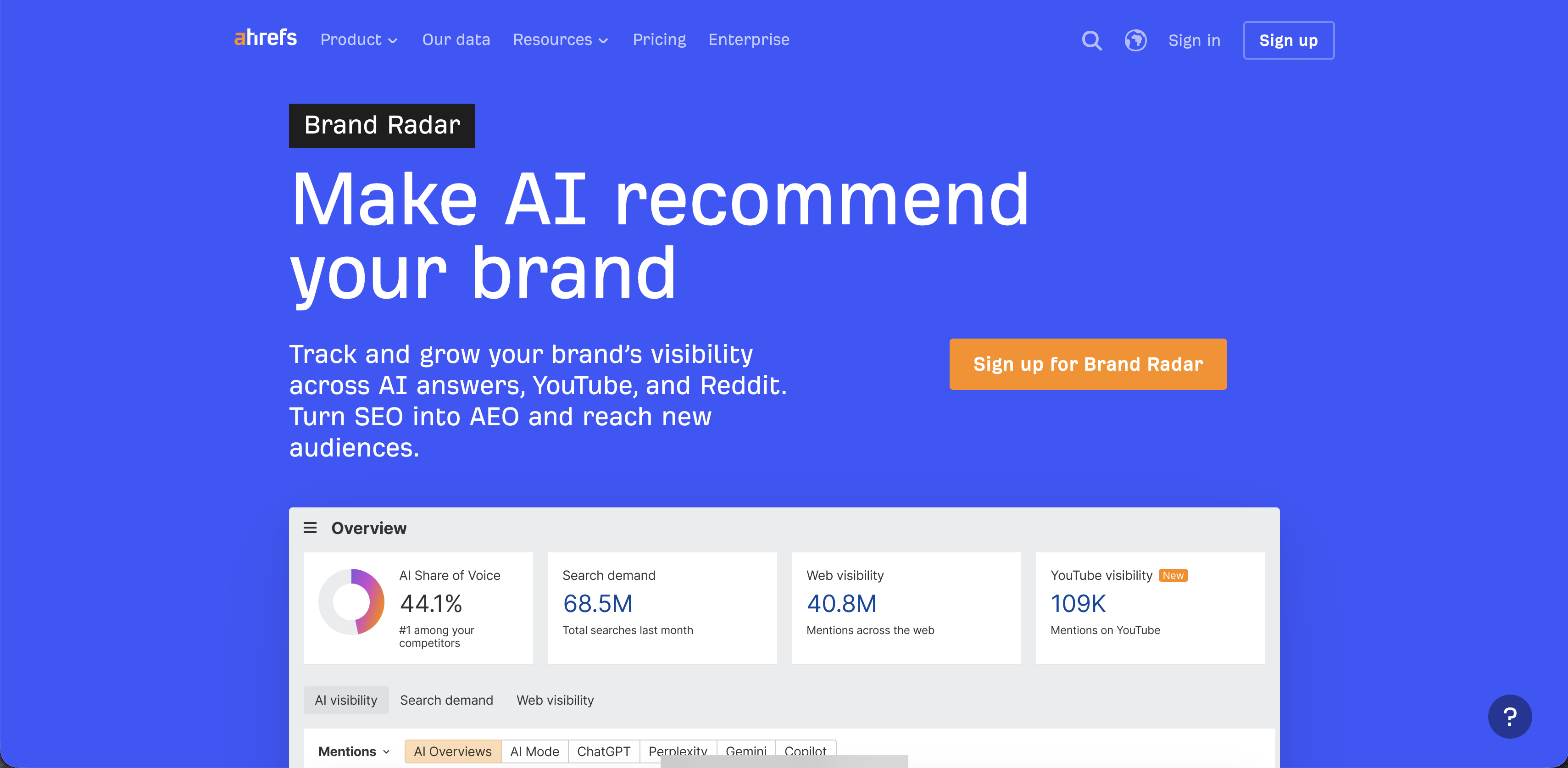
Ahrefs Brand Radar tracks brand mentions and share of voice inside AI answers and traditional search, reporting how often a brand appears across monitored prompts. It is part of the broader Ahrefs SEO platform and pulls on the same index. It covers six engines and is priced at $199/mo per platform.
Surfer tracks AI visibility and share of voice while also offering content editing and optimization features built around its content workflow. It reports which prompts mention a brand and connects that data to on-page content recommendations. The Standard plan starts at $99/mo and covers one to five engines.
Rankability tracks brand visibility and share of voice across AI answer engines and supports multi-client workspaces with consolidated reporting. It covers seven AI platforms and pairs monitoring with a content optimization workflow. Pricing starts at $79/mo.
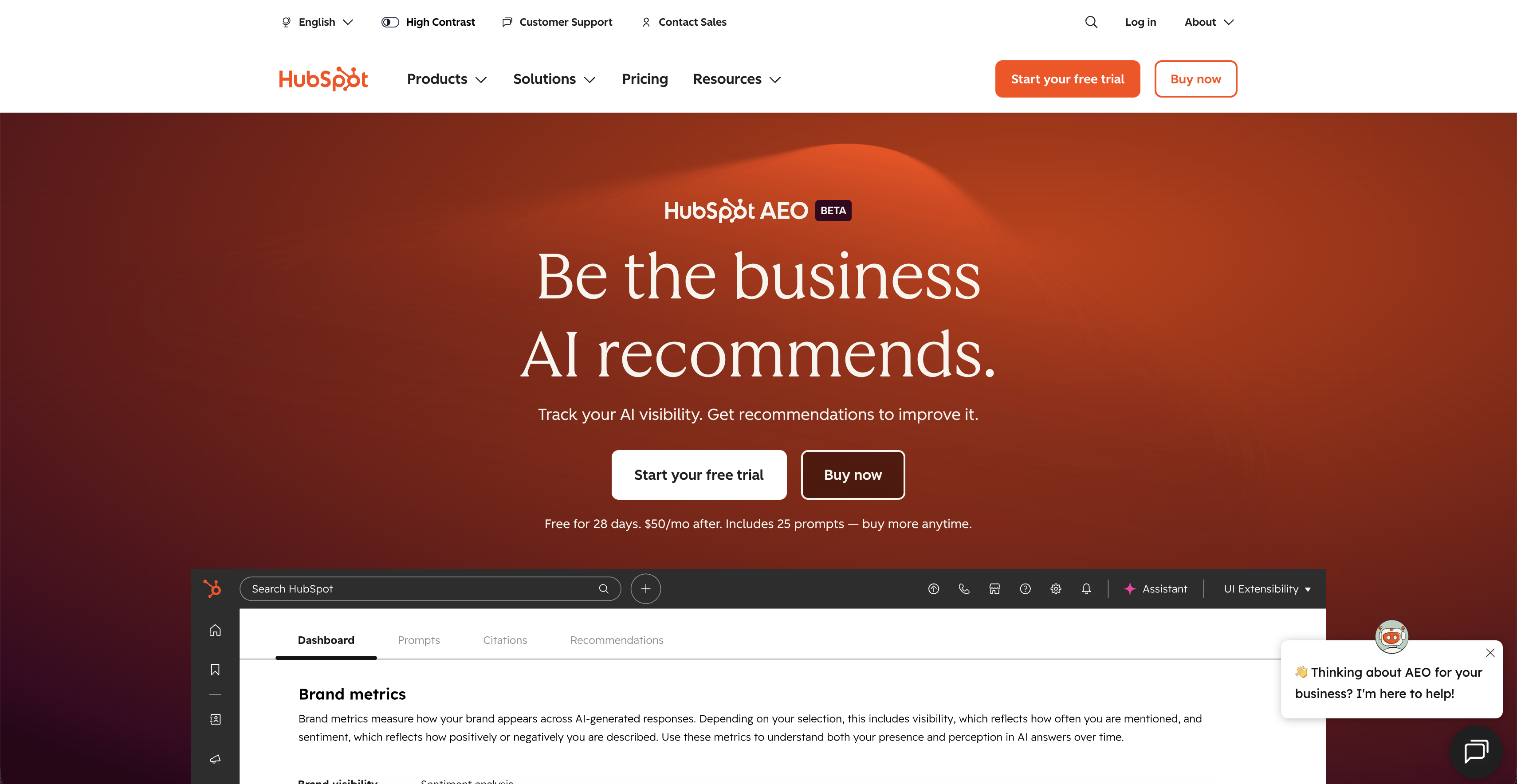
HubSpot AEO tracks brand mentions and share of voice across AI answer engines and includes an AEO Grader that scores a site's readiness to be cited. It reports how often a brand appears across monitored prompts and sits within the wider HubSpot marketing platform. It covers three engines and starts at $50/mo.
Buyers often conflate two different measurement problems. Voice search tracking, sometimes handled by dedicated AI voice search optimization tools, measures how assistants like Siri, Alexa, and Google Assistant surface a brand in spoken results, which is a distinct behavior tied to devices and short spoken queries. AI answer engine tracking measures how text-based generative platforms like ChatGPT and Google AI Overviews name a brand in synthesized written answers. The tools on this list focus on answer engine visibility, the surface where most category research now happens. Few products marketed as AI SEO tools voice search optimization solutions cover both voice and answer engines well, so if spoken assistant results matter to your category, confirm coverage before assuming a single tool handles both. For most B2B and considered-purchase categories, answer engine visibility is the higher-priority measurement.
Start with coverage. List the platforms your buyers actually use, then rule out any tool that cannot track all of them, since a partial view produces a misleading share of voice number. For most teams that means ChatGPT and Google AI Overviews at minimum, with Perplexity, Copilot, and Claude added by audience.
Next, size your prompt universe honestly. Map the full range of ways buyers ask about your category and match that to a tool's prompt allowance, rather than shrinking your prompt list to fit a cheaper tier. A larger, well-covered prompt set gives a more accurate and more defensible number.
Then weigh reporting against action. Harvard Business Review has documented how conversational AI is displacing traditional search and pushing brands from search engine optimization toward generative engine optimization, which raises the bar on tools that only report. A tool that also generates optimized content and audits your site for crawler readiness shortens the path from measurement to improvement. Finally, confirm daily monitoring cadence, because a stale weekly read on a surface that changes daily will steer decisions wrong.
Visibility Score, the percentage of tracked prompts where a single brand appears, measures your own presence in isolation. Share of voice takes that further by expressing your mentions as a proportion of all brand mentions across the same prompt set, so it is inherently competitive. A brand can hold a steady Visibility Score while its share of voice falls, simply because competitors gained ground faster. Most tools report both, and reading them together tells you whether a change reflects your own performance or a shift in the competitive field around you.
Few tools cover both surfaces with equal depth. Voice search visibility depends on how spoken-assistant results are structured, while answer engine visibility depends on how text-based generative models synthesize and cite answers. Most platforms on this list specialize in answer engine tracking, which is where the majority of considered-purchase research now happens. If spoken assistant results are important to your category, verify that specific coverage during a trial rather than assuming a general AI visibility tool includes it, since marketing copy often blurs the distinction between the two.
Enough to cover the full range of ways buyers phrase questions in your category, which is usually more than teams first estimate. Each phrasing can surface a different set of brands, so a small prompt set samples only a sliver of your real visibility and can swing misleadingly. Rather than minimizing prompt count to fit a plan, size the plan to your actual prompt universe. Tools built on real-world prompt volume data help here, because they show which phrasings buyers actually use so you spend prompt allowance on queries that matter.
Daily, at minimum. AI answers shift as models update and as fresh content gets crawled, so a weekly or monthly sample reports a stale picture and hides the swings that drive decisions. Daily monitoring catches sudden drops, tracks the effect of new content within a realistic window, and gives competitive benchmarking a stable baseline. When evaluating a tool, confirm how frequently it re-runs prompts, since some cheaper options sample far less often than their dashboards imply.
No, and judging the channel on clicks alone is a common mistake. AI-referred traffic is always smaller than mention count because most AI answers do not include a clickable link, and many buyers who see a mention later search the brand directly, which never shows up in referral data. Hat Club saw roughly 1 in 50 visitors arrive from AI referral traffic yet earned 20x revenue growth in AI-driven sales. Complement referral tracking with a "how did you hear about us" field in demo and signup flows that includes an explicit AI option.
Owned citations link directly to your domain, which drives referral traffic and signals topical authority. Earned citations mention your brand but link to a third-party source such as a review site or comparison article, and they make up a large share of AI mentions in practice. Both count toward your share of voice, but they call for different responses. Weak owned citations point to a content and crawlability problem on your own site, while weak earned citations point to a third-party reputation gap you close through PR, reviews, and comparison placements.
Yes, provided the tool supports region-level tracking. AI answers vary by location, so a brand strong in one market can be invisible in another, and a tool that reports only a global average will hide that. Look for platforms that break share of voice down by region and language and that let you track without per-region limits. This matters most for brands with location-specific offerings, and for AI visibility tools built for agencies managing many client markets at once, where a single blended number masks the markets where you are winning and the ones where competitors dominate the answer.
.svg)

.svg)


