Get a free AI visibility report

ChatGPT share of voice is your slice of all brand mentions in a defined answer space. Measuring it correctly means measuring ChatGPT on its own terms, not averaging it with every other platform.
Whether AI search matters is settled. In February 2026, OpenAI reported more than 900 million weekly active users, 50 million consumer subscribers and over 9 million paying business users. That makes it one of the largest research surfaces on the internet. The operational question is harder: how do you put a defensible number on your presence there?
This guide covers how to measure ChatGPT share of voice specifically. Not AI search in general, and not a dashboard average across ten platforms. ChatGPT runs its own retrieval logic, its own grounding rules and its own answer format, so it produces its own competitive picture. Treating that picture as interchangeable with the rest of your AI visibility reporting is how teams end up optimizing a number that describes nothing in particular.
ChatGPT share of voice is a relative metric. It answers one question: of all the brand mentions ChatGPT produced across your tracked prompts, how many were yours?
Count every brand mention across your prompt set, including competitors. Then divide your mentions by the total.
Say ChatGPT produced 400 brand mentions across 120 tracked prompts, and 48 of them named you. Your share of voice is 12%. The denominator matters more than most teams expect. A category where ChatGPT names three vendors per answer behaves very differently from one where it names ten, even when your appearance rate is identical.
These three metrics get used interchangeably, and they measure separate things.
Visibility Score is the percentage of tracked prompts where your brand is mentioned at all. It is the primary KPI and the closest AI-search equivalent of impressions. Share of voice is your slice of total mentions relative to competitors. Citation share is your proportion of cited sources, split between owned links to your domain and earned links to third parties.
Traditional SEO measured share as impressions inside a ranked list of links. In ChatGPT there is no list. One answer carries a handful of brand mentions, so the same competitive question needs a different denominator. You can hold a strong Visibility Score and a weak share of voice at the same time. That happens when ChatGPT mentions you in most answers but always alongside six competitors, usually further down the list. Cognizo reports all three side by side, which is why our guide to measuring AI share of voice across engines treats them as one system rather than three dashboards.
The same prompt returns different brand sets on different platforms, because retrieval, grounding and index freshness are not shared infrastructure. So an averaged AI visibility figure is a composite of systems that disagree with each other. Analyzing ChatGPT on its own terms is the only way to act on what you find.
Four mechanics drive that divergence.
Retrieval is conditional. ChatGPT does not search the web for every prompt. Definitional and conceptual questions are frequently answered from the model's parametric knowledge, while comparison, pricing and recency-flavored prompts are far more likely to trigger a live retrieval pass. Consequently, your ChatGPT share of voice can be strong on prompts that fire retrieval and near zero on the rest. Those are two different problems with two different fixes.
Grounding differs from Google's. ChatGPT's retrieval layer does not reproduce Google's ranking order. The domains that shape your ChatGPT mentions are frequently not the pages ranking for your keywords. Because earned properties dominate citation supply in practice, the work usually sits on third-party domains rather than your own site.
Answers often carry no link. Similarweb's 2026 Generative AI Landscape report measured this on US desktop. ChatGPT included citations in 22.6% of travel answers and 4.8% of education answers, against a 6.8% average across all answers. If your measurement counts only linked citations, you are discarding the large majority of your actual ChatGPT presence.
Output is not deterministic. Run the same prompt twice and the brand set can change. Add account memory, custom instructions and model version differences, and a single manual check tells you almost nothing about your real position.
ChatGPT share of voice is only as meaningful as the prompt set behind it. A number derived from 15 head terms describes 15 head terms.
Your buyers ask ChatGPT far more than your tracked keywords suggest. Fanout variations, vendor comparisons, problem-phrased questions, budget questions and objection-shaped prompts all belong in the set. Start from your existing demand data, then expand with real prompt volume signals. The set should reflect what people type, not what your keyword tool exports. Cognizo's Prompt Volumes module is built on billions of real-world signals and generates that expansion for you, including enrichment from your CRM and support data.
ChatGPT share of voice needs a denominator you control. List the brands you consider competitive, then add every brand ChatGPT names in your category whether you consider it a rival or not. Categories in AI answers are drawn by the model, not by your positioning deck. Teams regularly find adjacent vendors and marketplaces holding share in prompts they assumed they owned. Our walkthrough on tracking competitors in AI search results covers how to build that list.
Not every mention is worth the same. A mention inside "what is answer engine optimization" carries less commercial weight than one inside "best AEO tools for enterprise teams." Therefore, calculate share of voice per intent tier as well as in aggregate. Problem-aware, solution-aware and vendor-comparison prompts each get their own figure. Aggregate share of voice that looks healthy is frequently propped up by informational prompts while the vendor-comparison tier sits empty.
API sampling and browser output are not the same artifact. The rendered answer a real user receives can differ from an API response to the same prompt. Cognizo captures the live ChatGPT interface directly rather than relying on API sampling alone, so the answers behind your share of voice are the answers buyers actually read. Whatever method you use, document it, because the numbers are only comparable when the capture method is constant.
Because output varies between runs, one response per prompt produces noise rather than a baseline. Run each prompt multiple times and treat the mention rate across those runs as the true value. Cognizo handles that sampling continuously in the background, which removes most of the volatility teams misread as movement.
Brand names appear in many forms: legal entity, product name, abbreviation, misspelling, parent company. Additionally, a brand can be named twice in one answer, once in the recommendation and again in a comparison table. Decide whether you count mentions or answers containing a mention, then apply that rule identically to every competitor. Cognizo applies one counting rule across your brand and every tracked rival, since inconsistent normalization is the most common source of inflated share of voice.
Produce the aggregate figure, then break it down by prompt cluster, intent tier, region and language. The aggregate is a reporting number. The segments hold the action. They show which topic clusters you own and which ones a single competitor dominates. Answer Engine Insights splits every metric by model, topic, prompt, region and language, and unlimited seats on all tiers mean the whole team reads the same segments.
ChatGPT share of voice tells you who occupies the answer. Source mention rate tells you why. Look at which domains ChatGPT cites across your prompt set, then check which of those properties mention your competitors and not you. Comparison articles, review platforms, Reddit threads and industry publications carry most of that weight. Cognizo ranks those domains by source mention rate and hands the list to its content and PR toolbox, so the diagnosis turns into a target list instead of a chart.
ChatGPT's index refreshes, its models update and competitor content ships constantly. Continuous capture separates a measurement program from a snapshot. It is also the only way to attribute a movement in share of voice to something you did. Periodic manual audits catch the change long after the cause is untraceable. Our explainer on how ChatGPT rank tracking works covers the mechanics.
There is no credible universal benchmark, and any number presented as one deserves suspicion. Answer engine optimization tools that report share of voice draw on different prompt sets. Their published averages are not comparable either. Category concentration varies enormously. Where ChatGPT names three vendors, 33% is average. In a fragmented category naming twelve, 8% is average.
Build your benchmark from three internal comparisons instead. First, your share versus the highest-share competitor in the same prompt set. Second, your share in vendor-comparison prompts versus informational prompts, which shows whether your presence is commercially useful. Third, your own trend line over time on a fixed prompt set, which is the only comparison that isolates your work from category noise.
Averaging ChatGPT into a cross-platform score. A blended figure cannot be acted on, because the fix for a ChatGPT gap is rarely the fix for a Gemini gap.
Checking manually in your own account. Memory, prior conversations and custom instructions personalize what you see. Your logged-in account is the least representative sample available to you.
Using referral traffic as a proxy. Mentions are impressions; AI-referred sessions are clicks, and the gap between them is enormous. Similarweb's clickstream study found that brands recommended in ChatGPT were 2.5 times more likely to receive a site visit within seven days. Of those AI-influenced visits, 55.9% arrived through search rather than as a visible AI referral. The gap can be extreme: Hat Club drove 20x growth in AI-driven sales from roughly 1 in 50 visitors arriving via AI referral. Cognizo's AI Traffic Analytics sits on the other side of that gap, connecting GPTBot and OAI-SearchBot activity to sessions and conversions per platform.
Counting only linked citations. Given that most ChatGPT answers contain no link, citation-only measurement describes a small fraction of your presence.
Running a prompt set that is too small. Fifteen head prompts cannot represent a query space containing thousands of variations. Small sets also swing wildly, which makes every report unreadable.
Ignoring how you are described. A mention that misstates your category or capabilities counts toward ChatGPT share of voice while actively costing you deals. Cognizo pairs the metric with sentiment and positioning accuracy for exactly that reason.
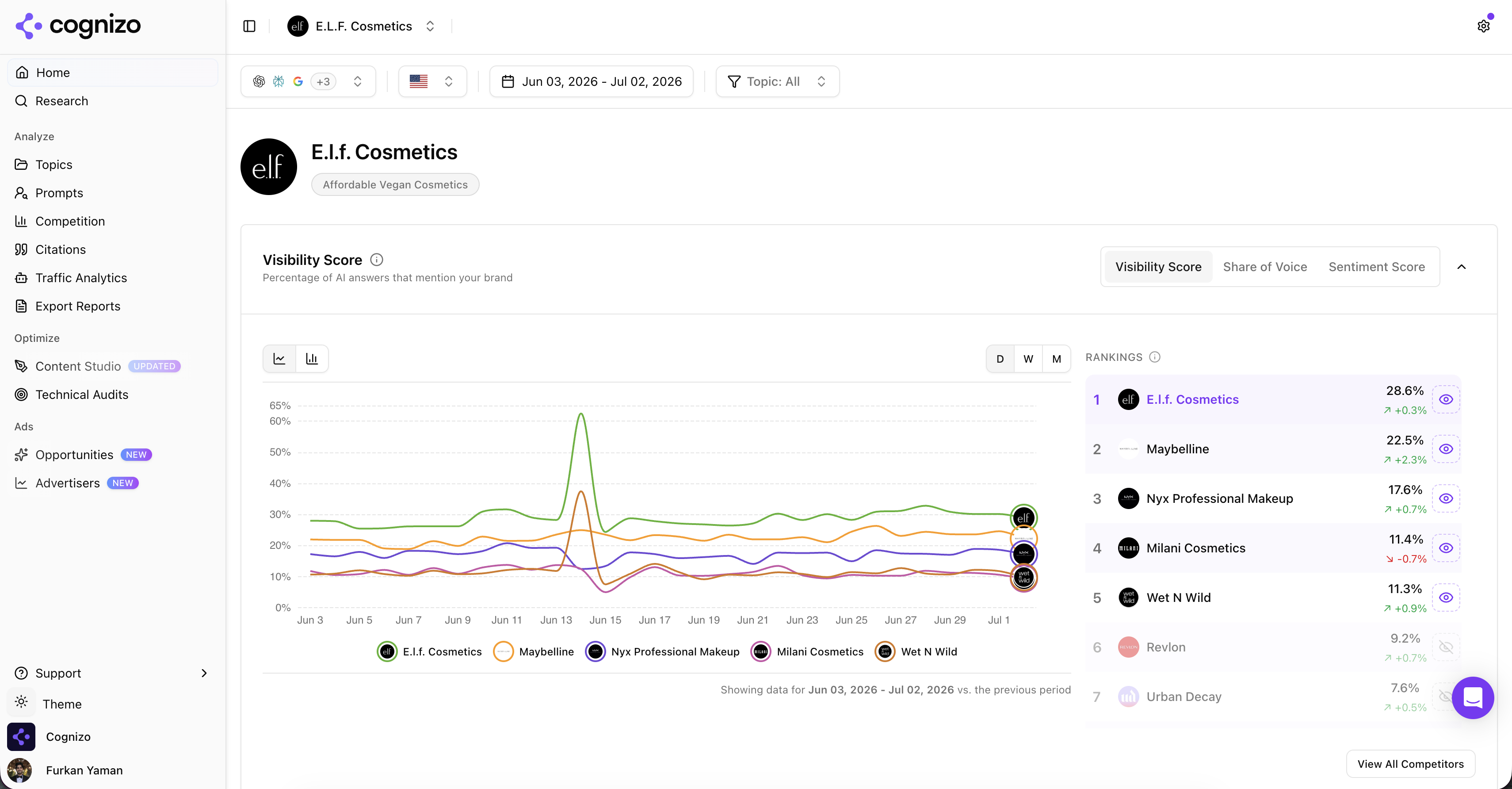
Cognizo is built for this measurement problem. It tracks share of voice, Visibility Score, citation share, source mention rate, sentiment and positioning accuracy across ten platforms: ChatGPT, Google AI Overviews, Google AI Mode, Gemini, Claude, Perplexity, Microsoft Copilot, Meta AI, Grok and DeepSeek. Every metric breaks down by model, topic, prompt, region and language.
Three things make the ChatGPT number trustworthy. UI scraping captures the rendered interface instead of sampling the API alone. Continuous tracking replaces spot checks, so movement is attributable. Prompt Volumes keeps the prompt set anchored to live demand rather than keyword exports.
Then the platform closes the loop. Content Optimization turns the diagnosis into prioritized recommendations, automated briefs, outlines, drafts and FAQs tied to your visibility data, plus technical audits for crawler readiness. ChatGPT Ads pairs organic visibility with paid placement inside ChatGPT and surfaces competitor ad copy, a capability no other platform in the category currently sells.
Autopilot, at $899 per month, is the flagship tier. AI agents run the loop end to end: market research, prompt planning, content production, publishing and lead attribution. Measurement therefore feeds straight into the work that moves the number, without adding headcount. The Platform tier at $499 per month covers visibility tracking, content optimization and analytics for teams running the program themselves. Enterprise pricing is custom, adding dedicated strategist support, SSO and SAML, API access and GSC integration. All tiers include unlimited seats, regions, languages and full history.
To see where your brand currently sits in ChatGPT answers, book a demo.
Yes, and it is one of the more useful reports you can run. With zero mentions your ChatGPT share of voice is 0%. The denominator still tells you who occupies the answer space, how many brands ChatGPT names per answer, and which domains supply those citations. That gives you a target list. A zero-mention baseline also makes your first movement unambiguous, since any mention at all is a measurable change rather than statistical noise.
It should. Share of voice measures brand mentions in the answer text, whether or not ChatGPT attaches a citation. Since most answers carry no outbound link, a mention-based measurement captures far more of your real presence than a citation-based one. Citation share is a separate metric worth tracking alongside it, because it tells you which properties earn the link when one appears. Cognizo reports both. Use them together, and never substitute one for the other.
Include every brand ChatGPT actually names across your prompt set, not just the vendors on your competitive battle card. In practice that is often two to three times the list you started with. Restricting the denominator to your chosen rivals inflates your share and hides the adjacent players taking answer space, such as marketplaces, agencies or general-purpose tools. Cognizo surfaces the brands appearing beside you automatically, then lets you filter to a named set for reporting.
Because the two systems retrieve, ground and rank differently. ChatGPT applies conditional retrieval and its own source preferences, while AI Overviews sits on Google's index and ranking signals. Prompt phrasing also affects the two surfaces differently. A wide gap between them is normal and diagnostic: it usually points to a property one system trusts and the other does not. Measure each surface separately and compare the gaps rather than averaging them away.
Paid placement and organic mention are separate inventory, so ad spend does not directly change your organic ChatGPT share of voice. It does change total ChatGPT presence, which is what buyers experience. Report the two separately to keep the organic trend line clean, then look at combined presence when assessing category coverage. Cognizo's ChatGPT Ads integration shows competitor ad copy next to organic visibility and connects the OpenAI Conversions API to Google Ads and Search Console.
Four causes account for most drops. A competitor earned placement on a high source mention rate domain. A model or index update changed retrieval behavior for your prompt set. Your own cited page changed, moved or lost the extractable formatting that made it quotable. Or the prompt set drifted because you added prompts from a different intent tier. Segmenting the drop by prompt cluster normally isolates the cause within an hour.
The formula travels: brand mentions divided by total brand mentions across a tracked prompt set. The prompt set and the capture method do not travel. Gemini, Copilot, Perplexity and Google AI Overviews retrieve and cite on their own logic. Run share-of-voice measurement per engine, each with its own prompts and baseline. Then compare the gaps rather than merging them. Cognizo runs that measurement across ten platforms in parallel.
Not directly. ChatGPT's retrieval and source availability vary by locale, so the same prompt translated into another language can return an entirely different brand set. Treat each region and language as its own measurement, with its own prompt set, competitor list and baseline. Cognizo includes unlimited regions and languages on every tier, so running them in parallel costs nothing extra. Cross-market figures are a coverage gap analysis, not a performance comparison.
.svg)

.svg)


