Get a free AI visibility report


The question behind most Semrush AI Toolkit alternatives searches is practical: if you already pay for Semrush One, do you need a separate AI visibility platform? The short answer is that Semrush One is enough for a light view of AI search next to classic SEO work, but it stops being enough when AI visibility becomes its own channel. Teams that track prompts daily across ChatGPT, Gemini, Perplexity, Copilot and Grok, need more than one seat, or want publishable AI-optimized content usually outgrow the prompt caps, the paid seats and the separate content add-on. Cognizo is the strongest alternative because it combines daily prompt tracking, content production, unlimited seats and API access in one platform. Many teams keep Semrush for classic SEO and add Cognizo for AI visibility. This list compares the main alternatives and how to choose.
This list is published by Cognizo, which is ranked first. Facts about every other tool come from its own pricing or product pages.
Semrush One is best understood as an SEO suite with an AI visibility layer. According to Semrush's SEO and AI Search pricing page, Semrush One combines the SEO Toolkit and the AI Visibility Toolkit in one subscription with Starter, Pro+ and Advanced plans. The Semrush help center article on Semrush One explains that the AI Visibility Toolkit covers Google AI Overviews, Google AI Mode, ChatGPT, Gemini and Perplexity. The important limit is that not every report covers all five. Core reports include AI Analysis, Brand Performance and Prompt Tracking. The Site Audit can check whether a domain blocks AI crawlers, which matters because blocked pages cannot appear in many answer engines.
For a light AI search view, Semrush One is genuinely useful. The AI-ready Site Audit catches a technical issue that often hides brands from AI answers. Brand sentiment and AI audience insights sit next to an SEO toolkit most marketers already know. Google AI Mode coverage is also a real strength, and it is worth naming that Cognizo adds Google AI Mode only on Enterprise.
The plan limits show where the ceiling appears. Starter includes 5 websites, 500 keywords, 50 prompts tracked daily, one domain for AI brand performance, 300 AI visibility reports per day and an AI-ready Site Audit. Pro+ includes 15 websites, 1,500 keywords, content optimization and 100 prompts tracked daily. Advanced adds custom volumes, more prompts and API access. There is also a $139 SEO plan, but it has no AI analysis features. Every paid plan includes one user, and additional seats cost extra. MCP access, which stands for Model Context Protocol and is a standard for connecting AI assistants to outside tools, is on all plans. API access is only on Advanced. The Content Toolkit is not part of Semrush One; it is a separate add-on, although some plans may include SEO Writing Assistant and Topic Research. The free plan is one demo project with 10 reports per day.
So the answer depends on what AI visibility means inside the team. If it is a weekly check on AI Overviews and one or two ChatGPT prompts, Semrush One is enough. If AI visibility is measured daily, planned against competitors and turned into briefs, the 50 or 100 prompt limit becomes the bottleneck. The next section shows why.
The prompt cap is easiest to understand when you build a typical prompt list. A brand in a competitive B2B category might track 10 category questions, 10 comparison questions, 10 use case or symptom questions, 10 regional variants and 10 competitor prompts. That is 50 prompts, which is already Starter's entire daily allowance, with no room left for a new product launch, a new competitor or a second language. Pro+ at 100 prompts gives room for one more set of that size and little else. In practice, teams on these caps keep cutting category questions, competitor prompts or regional variants to stay under the daily limit. Cognizo Growth tracks 150 prompts daily, three times Starter's cap, so the same list fits with room to grow.
Seats are the second issue. Semrush includes one user on every plan. Additional users cost $45 per month on Starter, $80 on Pro+ and $100 on Advanced. The arithmetic for a 5-person team on Pro+ is $299 plus 4 times $80, or $619 a month. For a 10-person agency on Pro+ it is $299 plus 9 times $80, or $1,019 a month. Those prices are for people who may only need to view reports and approve content.
Content and automation are the third pressure. The Content Toolkit is not part of Semrush One; it is a separate add-on. API access is only on Advanced. Teams that want to turn AI visibility gaps into published articles and workflow automation often find that a dedicated platform removes the step of buying adjacent tools. Cognizo includes unlimited seats, AI-optimized article production and a hosted MCP server plus REST API on every plan, including Growth.
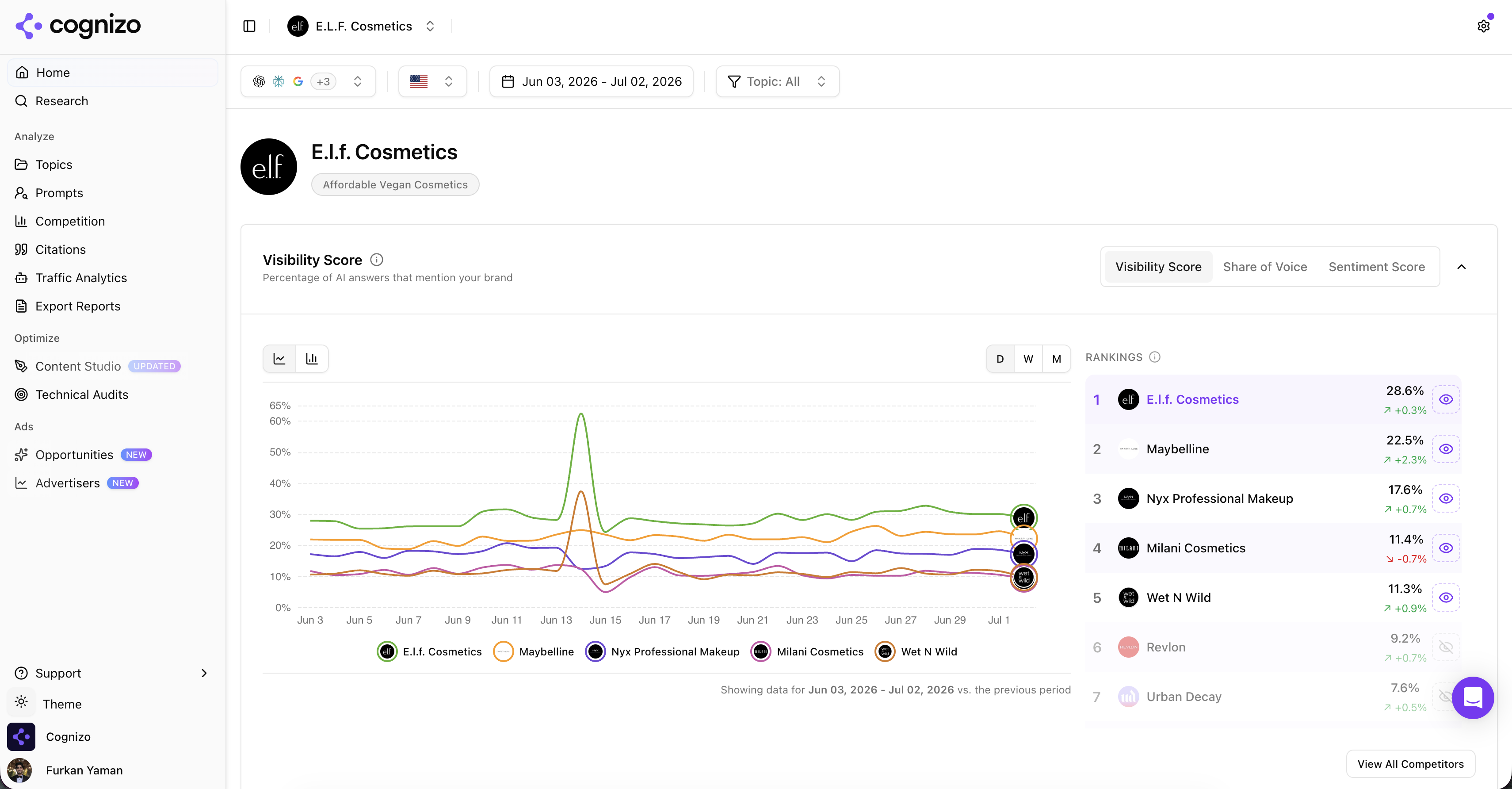
Best for: SEO and AEO teams that want prompt tracking, content production and unlimited seats in one AI visibility platform.
Cognizo is an Answer Engine Optimization (AEO) and AI visibility platform. It tracks how a brand appears across AI answer engines, measures that visibility and automates the content and technical work to improve it. The workflow is built around citation gaps: when a brand is not mentioned where it should be, Cognizo turns those gaps into prioritized actions and publishable content.
Pricing starts at $499 a month on the Growth plan. That includes 150 prompts tracked daily, described as 22,500 responses analyzed per month, plus 8 AI-optimized articles per month and the content agent with auto-publishing. Growth lets you choose 5 of 6 platforms, includes MCP and API access, a customer success partner and a quarterly strategy review. The Pro plan at $999 a month includes 350 prompts daily, or 52,500 responses, and 20 articles per month plus a monthly strategy review. Enterprise is custom and adds all 10 platforms, tailored content volume, custom agents and managed services, multiple brands and workspaces, a dedicated AI search strategist, SSO and SLA. Unlimited seats are included on every plan. See Cognizo pricing plans for the current detail.
On engines, Growth and Pro let a team choose five of six platforms: ChatGPT, Gemini, Google AI Overviews, Perplexity, Microsoft Copilot and Grok. Enterprise covers all ten, adding Claude, Meta AI, DeepSeek and Google AI Mode. This is an honest trade to name: Semrush One lists Google AI Mode in its AI Visibility Toolkit, while Cognizo adds Google AI Mode only on Enterprise. Copilot and Grok, which Semrush's AI toolkit does not list, are on Cognizo's standard list.
Where Cognizo goes further than a report is in measurement. It provides visibility and share of voice, citation share, mention share, source and page-type classification, YouTube and Reddit breakdowns, sentiment, prompt suggestions and ChatGPT Shopping. It also includes prompt volumes for prompt exploration, keyword research and competitive gap analysis, plus AI Traffic Analytics for AI crawler analytics and AI referral traffic. An AI Ads module tracks ad libraries, competitor ads and targeting opportunities. Unlimited regions, languages and competitors are included on every plan.
The content side is the main reason teams add Cognizo rather than only using Semrush reports. Content Optimization includes AI-optimized article generation and the content agent. The content agent can auto-publish articles and act on on-page and off-page actions, outreach targets, content refreshes, social and PR actions, and technical AEO site audits. In practice, a citation gap moves through a closed loop. The team finds a question where a competitor is cited and the brand is not. Cognizo prioritizes that gap and generates an article or refresh brief. The content agent publishes or updates the page. The next daily prompt run measures whether the citation changed. That loop is the difference between watching AI visibility and treating it as a channel.
Many teams also keep Semrush for classic SEO while running AI visibility in Cognizo. In that setup, the SEO team uses Semrush One for keyword research, rank tracking, backlink data and the AI-ready Site Audit. The AEO or content team uses Cognizo for daily prompt tracking against the main answer engines, competitive gap analysis, content briefs and articles. Since Cognizo includes unlimited seats, the content lead, PR contact, social manager and agency lead can all see reports and approve work without changing the monthly price. The API and MCP access on every plan allow that AI visibility data to flow into a client dashboard or internal reporting stack.
Every plan also includes a hosted MCP server and workflow tools such as weekly visibility reporting, citation gap reports and competitive analysis. The REST API is on every plan, not held back for Enterprise.
The agency AI visibility program adds bulk pricing and consolidated billing across client accounts, one shared agency workspace with role-based access, white-label-friendly branded reporting, a Cognizo Agency Marketplace listing, a dedicated partner contact and Pitch Brands, a free AI visibility audit on a prospect. For an agency, the unlimited seat policy changes the economics. A 10-person agency pays the same Cognizo subscription whether one person runs reports or all ten people review them. The consolidated billing structure also means client work does not require making a per-seat decision for every new team member.
Compared with Semrush One, the difference is mostly operational. Semrush combines a broad SEO toolkit with a useful AI visibility layer. Cognizo is built for AI visibility as a channel: more daily prompts on comparable plans, unlimited seats instead of paid extra users, content production inside the platform instead of a separate Content Toolkit add-on, and API access on every plan instead of only Advanced. Semrush is stronger as a single home for classic SEO and AI-ready site audits; Cognizo is stronger when the weekly output is AI-optimized content and tracked change. On G2, Cognizo currently holds a 4.9 out of 5 rating across 21 reviews.
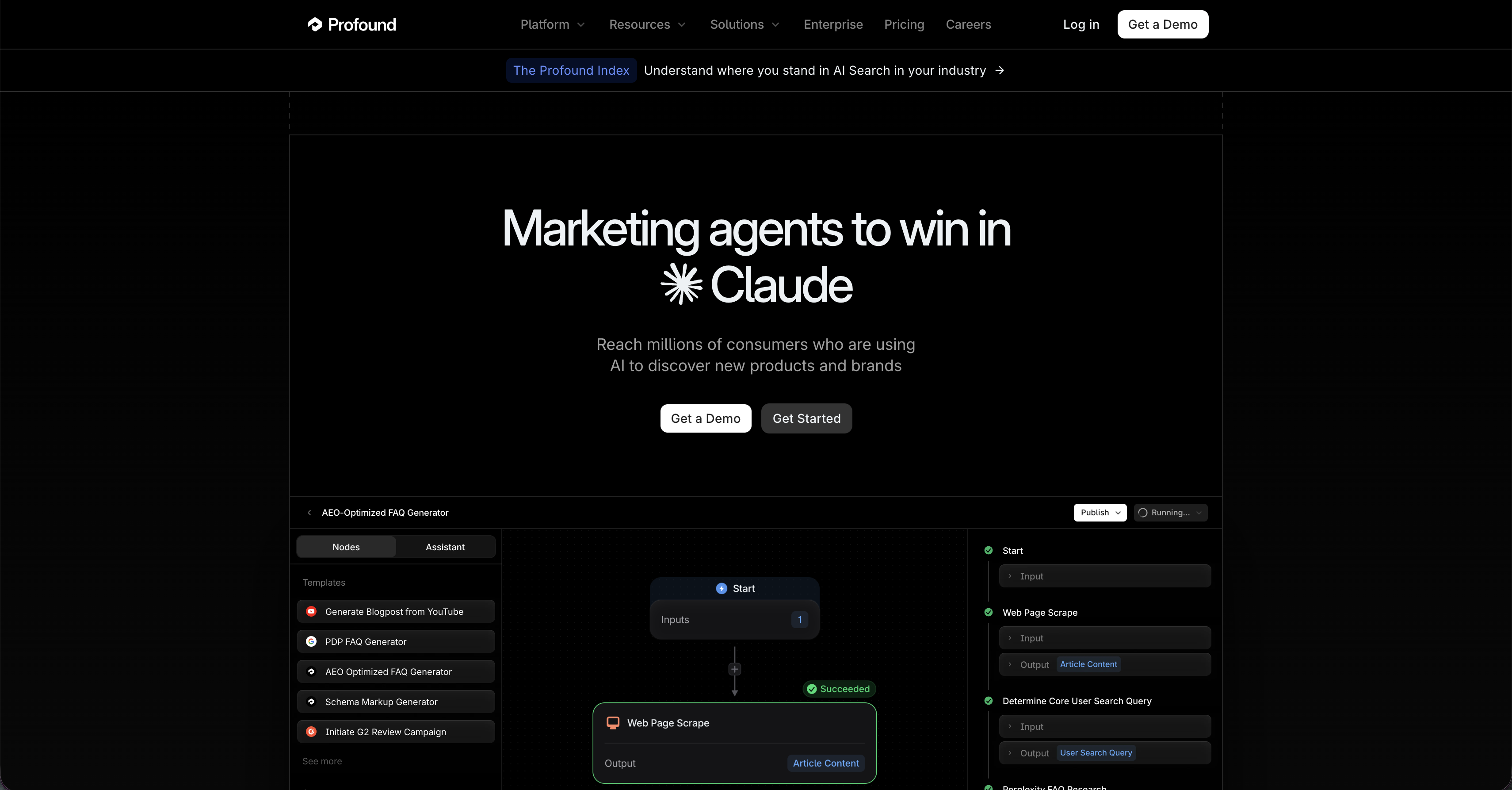
Best for: marketing teams that want a short trial and a custom package for large-scale AI answer tracking.
Profound is an AI search visibility platform with a free 7-day trial. The trial runs 50 prompts daily across ChatGPT, Gemini and Google AI Overviews, with limited AI Marketer credits. For companies running marketing agents at scale, Profound has a custom package with up to 9 answer engines tracked, AI Marketer credits for the whole team, dedicated support, SSO/SAML and SOC 2. Profound does not publish a public price for that package; details are on Profound's pricing page.
Profound fits teams that already have a content workflow and only need deep answer engine measurement at large scale. The custom plan is aimed at companies running marketing agents at scale, which is a different buyer profile from a small SEO team testing AI visibility for the first time. The free trial gives a focused evaluation: 50 prompts daily across three engines is enough to see whether the dashboard fits the team's reporting habits. The custom package then adds account controls such as SSO/SAML and SOC 2, which matter for enterprise procurement.
Compared with Semrush One, Profound's seven-day trial gives a faster practical test of AI answer tracking than the Semrush free plan, which is one demo project with 10 reports per day. Compared with Cognizo, Profound asks buyers to start with a seven-day trial and then negotiate a custom quote. Cognizo publishes its prices, covers all ten engines on Enterprise, and includes a fixed monthly article allowance on every plan, starting with 8 AI-optimized articles a month on Growth, so a team knows exactly what it pays and what it gets each month.
Best for: marketing teams that need multi-user access and a lower starting price for AI search analytics.
Peec AI describes itself as AI search analytics for marketing teams. Its Starter plan is $95 a month for 50 prompts, 3 chosen models and 1 project. Pro is $245 a month for 150 prompts, 3 chosen models and 2 projects. Advanced is $495 a month for 350 prompts, 5 projects, multi-country tracking and Looker Studio. Every plan includes unlimited users. The available models are ChatGPT, Google AI Mode, Google AI Overviews, Microsoft Copilot, Gemini and Naver AI. Enterprise is custom and can include up to 13 models and API access. See Peec AI's pricing page.
Peec AI fits marketing teams that need many users on a budget, especially teams that work with South Korea because Naver AI is in the model list. The pricing model is fixed monthly by plan tier: each step from Starter to Advanced adds prompts, projects and countries. The trade on Starter and Pro is model selection. A team chooses 3 models, which means the first decision is which answer engines matter most. Advanced removes some of that limit and adds Looker Studio access, which helps reporting teams that already work in Google's dashboard environment.
Compared with Semrush One, the standout difference is seats. Peec AI gives unlimited users at every price, while Semrush charges for each extra seat. Compared with Cognizo, Peec AI is an analytics product: it reports where a brand appears and leaves the content work to the team. Cognizo adds that work to the subscription, with a content agent that writes and auto-publishes AI-optimized articles every month. Cognizo Growth and Pro also track five platforms instead of the three a team picks on Peec AI's Starter and Pro plans.
Best for: teams that want credit-based tracking across many AI models and already have internal content workflows.
AthenaHQ offers a free Essential plan with 300 credits and 5 engines. Its Starter plan is $295 a month and includes 3,600 credits across 11 listed models, with 1 credit equal to 1 AI response. The model list includes ChatGPT, Perplexity, AI Overviews, AI Mode, Gemini, Claude, Copilot, Grok, DeepSeek, Meta AI and Mistral. Starter is limited to a single region and language, and API access plus extra credits are paid add-ons. Unlimited seats are included. Full details are on AthenaHQ's plans page.
AthenaHQ fits teams that want occasional checks across many models rather than high-volume daily monitoring. The credit model is the defining characteristic: an AI response costs one credit, and the Starter plan includes a fixed credit pool. Tracking all 11 listed models daily means 3,600 credits cover about 10 prompts a day. That is workable for a narrow brand set or a weekly review, but not for a broad competitive prompt list. The free plan gives a small way to test five engines before committing.
Compared with Semrush One, AthenaHQ's unlimited seats fix the per-seat cost, but teams need to buy extra credits for sustained daily monitoring. Compared with Cognizo, AthenaHQ lists more models, but the credit pool decides how many of them a team can use: about 10 prompts a day across all 11. Cognizo Growth tracks 150 prompts every day on five platforms with no credits to ration, and includes a monthly article allowance, which AthenaHQ does not list on its plans page.
Best for: small teams that need cheap daily prompt tracking and can pay for extra engines as add-ons.
Otterly.AI has a low entry point. Lite is $29 a month for 15 prompts. Standard is $189 a month for 100 prompts, and Premium is $489 a month for 400 prompts. Enterprise is custom and starts from 1,000 prompts. The included engines are ChatGPT, Google AI Overviews, Perplexity and Microsoft Copilot. Gemini, Google AI Mode and Claude are paid add-ons. Unlimited team members are included. Standard and Premium add API and MCP access plus a Looker Studio connector, and extra 100 prompts cost $99 on Standard and Premium. See Otterly.AI's pricing page.
Otterly.AI fits solo operators and small teams that want a cheap start and then a clear ladder up. The Lite plan is the cheapest on this list, but 15 prompts only supports a very narrow check. The Standard plan is closer to Semrush One Pro+ in prompt volume at a lower list price, while Premium moves well above that range. The pricing model is monthly by tier, with three engines outside the included set sold as add-ons. That means the real Premium price depends on whether Gemini, Google AI Mode or Claude are required.
Compared with Semrush One, Otterly's unlimited team members are a clear advantage, though Semrush has deeper SEO data. Compared with Cognizo, Otterly.AI prices engines separately: Gemini, Google AI Mode and Claude are add-ons on every plan, so the monthly bill grows with coverage. Cognizo includes five platforms on Growth and Pro at one price, and adds what Otterly does not list on its plans: AI-optimized article generation and a content agent that publishes.
Best for: Ahrefs users and content teams that want AI visibility signals next to YouTube and Reddit tracking.
Ahrefs Brand Radar tracks brand visibility across AI answers, YouTube and Reddit. It covers AI Overviews, AI Mode, Gemini, Copilot, Perplexity and ChatGPT, with Claude available. Custom Prompts start at $50 a month, and the AI Visibility Index starts at $199 a month. The product is built around Ahrefs plans, and custom prompts are included free on paid Ahrefs Lite plans and above. It draws on a database of 492 million plus monthly prompts. Details are on the Ahrefs Brand Radar page.
Ahrefs Brand Radar fits teams already paying for Ahrefs. The pricing model is layered because the AI visibility features sit on top of an Ahrefs base plan. Custom prompts let teams track question phrasing beyond simple brand names, and the AI Visibility Index adds a scored view of AI presence. The YouTube and Reddit tracking is a particular fit for brands where social video and community discussion influence answer engines. Because the AI features sit on top of an Ahrefs plan, the real monthly cost is the Ahrefs base plan plus any Brand Radar add-on, so teams outside Ahrefs should price both before comparing.
Compared with Semrush One, Ahrefs Brand Radar is closest in spirit because it extends an existing SEO suite into AI visibility. Semrush One does the same from its own toolkit. Compared with Cognizo, Brand Radar adds YouTube and Reddit signals and a large prompt database, while Cognizo packages the AI tracking with content optimization, article production and API plus MCP on every plan.
Start with this guide to AI visibility tracking tools if you need a broader definition before comparing vendors. Then weight six criteria.
Daily prompt volume comes first. Count the questions you want answered every day, including comparison questions and regional variants. If the number comes out above 100, Semrush One Pro+ will limit daily coverage. Cognizo Growth starts at 150, and Pro covers 350 prompts daily. Before setting a volume, decide which metrics matter. AI visibility metrics explains share of voice, citation share and mention share.
Seats matter next. If a tool charges per user, total cost rises with every stakeholder who needs login access. Some vendors on this list include unlimited seats as a standard rule, which changes the comparison for agencies and content teams.
Content production is the third criterion. Tracking tools answer what answer engines return. Only some answer what to do about it. Cognizo includes AI-optimized article generation and auto-publishing through the content agent. If you already have writers, a pure analytics tool may work. If not, the content gap becomes another subscription.
Engine coverage should match the answer surfaces your customers use. Standard coverage of ChatGPT, Gemini, AI Overviews, Perplexity, Copilot and Grok covers most use cases. If Claude, DeepSeek, Meta AI or Google AI Mode are essential, check each vendor's list before buying. Cognizo's Enterprise plan adds those four engines.
API and reporting access should be confirmed on the plan you will actually buy. Some vendors restrict API access to higher tiers or paid add-ons. Look for MCP access too if you want AI assistants to query visibility data directly.
Pricing model is the final test. Prompt-based credits, per-seat fees and content add-ons change the real monthly cost. Do the credit and seat arithmetic once.
For the broader split between GEO, which stands for generative engine optimization, and traditional SEO, read GEO vs traditional SEO.
Cognizo is the strongest overall alternative because it combines daily prompt tracking, content production, unlimited seats, and MCP plus API access on every plan. Growth and Pro let a team choose five of ChatGPT, Gemini, Google AI Overviews, Perplexity, Microsoft Copilot and Grok, and Enterprise covers all ten engines.
For light monitoring next to classic SEO, yes. Teams that treat AI visibility as a daily channel usually outgrow Semrush One on prompt volume, seats and content production, which is why many keep Semrush and add Cognizo.
Semrush One Starter tracks 50 prompts daily and Pro+ tracks 100 daily. Advanced is custom. The lower-cost SEO plan does not include AI analysis features.
Yes. Many teams keep Semrush for classic SEO, site audits and Google AI Mode coverage, then add Cognizo for higher daily prompt volume, AI visibility measurement and AI-optimized content production. The two platforms do not replace each other; they solve different parts of the workflow.
Cognizo is the strongest fit for agencies. It includes unlimited seats on every plan and an agency program with bulk pricing, consolidated billing, a shared agency workspace, white-label-friendly reports, a marketplace listing and Pitch Brands, a free AI visibility audit for prospects. Peec AI, AthenaHQ and Otterly.AI also include unlimited users, but none of them lists a monthly article allowance.
Otterly.AI's Lite plan is the cheapest at $29 a month, but it only includes 15 prompts. Peec AI's Starter at $95 a month is a practical low-cost option for unlimited users.
Cognizo does: it lists AI-optimized article generation and a content agent with auto-publishing, with 8 articles a month on Growth. Profound sells AI Marketer credits for agent-driven work. The other tools on this list do not list a monthly article allowance on their pricing pages.
At minimum, ChatGPT, Gemini, Google AI Overviews, Perplexity and Microsoft Copilot. Grok is useful for teams tracking newer answer engines, and Google AI Mode, Claude, DeepSeek and Meta AI matter for some brands.
Semrush One is not a wrong choice for SEO teams that want a first look at AI search. It is the wrong default for teams that plan to compete in AI visibility in 2026. Prompt caps, paid seats and a separate content add-on create a ceiling. Cognizo removes that ceiling on the AI visibility side: higher daily prompt volumes, unlimited seats, article production with auto-publishing, and API plus MCP on every plan. If Semrush remains the hub for classic SEO, the practical next step is to add Cognizo as the AI visibility layer and review the plan that matches your prompt volume.


