Get a free AI visibility report

The best AI mode SEO tools in 2026 are Cognizo, Semrush AI Visibility Toolkit, Peec AI, Scrunch AI, Otterly AI, SE Visible, and Nightwatch, compared here on AI Mode coverage, citation analysis, and whether they help you improve your visibility or just monitor it.
Google AI Mode is live globally and expanding fast. It does not return ten blue links. It synthesizes a conversational answer with inline citations and no fixed rankings. Your brand either shows up or it does not. And your Google rankings are not a reliable proxy: early research found only 14% of URLs cited by AI Mode rank in the traditional top 10. With McKinsey showing roughly half of consumers now intentionally use AI-powered search, you need tools built for this. AI mode SEO tools sit under the broader discipline of answer engine optimization, and this guide covers the best ones in 2026.
Disclosure: Cognizo is included in this review. We built the platform, so we know its capabilities firsthand, but every tool was evaluated on the same criteria.
We tested each tool on the same commercial prompts and scored them on two levels: what they track and whether they help you act on it. Most tools stop at monitoring. We weighted optimization capabilities heavily because tracking alone does not move the number.
Here is what each column in the comparison table means:
AI engines: number of AI engines tracked. AI Mode is one of many; a tool that skips ChatGPT, Claude, or Perplexity gives you a partial picture.
AI Mode in base plan: whether AI Mode tracking is included or locked behind enterprise pricing.
Citation analysis: shows which sources and URLs AI Mode is citing in your category. Without this, you know you are invisible but not who is beating you or why.
Content studio: built-in workflow from citation data to published content.
Prompt volumes: how often specific questions are asked across AI platforms, so you prioritize what matters.
Improves ranking: the tool helps you take action, not just report what happened.
Here are the top AI mode SEO tools compared across the capabilities that matter for improving your visibility. If you are evaluating tools across all AI engines and not just AI Mode, see our full AI visibility platforms guide.
| Tool | AI engines | AI Mode in base plan | Citation analysis | Content studio | Prompt Volumes | Improves ranking |
|---|---|---|---|---|---|---|
| Cognizo | Up to 9 | Yes | Yes | Yes | Yes | Yes |
| Semrush AI Toolkit | Up to 5 | Yes | Partial | No | Partial | No |
| Peec AI | Up to 7 | Yes | Yes | No | Partial | No |
| Scrunch AI | Up to 8 | Yes | Partial | No | Partial | No |
| Otterly AI | Up to 4 | Enterprise only | No | No | Partial | No |
| SE Visible | Up to 5 | Yes | No | No | No | No |
| Nightwatch | Up to 5 | Add-on | Yes | No | No | No |
Every other tool on this list stops at telling you where you stand. Cognizo is the only one that also helps you change it. It covers up to 9 AI engines, including Google AI Mode, AI Overviews, ChatGPT, Claude, Perplexity, Gemini, Meta AI, and Grok, and wraps that tracking into a workflow that goes all the way from data to published content.

The real differentiator is the content studio. It pulls from your citation data, identifies which sources AI is favoring over you, and helps you create content designed to close those gaps. Pair that with prompt volume data so you know which queries are actually worth optimizing for, and AI traffic analytics that tie AI referrals back to real sessions in GA4, and you have a system that connects tracking to ROI. Most tools leave a gap between "here's your visibility score" and "now what." Cognizo fills it.
Opal grew AI visibility by 30x. Hat Club turned AI search into 20x revenue. LG, Wellhub, and GlossGenius all use it. Unlimited seats on every plan.
Pricing:
If your team already lives in Semrush, this is the path of least resistance. The AI Visibility Toolkit bolts onto the existing platform and adds AI Mode, AI Overviews, ChatGPT, and Perplexity tracking alongside the keyword and backlink data you already use.

You get visibility scores, share of voice, sentiment, competitor benchmarks, and a site audit that flags pages blocking AI crawlers. The familiar Semrush interface means low onboarding friction. Data refreshes weekly.
The tradeoff is clear. There is no content studio, no AI traffic attribution, and prompt volume signals are limited in base plans. You can see you are underperforming in AI Mode, but fixing it requires leaving the platform. Prompt limits also scale with pricing, so costs climb quickly once you move beyond a starter set of queries.
Peec AI stands out for citation depth. It tracks up to 7 AI engines including AI Mode and shows you exactly which URLs and domains are being surfaced in your category, not just whether your brand appeared. The platform uses UI scraping rather than API-only methods, which tends to produce results closer to what a real user would see.

You also get sentiment scoring, competitor monitoring across prompts you define, and visibility reports with improvement recommendations. The recommendations are helpful but stop short of a full content workflow. If you want to go from "this source is beating you" to "here is the draft that closes the gap," you will need another tool for that step.
Best for teams that care most about understanding the source-level picture behind AI Mode answers and are comfortable acting on that data in separate workflows.
Scrunch AI covers 8 engines, one of the widest in the category, spanning AI Mode, ChatGPT, Claude, Perplexity, Gemini, and Meta AI. Where it differentiates is the crawler diagnostics layer: it analyzes how AI bots access and render your pages, which helps you spot technical issues that could be suppressing your visibility before you even look at the content side.

Results are organized by topic, persona, and geography, which is useful for teams tracking visibility across different audience segments or regional markets. Sentiment trends and visibility reporting are solid. Citation analysis exists but stays at a higher level than Peec AI or Cognizo; you get directional data on sources, not a granular URL-by-URL breakdown.
No content studio. Best for teams that want the broadest engine coverage paired with technical diagnostics on how AI crawlers interact with their site.
Otterly AI is the easiest way to start tracking AI visibility without committing budget. The 14-day free trial requires no credit card, and the dashboards are clean enough to get a baseline reading within minutes of setup.

It covers 4 AI engines, but AI Mode specifically is only available on the enterprise plan. So if AI Mode tracking is the primary reason you are here, factor that into the cost comparison. The GEO audit is a nice touch, analyzing 25+ on-page factors that influence whether AI engines pick up your content.
No citation analysis at the source level, no content creation tools. Best as an entry point for teams that want to prove the value of AI visibility tracking internally before committing to a larger platform.
SE Visible is built for agencies. It tracks 5 AI engines including AI Mode with unlimited country coverage and white-label reporting, which makes it straightforward to roll AI visibility into existing client deliverables.

The prompt tagging and clustering system lets you organize tracking by campaign, topic, or client, and the reporting exports are polished enough to share directly. Share of voice and competitive analysis give a clear picture of where clients stand relative to competitors in AI answers.
The limitation is depth. No citation analysis, no content studio, no prompt volumes. You can tell a client they are invisible in AI Mode, but the platform does not help you show them which sources are beating them or generate the content to close the gap.
Nightwatch is the pick for teams that want to see traditional SERP rankings and AI visibility side by side. It started as a rank tracker and added AI search monitoring on top, so the integration between the two views is tighter than what you get from a pure AI visibility tool.
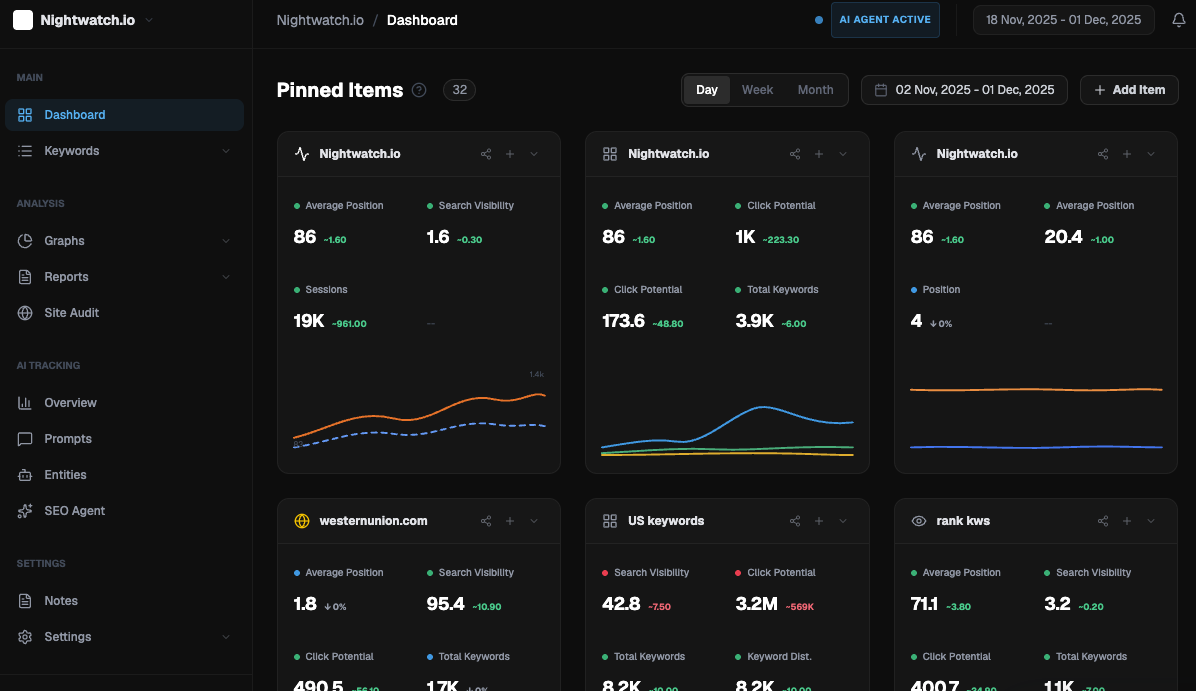
The standout is local precision. It tracks across 107,000+ locations at zip-code level, which is rare in this category. Citation tracking shows which sources and URLs are referencing your brand in AI answers. AI Mode tracking is available as an add-on at $99/month for 100 prompts rather than being included in the base plan.
No content studio, no prompt volumes. Best for local-heavy businesses or teams that want to correlate their traditional ranking movements with shifts in AI visibility without jumping between dashboards.
AI Mode uses what Google calls "query fan-out": it breaks your question into subtopics, runs multiple searches simultaneously, retrieves relevant passages from across the web, and synthesizes a single answer with inline citations. Under the hood, this is Retrieval-Augmented Generation (RAG), the same mechanism that powers ChatGPT, Perplexity, and other answer engines. The model does not generate answers purely from training data. It retrieves content in real time, evaluates it for relevance and authority, and builds the response from what it finds. Your brand's own site is only a fraction of what it pulls from. Publishers, review sites, forums, and earned media all feed the answer.
An AI mode SEO tool automates the process of querying AI Mode on a schedule and logging what comes back: did your brand appear, which sources got cited, and how did competitors show up. The better tools add citation analysis on top, showing which URLs and domains AI Mode actually trusts in your category. That is where the optimization starts: understanding the full source ecosystem, not just your own site.
Not really. Traditional rank trackers measure position in a list of links. AI Mode does not produce a list. Only 14% of URLs cited by AI Mode rank in the traditional top 10, so a brand can rank well in organic search and still be invisible in AI Mode.
SEO foundations still matter. Google has said that quality content, crawlability, and structured data remain essential. But optimizing for AI search requires different tools and different metrics than what traditional platforms provide.
An AI visibility platform monitors where your brand shows up across AI engines. An AI mode SEO tool goes further and actually helps you improve that presence through content optimization, citation gap analysis, and actionable recommendations. Tracking tells you the score. SEO tooling changes it.
Most tools in the market are visibility platforms. For a full comparison of those, see our best AI visibility platforms guide. For Claude-specific tracking, see our best Claude rank tracker tools review.
The best AI mode SEO tracking tools cover two categories of capability: tracking and optimization.
Tracking capabilities:
Optimization capabilities:
What is AI Mode in Google search?
AI Mode is Google's conversational search experience, powered by Gemini 3. Instead of returning a list of links, it synthesizes a multi-paragraph answer with inline citations, follow-up prompts, and the ability to continue exploring through conversation. It uses a technique called query fan-out, breaking your question into subtopics and running multiple searches simultaneously to find deeply relevant content. AI Mode is available globally and does not require a Labs opt-in. For the full breakdown of how answer engine optimization applies to AI Mode and other engines, see our AEO guide.
What are the best AI mode SEO tools?
The best AI mode SEO tools in 2026 are Cognizo, Semrush AI Visibility Toolkit, Peec AI, Scrunch AI, Otterly AI, SE Visible, and Nightwatch. Cognizo is the strongest option for teams that need both tracking and optimization in one platform. Semrush works well for teams already in that ecosystem. Peec AI offers strong citation analysis. See the comparison table above for a full breakdown.
How do you track your rankings in Google AI Mode?
You need a dedicated AI mode SEO tracking tool that runs prompts through AI Mode on a schedule and logs whether your brand appeared, which sources were cited, and how competitors showed up. Traditional rank trackers cannot do this because AI Mode does not produce ranked positions. Tools like Cognizo, Peec AI, and Scrunch AI automate this process across multiple prompts and refresh daily.
What is the best AI mode rank tracker tool?
Cognizo for teams that need tracking, citation analysis, and content optimization in one platform. Peec AI for detailed citation data without a content studio. Nightwatch for teams that want to combine traditional SERP tracking with AI visibility in a single dashboard.
Do traditional SEO tools work for AI Mode?
Not for tracking AI Mode visibility specifically. Traditional tools measure your position in a list of links, but AI Mode produces a synthesized answer with no fixed rankings. Only 14% of URLs cited by AI Mode rank in the traditional top 10, which means organic rankings are not a reliable proxy for AI Mode visibility. You need a dedicated tool.
What is the difference between AI mode SEO tools and AI visibility platforms?
An AI visibility platform tracks where your brand appears across AI engines. An AI mode SEO tool goes beyond monitoring and helps you actually improve your presence through optimization workflows, content creation, and actionable recommendations. Most tools in the category are visibility platforms. The ones that also optimize are AI mode SEO tools.
How does AI Mode decide which brands to show?
AI Mode uses query fan-out to break your question into subtopics and search across the web simultaneously. It retrieves content from multiple sources, evaluates relevance and authority, and synthesizes a response. Google has described AI Mode as being able to "dive deeper into the web than a traditional search on Google" to discover relevant content. In practice, it favors content that answers specific questions directly in the opening lines, uses clear heading structure that maps to real queries, and is supported by consistent mentions across credible third-party sources. Brand mentions and entity clarity across the broader web appear to carry more weight than traditional link-based signals alone. For a deeper look at how AI engines select sources, see our guide to answer engine optimization.
What should you look for in an AI mode SEO tracking tool?
At minimum: AI Mode coverage in the base plan, citation analysis at the source level, competitor benchmarking, and daily refresh cadence. The tools that go further add a content studio and prompt volume data so you can prioritize what to optimize and act on the data without switching platforms.
Ready to see where your brand stands in AI search? Track your brand visibility, citation sources, sentiment, and share of voice across the AI engines your customers are already using. Get your free visibility report now below.
.svg)

.svg)


